Japan Earthquake: Kumamoto Rescue Efforts Intensify After Deadly Quake
Japan earthquake rescue crews continue searching Kumamoto after a deadly 7.1-magnitude quake caused widespread damage, displacement and disruption.
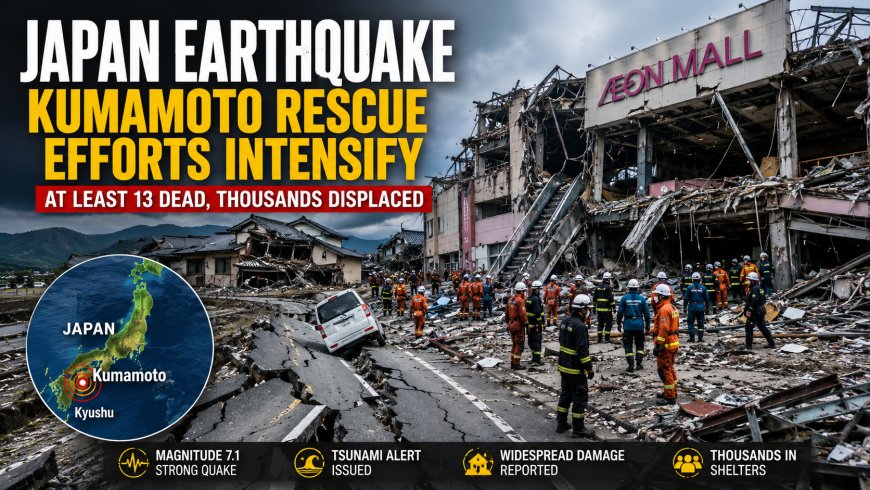
The Japan earthquake that struck Kumamoto Prefecture has become one of the country's deadliest disasters of the year, killing at least 13 people while leaving thousands displaced. Emergency crews remain in a race against time as they search damaged buildings, restore essential services, and assess the full scale of destruction caused by the powerful 7.1-magnitude earthquake.
Rescue operations continue as search enters a critical phase
Japanese emergency authorities have deployed firefighters, police officers, Self-Defense Forces personnel, and specialist rescue teams across Kumamoto Prefecture. Search operations remain concentrated around heavily damaged structures where officials believe people could still be trapped beneath collapsed concrete and steel.
One of the largest rescue missions is taking place at the severely damaged Aeon Mall in Kashima Town. According to officials, hundreds of shoppers managed to evacuate after the earthquake, but a powerful explosion later caused extensive structural damage, leaving rescue workers facing dangerous conditions. Engineers are carefully inspecting the unstable building before allowing crews deeper inside.
Authorities continue warning residents about powerful aftershocks that could trigger additional collapses, making rescue efforts slower and more dangerous.
Why the Aeon Mall disaster has become the biggest story
While much of the international attention has focused on the earthquake itself, the destruction of the recently reopened Aeon Mall has become one of the most significant developments. The shopping center had undergone years of reconstruction following damage from the devastating 2016 Kumamoto earthquakes and had reopened only recently.
Structural experts say the building appears to have survived the initial shaking relatively well. However, investigators believe a secondary explosion—possibly linked to damaged gas infrastructure—caused catastrophic failures that ultimately reduced large sections of the complex to rubble. The incident highlights how secondary hazards can be as deadly as the earthquake itself.
Infrastructure shows both strengths and vulnerabilities
Despite widespread destruction, Japan's earthquake-resistant engineering once again demonstrated its importance. Many modern buildings remained standing after experiencing the strongest level of shaking on the Japan Meteorological Agency's seismic intensity scale.
However, damaged highways, cracked roads, power outages affecting tens of thousands of households, airport disruptions, and localized fires showed that even one of the world's most prepared nations cannot completely eliminate earthquake risks. Authorities also confirmed that inspections at nearby nuclear facilities found no significant abnormalities.
Transportation services across parts of Kyushu continue to experience delays while engineers inspect bridges, railway lines, and airport infrastructure before reopening them fully.
How memories of the 2016 Kumamoto earthquakes shaped the response
For many residents, the latest disaster revived painful memories of the 2016 earthquake sequence that devastated Kumamoto. Those earthquakes prompted stricter building standards, improved emergency communication systems, and expanded evacuation planning across the region.
Those improvements helped emergency agencies respond more quickly this time, with evacuation centers opening within hours and disaster response teams arriving rapidly from neighboring prefectures. Nevertheless, officials acknowledge that severe earthquakes continue to present unpredictable challenges, especially when aftershocks and secondary disasters occur simultaneously.
What happens next in Kumamoto
Authorities say rescue efforts remain the highest priority as crews continue searching damaged buildings. Engineers will also conduct thousands of structural inspections before residents are allowed to return to homes, businesses, schools, and public facilities.
Meanwhile, meteorologists continue monitoring aftershock activity and advise residents to remain alert. Emergency shelters are accommodating thousands of displaced people while governments coordinate food supplies, temporary housing, medical assistance, and utility restoration.
The coming days are expected to provide a clearer picture of the earthquake's full human and economic impact, but officials emphasize that recovery will likely take months as Kumamoto begins rebuilding once again.
Want to know more about the people involved? Read complete biographies at BiographyPoints.com
Frequently Asked Questions
Where did the Japan earthquake happen?
The earthquake struck Kumamoto Prefecture on Japan's southern island of Kyushu, producing extremely strong shaking across nearby communities and causing major structural damage.
Was a tsunami triggered?
Japanese authorities issued a tsunami alert immediately after the earthquake because waves of up to one meter were possible. Officials continued monitoring coastal conditions while advising residents to stay away from shorelines until the risk eased.
Why is the Aeon Mall receiving so much attention?
The mall had recently reopened after years of reconstruction following the 2016 Kumamoto earthquakes. Although many people evacuated after the quake, a later explosion caused catastrophic damage that complicated rescue operations.
What's Your Reaction?
 Like
0
 Dislike
0
 Love
0
 Funny
0
 Angry
0
 Sad
0
 Wow
0