PepsiCo Recalls 122,000 Cases of Gatorade Over Undeclared Yellow Dyes
PepsiCo Gatorade recall covers 122,000 cases in 37 states over undeclared Yellow No. 5 and No. 6 dyes. Check if your bottle is affected.
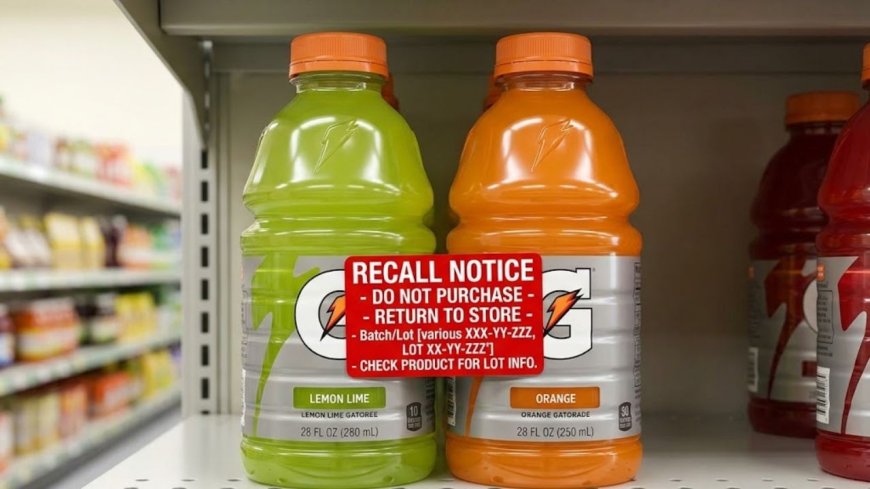
PepsiCo has voluntarily recalled more than 122,000 cases of Gatorade sold across 37 states after the U.S. Food and Drug Administration confirmed the products contain undeclared artificial dyes that were missing from ingredient labels. The Gatorade recall affects 28-ounce bottles of four flavors — Lemon Lime, Lemon Lime Zero, Orange, and Orange Zero — which were found to contain Yellow No. 5 and Yellow No. 6, two synthetic food dyes that federal law requires to be listed on packaging. The recall was classified by the FDA as Class II, meaning exposure may cause temporary or medically reversible health consequences. PepsiCo initiated the voluntary recall on September 25, 2026, and the FDA formally classified it on October 2.
According to the FDA's enforcement database, the recall covers 122,021 cases distributed across 37 states including Texas, Florida, California, New York, Illinois, Ohio, Georgia, and 30 others. The recall number is H-0009-2027, and consumers can verify specific lot codes and best-by dates — which fall between April and June 2027 — on the FDA's official website. The FDA stresses that both Yellow No. 5 and Yellow No. 6 are approved food colorings for the general population, but the problem lies entirely in the failure to declare them on product labels. People who are sensitive to these dyes — including those with aspirin-related asthma or specific food dye allergies — depend on accurate labels to make safe choices.
What makes this recall particularly notable is the timing. Earlier in 2026, PepsiCo publicly announced it was reformulating several Gatorade flavors — including Lemon Lime and Orange — to replace artificial dyes with plant-based colorings before the end of fall 2026. The company confirmed the transition was underway across both Gatorade Thirst Quencher and Gatorade Zero product lines. PepsiCo has not publicly explained how the labeling discrepancy occurred during this transition period, and no official statement has clarified whether the recall is directly tied to the reformulation process. What is clear is that over 122,000 cases reached consumers in stores across the country without the required label information.
Which Gatorade Products Are Included in the Recall?
The Gatorade recall is limited strictly to 28-ounce bottles — no other bottle sizes or packaging formats are included. The four affected products are Gatorade Thirst Quencher Lemon Lime, Gatorade Thirst Quencher Orange, Gatorade Zero Lemon Lime, and Gatorade Zero Orange. These products were distributed to retail stores across 37 states: Arkansas, Alaska, Arizona, California, Colorado, Florida, Georgia, Hawaii, Idaho, Illinois, Indiana, Iowa, Kansas, Kentucky, Louisiana, Michigan, Minnesota, Mississippi, Montana, Nebraska, Nevada, New Jersey, New Mexico, New York, North Carolina, North Dakota, Ohio, Oklahoma, Pennsylvania, South Carolina, South Dakota, Tennessee, Texas, Utah, Washington, Wisconsin, and additional states listed on the FDA enforcement report. Consumers should check the lot codes printed on the bottom of their bottles against the FDA's full list of 15 specific lot codes covered by recall number H-0009-2027.
The recalled bottles contain Yellow No. 5 (also known as Tartrazine) and Yellow No. 6 (also known as Sunset Yellow FCF). These dyes are commonly used to give food and beverages a bright yellow or orange color. Under FDA regulations, both dyes must be declared by name on ingredient labels, not merely listed as "artificial color." For most consumers, consuming these dyes poses no known health risk. However, individuals who are allergic to aspirin may experience cross-reactions, and some people with general food dye sensitivities may develop mild symptoms including rash or breathing discomfort. Anyone who experiences throat tightness, facial swelling, dizziness, or difficulty breathing after consuming the recalled products is advised to seek emergency medical care immediately.
What Should You Do If You Have Recalled Gatorade at Home?
The FDA and PepsiCo are advising consumers not to drink any 28-ounce Gatorade bottles that match the recalled lot codes. Consumers should return the product to the store where it was purchased for a full refund or dispose of it properly. Retailers across the 37 affected states have been notified and the recall remains active as of October 5, 2026. There is no need to contact a doctor unless symptoms are already present — for most people, the health risk is described by the FDA as remote.
To report a suspected adverse reaction, consumers can use the FDA's MedWatch safety reporting portal at fda.gov. Retailers who stocked the recalled products have been directed to pull them from shelves, but the FDA recommends consumers verify independently since distribution chain delays can mean affected bottles remain in some locations. PepsiCo has not issued a consumer hotline specific to this recall, but general customer service contact information is available on the Gatorade website. The fact that this recall covers only a labeling issue — not contamination or a dangerous ingredient — means the resolution path is straightforward once the affected bottles are identified and removed from circulation.
The Bigger Picture: Gatorade Was Already Removing Artificial Dyes
This Gatorade recall lands at a moment when PepsiCo was actively trying to move away from synthetic food coloring entirely. In April 2026, the company announced that Lemon Lime, Orange, and Fruit Punch Gatorade flavors would transition to plant-based colorings by fall 2026, part of a broader industry shift prompted by the FDA's encouragement for food manufacturers to voluntarily phase out six synthetic dyes — including Yellow No. 5 and Yellow No. 6. Federal health officials, along with several state governments, have been pushing for cleaner food labeling after studies raised concerns about neurobehavioral effects of certain artificial dyes in children. PepsiCo's own internal research found that more than half of consumers it surveyed were actively trying to reduce their intake of artificial dyes, which accelerated the company's reformulation timeline.
The Gatorade recall does not affect the company's reformulation plans, and PepsiCo has not linked the labeling error to the transition process in any public statement. What it does highlight is the regulatory and operational complexity of reformulating mass-market products at scale — a process that can involve multiple production lines, updated ingredient sourcing, and packaging changes happening simultaneously. For consumers, the immediate priority is checking their 28-ounce bottles against the FDA recall list. The recall remains ongoing, the affected lot codes are specific and verifiable, and the process for getting a refund is straightforward through any major retailer that carried the product.
Frequently Asked Questions
Which Gatorade flavors are being recalled in 2026?
The recall covers four flavors in 28-ounce bottles only: Gatorade Lemon Lime, Gatorade Lemon Lime Zero, Gatorade Orange, and Gatorade Orange Zero. No other sizes or flavors are included. Consumers should check lot codes on the FDA's enforcement report under recall number H-0009-2027 to confirm whether their specific bottle is affected.
Is the recalled Gatorade dangerous to drink?
The FDA classified this as a Class II recall, meaning the health risk is temporary or remote for most people. The dyes themselves — Yellow No. 5 and Yellow No. 6 — are FDA-approved. The issue is that they were not declared on labels, putting people with aspirin-related asthma or specific dye sensitivities at risk. For the general population, the FDA considers the probability of serious health consequences remote.
Why did PepsiCo recall Gatorade now?
PepsiCo voluntarily initiated the recall on September 25, 2026, after the labeling discrepancy was identified. The FDA formally classified it as Class II on October 2. The recall comes as Gatorade was already undergoing a reformulation to replace artificial dyes with plant-based colorings, though the company has not confirmed a direct connection between the transition and the labeling error.
What's Your Reaction?
 Like
0
 Dislike
0
 Love
0
 Funny
0
 Angry
0
 Sad
0
 Wow
0