AfD Leads Germany Poll as CDU/CSU Falls to 19.5%
AfD leads Germany’s latest poll at 29%, while the CDU/CSU falls to 19.5% after Saxony-Anhalt. Upcoming state elections could test the trend in Germany.
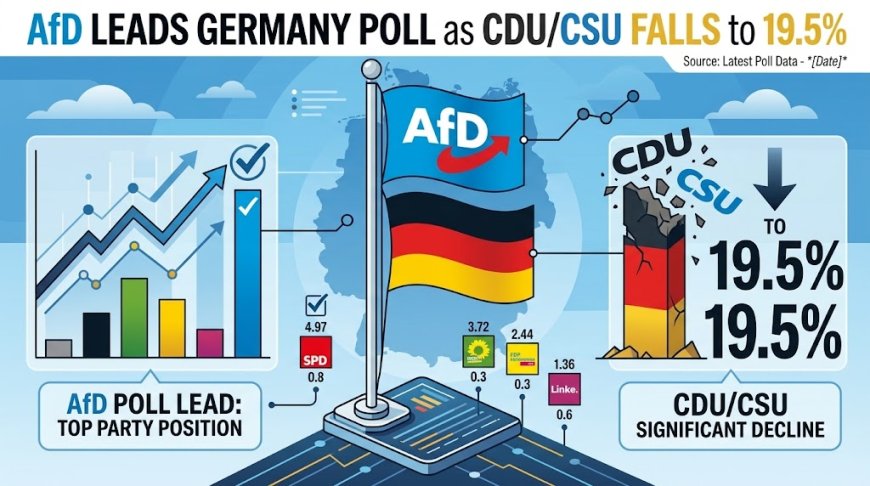
AfD leads Germany’s latest national poll at 29%, opening a 9.5-point gap over the CDU/CSU, which has dropped to 19.5% in a fresh INSA survey conducted after the AfD’s sweeping victory in Saxony-Anhalt. The figures mark a major warning for Chancellor Friedrich Merz and Germany’s governing conservatives, but they do not mean the AfD has won a federal election or is about to take power in Berlin. The survey instead captures a sharp shift in voter sentiment at a politically sensitive moment.
The INSA poll for BILD questioned 2,010 people online between September 4 and September 7, with the fieldwork overlapping the September 6 Saxony-Anhalt state election. The AfD was measured at 29%, unchanged from its previous level, while the CDU/CSU fell one point to 19.5%. The Greens stood at 13.5%, the SPD at 12.5% and the Left at 10.5%, while the FDP and BSW remained below the five-percent threshold at 4.5% and 4%, respectively.
The timing gives the survey particular political significance because the AfD had just recorded its strongest-ever result in Saxony-Anhalt. Preliminary official results put the party at 43.8%, more than twice the CDU’s 17.2%. That result has intensified debate over whether Germany’s long-standing political isolation of the AfD can continue to contain the party as its electoral support expands, particularly in eastern Germany.
What does the AfD lead in the Germany poll actually mean?
AfD leads Germany poll numbers show a significant change in the balance of voter support, but they should not be confused with an election result. Germany is not scheduled to hold its next regular Bundestag election until 2029, meaning the latest national figures are a snapshot of current voter intentions rather than a mandate to form a federal government. The nine-and-a-half-point advantage nevertheless matters because it places the AfD substantially ahead of the conservative Union in a survey taken immediately after a major state-level victory.
The poll also reveals a fragmented political landscape. The SPD and Greens together reach 26%, while the CDU/CSU and SPD together reach only 32%, according to the published figures, leaving the current governing combination well short of a majority on these numbers. The Greens would be needed alongside those parties to reach a larger combined total, illustrating how difficult coalition-building could become if this pattern were repeated in an actual federal election.
Why is the CDU/CSU under pressure after Saxony-Anhalt?
The immediate pressure comes from the scale of the Saxony-Anhalt defeat. The AfD received 43.8% of the vote on September 6, while the CDU, led nationally by Merz, finished far behind at 17.2%, giving the far-right party its strongest showing in the state. The result was particularly damaging because it arrived while Merz’s federal government was already facing questions over economic performance, political communication and voter dissatisfaction.
Merz has rejected the idea that the result should force him from office, while insisting that Germany’s constitutional principles remain outside ordinary political bargaining. The AfD’s success has nevertheless revived a central question in German politics: whether mainstream parties can maintain their refusal to cooperate with the party as its vote share continues to rise. The issue is especially important because the AfD won the largest share in Saxony-Anhalt but still does not automatically possess the majority required to govern the state alone.
What happens next in Germany’s elections?
The next major electoral test comes on September 20, when voters in Berlin elect the Abgeordnetenhaus and voters in Mecklenburg-Vorpommern elect a new state parliament. Germany’s Federal Returning Officer lists both elections for that date, following the September 6 vote in Saxony-Anhalt. A municipal election in Niedersachsen is scheduled for September 13, meaning German parties face several electoral tests in quick succession.
These elections will show whether the surge visible in Saxony-Anhalt is spreading across different regions or remains particularly strong in the east. Berlin presents a different political environment from Saxony-Anhalt, while Mecklenburg-Vorpommern has its own long-running competition between the established parties and the AfD. If the AfD performs strongly again, pressure on Merz and the CDU/CSU could increase; if it underperforms, the Saxony-Anhalt result may look more like a regional shock than a uniform national trend.
The September 8 INSA numbers therefore matter less as a prediction of an immediate federal change and more as evidence of how quickly Germany’s political balance is moving. The AfD now has a 9.5-point lead over the Union in this particular survey, while the CDU/CSU has reached 19.5%, its lowest level in the current INSA polling series highlighted by German media. Whether that gap persists will depend on economic conditions, government performance, coalition politics and the results of the next state elections.
Frequently Asked Questions
Is the AfD leading Germany’s latest poll?
Yes. The September 8 INSA survey puts the AfD at 29%, ahead of the CDU/CSU at 19.5%. The survey was conducted among 2,010 people from September 4 to September 7, 2026.
Why did the CDU/CSU fall to 19.5%?
The CDU/CSU fell one point in the latest INSA survey, with the poll conducted immediately before and after the AfD’s major victory in Saxony-Anhalt. The result adds pressure to Chancellor Friedrich Merz and the governing conservatives.
When are Germany’s next state elections?
Berlin and Mecklenburg-Vorpommern will hold elections on September 20, 2026. Those votes will provide an important test of whether the AfD’s momentum in Saxony-Anhalt is spreading to other parts of Germany.
What's Your Reaction?
 Like
0
 Dislike
0
 Love
0
 Funny
0
 Angry
0
 Sad
0
 Wow
0