Donald Trump White House Confidentiality Faces New Scrutiny
Donald Trump White House confidentiality faces scrutiny after a former teleprompter operator was fined $172,000 for trading on private speech information.
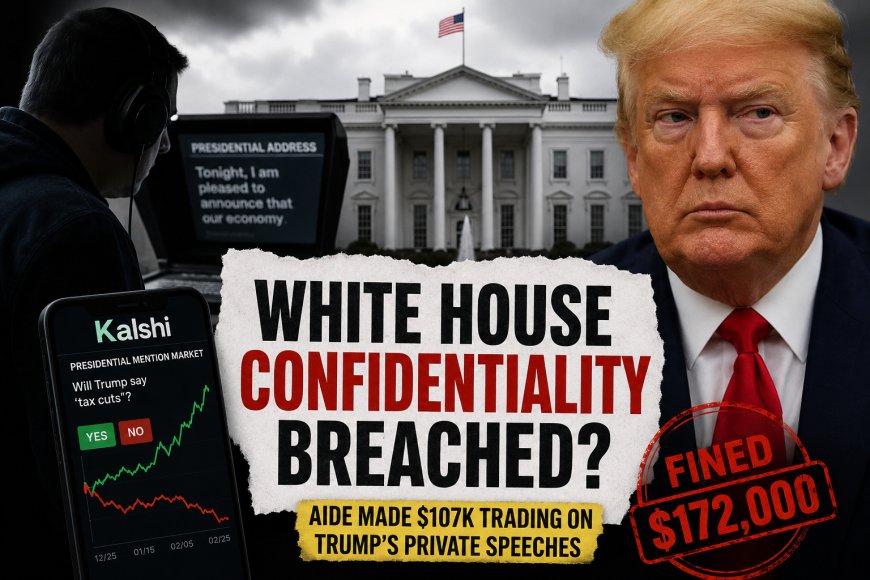
Donald Trump White House confidentiality is facing fresh scrutiny after federal regulators found that a former White House teleprompter operator used advance access to presidential speeches to make profitable trades on a prediction market. The Commodity Futures Trading Commission ordered Gabriel Perez to give up more than $107,000 in trading profits, pay a $65,000 civil penalty and accept a three-year trading ban. The case puts an unusual spotlight on how confidential information handled inside the White House can create financial opportunities outside government.
What happened with the White House speech information?
The CFTC said Perez had access to presidential remarks before they were publicly delivered as part of his work as a White House teleprompter operator. Instead of treating that information only as part of his official duties, regulators found that he used it for personal financial gain. The agency described the information as material, nonpublic information obtained through federal government employment and said its use breached a duty of trust and confidence.
The conduct involved Kalshi's so-called “mention markets.” These contracts are designed around whether particular words or phrases will appear in a public figure's speech. That means information contained in a prepared presidential address can potentially become financially valuable before the public hears the speech. In Perez's case, regulators said his access allowed him to trade with information that ordinary market participants did not yet have.
How much money did Gabriel Perez make?
According to the CFTC's settlement order, Perez generated $107,539.02 in profits from the trades. He must disgorge that amount and pay an additional $65,000 civil monetary penalty, bringing the total financial obligation to $172,539.02. The regulator also imposed a three-year trading ban and ordered him to cease and desist from future violations of the Commodity Exchange Act and related CFTC regulations.
The CFTC said the civil penalty was substantially discounted because Perez cooperated with the investigation. The agency specifically cited his cooperation as a reason for reducing the penalty. Perez consented to the regulatory order, while the enforcement action establishes the regulator's findings without requiring a separate trial to determine the allegations.
Why is White House confidentiality important in this case?
The unusual feature of the case is not simply that a government employee made money through a prediction market. It is the value of information obtained because of his position. Presidential speeches are often prepared, revised and rehearsed before delivery. People who see those materials ahead of the public can potentially know what a president is likely to say before investors, journalists and members of the public do.
That distinction matters because prediction markets are built around information. When a participant has access to information that other traders cannot reasonably obtain, the market can become unfair. The CFTC's action therefore sends a broader message about the treatment of confidential government information as prediction markets expand and increasingly resemble financial markets.
The case also shows why confidentiality rules can have consequences beyond traditional government leaks. The information did not need to involve classified national-security material to have economic value. The regulator's case focused instead on material, nonpublic information obtained through federal employment and allegedly used for personal benefit.
What did regulators find about the trading?
The CFTC said Perez traded presidential mention-market contracts while working as a teleprompter operator. The contracts were tied to words or phrases President Donald Trump might use during speeches. Because Perez had advance access to the prepared remarks, the regulator concluded that he possessed information unavailable to the broader market.
The enforcement action also illustrates how prediction-market activity can come under regulatory scrutiny. The CFTC credited KalshiEX with assisting the investigation. That cooperation is significant because suspicious trading patterns can be identified by platforms before regulators have a complete picture of what happened.
What is the penalty against the former White House operator?
Perez must return the $107,539.02 in profits identified by the CFTC and pay a $65,000 civil penalty. He is also prohibited from trading on CFTC-registered entities for three years. The settlement further requires him to stop conduct that would violate the Commodity Exchange Act or CFTC regulations.
The financial penalty is important, but the trading ban may be the more lasting consequence for someone whose conduct involved a prediction market. The CFTC's decision makes clear that access gained through government employment cannot simply be converted into a private trading advantage when the information has not yet reached the public.
What does this mean for presidential speech information?
The case does not mean that every employee who sees a presidential speech draft is automatically prohibited from discussing or handling it under every circumstance. The central issue identified by the CFTC is the alleged conversion of material, nonpublic information obtained through government employment into personal trading profits.
That distinction is important for readers trying to understand the case. The enforcement action is about the use of information and the duty attached to the employee's position, rather than a claim that every presidential speech document is classified. The CFTC specifically described Perez's conduct as a breach of his duty of trust and confidence.
The case could also become relevant as prediction markets continue to grow. Contracts based on political events, public statements and other measurable outcomes can create incentives to obtain information before it becomes public. Regulators therefore face a difficult question: how should existing market rules apply when a new type of market turns ordinary insider access into a potential trading advantage?
How does this fit into the latest Trump news cycle?
The enforcement action arrives during a busy period for stories involving President Trump and his administration. Separately, U.S. District Judge Alvin Hellerstein rejected Trump's latest effort to move his New York hush-money case into federal court. Hellerstein ruled that Trump's arguments for another removal were not legally sufficient and rejected the argument that the conduct at issue was protected by presidential immunity. :contentReference[oaicite:5]{index=5}
Those developments are legally separate from the Perez case. The confidentiality story concerns the handling and alleged use of advance presidential speech information by a former government employee, while the Hellerstein ruling concerns Trump's already-decided New York criminal conviction and his effort to obtain federal-court treatment.
Why the case could matter beyond one employee
The broader lesson is about information advantage. A presidential speech may contain policy announcements, economic language or other details that can affect expectations before the speech begins. If someone with privileged access can trade on those details in a market built around the speech itself, the informational gap can become financially meaningful.
The CFTC's action demonstrates that regulators are prepared to examine that type of conduct. It also reinforces the importance of separating legitimate government responsibilities from private financial activity. For prediction-market users, the case is a reminder that having an advantage does not necessarily mean the advantage can lawfully be used.
For the White House, the episode highlights a less visible side of confidentiality: not every sensitive piece of information has to involve national security to carry significant value. Advance knowledge of what a president will say can itself become an asset when markets are designed to trade on those statements.
What's Your Reaction?
 Like
0
 Dislike
0
 Love
0
 Funny
0
 Angry
0
 Sad
0
 Wow
0