Nepal Flood Kills 95, Hundreds Missing Near Tibet Border
Nepal flood kills at least 95 near the Tibet border as hundreds remain missing, roads collapse and rescue teams search Rasuwa, Gyirong and nearby areas.
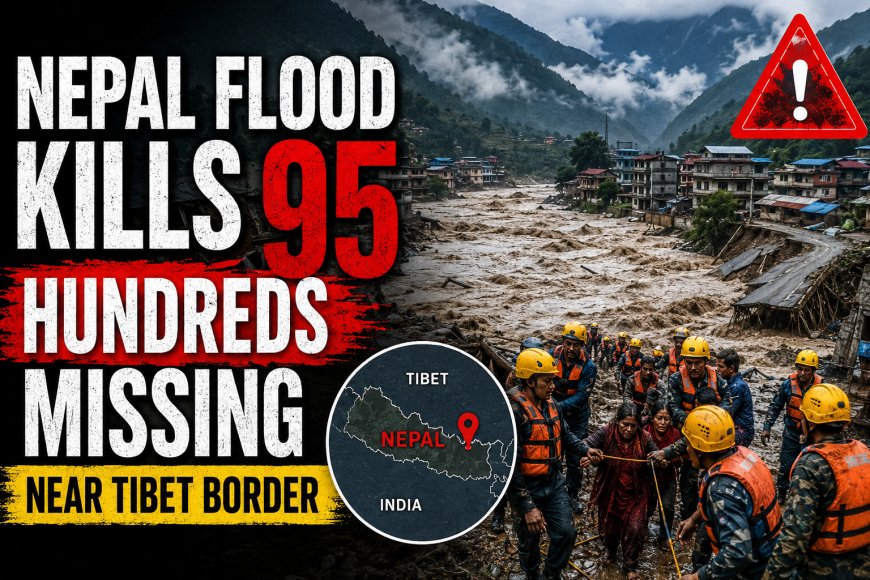
At least 95 people have died after a powerful Nepal flood swept through Himalayan communities near the Tibet border, while hundreds of travellers, workers and local residents remain unaccounted for. The disaster struck early Wednesday in Rasuwa district, where a sudden surge of mud and water destroyed homes, bridges, roads and power infrastructure along the Bhote Koshi river system.
What happened in the Nepal flood?
The flooding began after a wall of mud, rock and ice appears to have entered a river on the Nepal-China border. The surge then moved downstream through the Bhote Koshi and Trishuli river basins, carrying heavy sediment and debris into settlements in Rasuwa and neighbouring districts.
Nepal’s foreign minister told lawmakers that a magnitude 4.4 earthquake may have triggered an avalanche in the border area. Preliminary assessments have also pointed to a rock-and-ice collapse or a glacial lake-related event. Officials have not yet confirmed the exact chain of events, so the earthquake explanation remains provisional. [2][3]
The affected area is difficult to reach. Floodwater rose above normal river levels, roads were cut, bridges disappeared and thick layers of sediment covered access routes. Rescue helicopters initially struggled to land because of strong winds, dangerous conditions and the continuing flow of water.
How many people are dead or missing?
Police and government agencies have reported rapidly changing figures as teams recover bodies and contact people listed as missing. The latest figure in the supplied reports is at least 95 deaths, but earlier updates placed the toll much lower. Authorities are expected to revise the number as isolated communities become accessible.
The Nepal Tourism Board said 384 travellers had been reported missing from affected areas, including 291 foreign nationals and 93 Nepali citizens. The list included more than 100 Indian nationals, 12 British citizens, three Americans, Malaysian and South African travellers, and people from several other countries. Officials stressed that the preliminary list was still being checked and did not necessarily mean every person had been confirmed dead. [2][3]
Twelve British citizens, including a 13-year-old girl, were reportedly travelling with Alpine Eco Trek when contact was lost. Eight South Koreans working at a hydropower project were also reported missing, while other people remained stranded in villages cut off by damaged roads.
Which areas have been affected?
Rasuwa is at the centre of the emergency. The settlements of Timure, Syabrubesi and Betrawati were among the locations placed on high alert, while rescue teams also worked around Mailung and other communities along the river corridor.
Floodwater and landslides also damaged parts of Nuwakot, Dhading and nearby districts. Verified video reviewed by the BBC showed a bridge being pulled from its foundations as a swollen, sediment-filled river moved through Trishuli Bazaar. Buildings near the riverbank were damaged, buried or swept away. [2]
On the Chinese side, a mudslide affected the Gyirong area and the Gyirong Port, an important crossing for travel and trade between Tibet and Nepal. Roads, communications and electricity links were disrupted, and Chinese officials warned of major casualties and missing people. The full extent of the damage in Tibet was not immediately clear. [1]
Why is the damage so severe?
The affected rivers run through narrow Himalayan valleys, leaving settlements, roads, bridges and construction sites close to the water. In such terrain, a sudden release of water blocked by rock or ice can become a fast-moving wall of debris. It can travel downstream before residents have time to respond.
The timing also increased the danger. Floodwater arrived with mud, boulders, trees and broken infrastructure, making it more destructive than ordinary seasonal river flooding. A thick layer of sediment then slowed rescue work and made it difficult for helicopters and vehicles to reach survivors.
Experts have warned that additional blockages upstream could create another sudden release. Authorities are therefore monitoring river levels and telling people living near riverbanks to move to higher ground and remain alert even after the first surge has passed.
What happened to Nepal’s power and transport links?
The flood caused a serious infrastructure emergency beyond the immediate loss of homes and lives. Nepal’s energy ministry said about 430 megawatts of electricity capacity was affected, largely at hydropower facilities. That represents more than 12% of the country’s installed hydropower capacity, according to a Reuters calculation. [1]
At least 19 bridges and around 40 kilometres of roads were reported damaged in later updates, while project sites, trucks and border transport routes were swept away. Sections of the Prithvi Highway, a major route linking Kathmandu with Pokhara, were also disrupted by flooding and collapsed bridges.
The damage to the Gyirong crossing could affect supplies and trade between Nepal and Tibet. Even if the floodwater recedes quickly, restoring roads, communications, electricity and bridges in the mountain region could take considerably longer.
How are rescue teams responding?
Nepal has deployed police, armed police, soldiers, medical teams and helicopters to search for survivors. Rescue workers are focusing on settlements that lost road access and on locations where travellers, workers or security personnel were last seen.
Officials said dozens of people had already been rescued, but operations remained slow because of unstable slopes, high water, damaged landing areas and poor communications. Some security personnel were also reported missing after barracks and work sites were overwhelmed by the flood.
China has ordered a large-scale search and rescue operation around Gyirong and instructed authorities to strengthen monitoring and early-warning systems. India has also been watching water levels downstream, with authorities in Bihar and Uttar Pradesh preparing for possible rises in rivers flowing out of Nepal.
Is it safe to travel near Rasuwa?
Travel near Rasuwa, Rasuwagadhi, Timure, Syabrubesi and other communities along the Bhote Koshi and Trishuli rivers should be postponed until local authorities reopen routes and issue safety clearance. Roads and bridges may remain unstable even where the visible water level has fallen.
People already in the affected region should move away from riverbanks, avoid bridges and damaged roads, follow instructions from police and local administrators, and maintain contact with hotels, tour operators or their embassies. Travellers should not attempt to cross flooded roads or return to buildings affected by landslides.
The casualty and missing-person figures are still being verified. Families and travellers should rely on official notices from Nepal’s authorities, the Nepal Tourism Board, embassies and registered tour operators rather than unconfirmed social-media lists.
Frequently asked questions
Where did the Nepal flood happen?
The worst impact was reported in northern Nepal’s Rasuwa district near the Tibet border, especially along the Bhote Koshi river. Flooding and landslides also affected Nuwakot, Dhading and nearby areas.
What caused the flash flood?
Preliminary reports suggest that a rock-and-ice avalanche or another sudden blockage failure released a large volume of water into the river. Officials also said a magnitude 4.4 earthquake may have triggered the event, but investigators had not yet confirmed the precise cause. [2]
How many travellers are missing?
The Nepal Tourism Board reported 384 missing travellers in a preliminary list, including 291 foreign nationals and 93 Nepali citizens. The number was still being checked as rescue teams reached isolated locations. [2][3]
Was Tibet affected too?
Yes. A mudslide affected the Gyirong area and border port in Tibet, disrupting roads, communications and electricity. Chinese officials also reported missing people and feared major casualties, although the full toll was not immediately available. [1]
Could another flood happen?
Authorities and environmental experts warned that secondary blockages upstream could create further surges. Residents and visitors near rivers should remain on higher ground and follow official evacuation instructions.
What happens next?
The immediate priority is to reach cut-off communities, identify missing people and provide medical care, shelter and food. Rescue officials must also inspect bridges, hydropower sites and unstable slopes before reopening transport routes.
The final death toll may rise as teams reach areas buried under mud or cut off by destroyed roads. Authorities are expected to publish updated casualty lists, infrastructure assessments and travel warnings as communications improve.
What's Your Reaction?
 Like
0
 Dislike
0
 Love
0
 Funny
0
 Angry
0
 Sad
0
 Wow
0