Amazon Cargo Plane Crash: 5 Dead in Miami
Amazon cargo plane crash at Miami International Airport killed five and injured five after a runway overrun. Here’s what investigators know so far today.
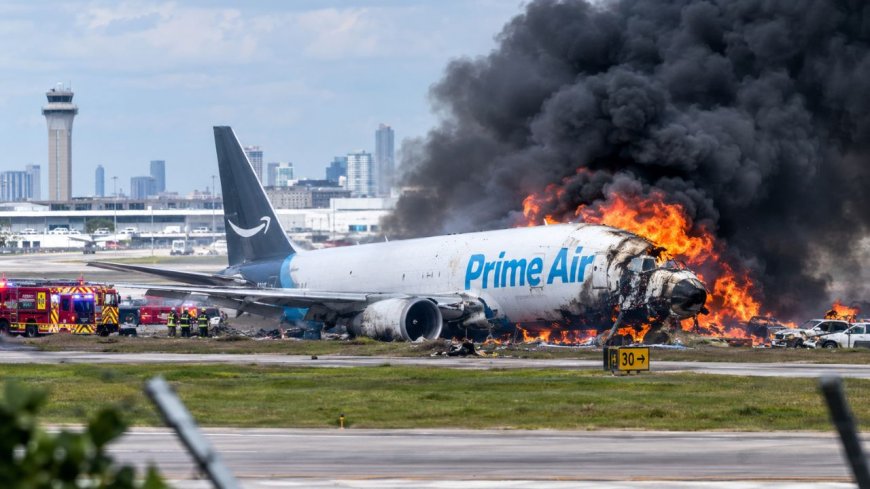
The Amazon cargo plane crash at Miami International Airport killed five people and injured five others after Prime Air Flight 7598 overran a runway, struck vehicles and caught fire on Sunday, September 6. The Boeing 767-300 was operated by cargo carrier 21 Air on behalf of Amazon and had arrived from San Juan, Puerto Rico. Federal investigators are now working to determine why the aircraft did not stop before leaving the usable runway. The cause has not been established, and early theories about weather, braking, pilot decisions or the aircraft itself remain unconfirmed.
The aircraft arrived at Miami shortly before 2 p.m. local time and overran the airport's diagonal Runway 30 during landing. It crossed beyond the airport's paved area and struck multiple vehicles near the 2100 block of Northwest 42nd Avenue before coming to rest and catching fire. Five people died on the ground or in the crash area, while five others were hospitalized, including three who were reported to be in critical condition. More than 60 Miami-Dade Fire Rescue units and about 200 personnel responded as crews dealt with fire, trapped victims and a fuel leak.
The accident immediately disrupted operations at one of the United States' most important cargo airports. Miami International Airport temporarily stopped flight operations while emergency crews worked at the scene, and flights resumed later Sunday with continuing disruption. The incident also triggered a federal investigation involving the Federal Aviation Administration and the National Transportation Safety Board. For readers trying to understand what happened, the most important unanswered question is not whether the aircraft left the runway, but why it still had enough speed to do so.
What does the Amazon cargo plane crash reveal about the landing?
One of the most important pieces of early evidence is the aircraft's speed as it reached the end of the usable runway. Flightradar24 reported that the Boeing 767 was traveling at about 112 knots, or roughly 129 mph, when it exited the usable runway area. That figure describes the aircraft's movement at that point in the sequence, but it does not by itself explain why the jet failed to stop. Investigators will need to reconstruct the landing from flight-data sources, cockpit information, aircraft systems and other evidence before determining what happened.
Weather is another significant part of the early picture, although it should not be treated as a confirmed cause. Flightradar24's aviation data recorded thunderstorms around Miami at the time, with winds of about 17 knots and gusts reaching 26 knots. The aircraft was landing on Runway 30, and the reported wind direction creates a potentially relevant tailwind component, depending on the exact conditions during the landing. Investigators will therefore examine the wind, runway surface, aircraft weight, braking performance, touchdown point and pilot actions together rather than treating any single factor as the explanation.
Why is the runway overrun still difficult to explain?
Runway 30 is about 9,360 feet long, giving investigators a substantial distance over which to reconstruct the aircraft's landing and deceleration. The key questions include where the main landing gear touched down, how much runway remained at that moment, how quickly the aircraft slowed and whether the crew attempted to correct an abnormal landing. Experts quoted in early reporting have also raised the possibility of a touchdown farther along the runway than intended, but that remains an investigative question rather than an established finding.
The aircraft's age is also likely to receive attention, but its age alone does not indicate a mechanical problem. The Boeing 767 was about 32 years old and had originally operated as a passenger aircraft before being converted to a freighter in 2015. Flightradar24 identifies the aircraft as registration N1997A and says it was a Boeing 767-33AER freighter operated by 21 Air. Investigators will examine maintenance records, braking systems, engines, flight controls and other aircraft data before deciding whether any mechanical factor contributed.
What happens next in the Miami plane crash investigation?
The National Transportation Safety Board has sent a team to Miami led by Chairwoman Jennifer Homendy, while the FAA has confirmed that it will investigate the accident. Investigators will collect aircraft records, weather information, runway data, air-traffic-control information and other evidence needed to reconstruct the final approach and landing. They will also examine the aircraft itself and its systems to determine whether anything prevented normal braking or control.
The human toll remains the most immediate concern, while the identities of those killed had not been released in the initial official reporting. Emergency crews faced a complex scene involving the aircraft, burning fuel, damaged vehicles and people trapped in wreckage. The airport has also warned travelers about continuing effects from the incident, with passengers advised to check directly with their airlines before traveling to Miami International Airport.
At this stage, the confirmed story is straightforward but the explanation is not. A 21 Air Boeing 767 operating for Amazon landed at Miami, overran Runway 30, struck vehicles and caught fire, leaving five people dead and five injured. The aircraft's speed at the runway exit, the active weather and the details of its touchdown will all be important evidence, but none is proof of causation yet. According to reports, investigators are now focused on establishing exactly where the landing went wrong and whether a combination of operational, environmental or mechanical factors led to the fatal overrun.
Frequently Asked Questions
What happened to the Amazon cargo plane in Miami?
Prime Air Flight 7598, operated by 21 Air, overran Runway 30 at Miami International Airport on September 6, 2026. The Boeing 767 struck multiple vehicles after leaving the runway and caught fire, killing five people and injuring five others.
Why did the Amazon cargo plane overrun the Miami runway?
The cause has not been determined. Investigators are expected to examine the aircraft's speed, touchdown location, braking performance, weather and wind conditions, runway conditions, mechanical systems and crew actions before reaching a conclusion.
Who operated the Amazon flight that crashed in Miami?
The Boeing 767 was operated by 21 Air on behalf of Amazon Prime Air. The flight, designated Prime Air Flight 7598, departed from San Juan, Puerto Rico, and arrived at Miami International Airport shortly before the runway overrun.
What's Your Reaction?
 Like
0
 Dislike
0
 Love
0
 Funny
0
 Angry
0
 Sad
0
 Wow
0