Trump Names Jay Clayton to Lead New AI "Super Intelligence Force"
Trump's Super Intelligence Force will be led by DNI Jay Clayton as America's new AI czar. Here's what the task force means for US tech policy.
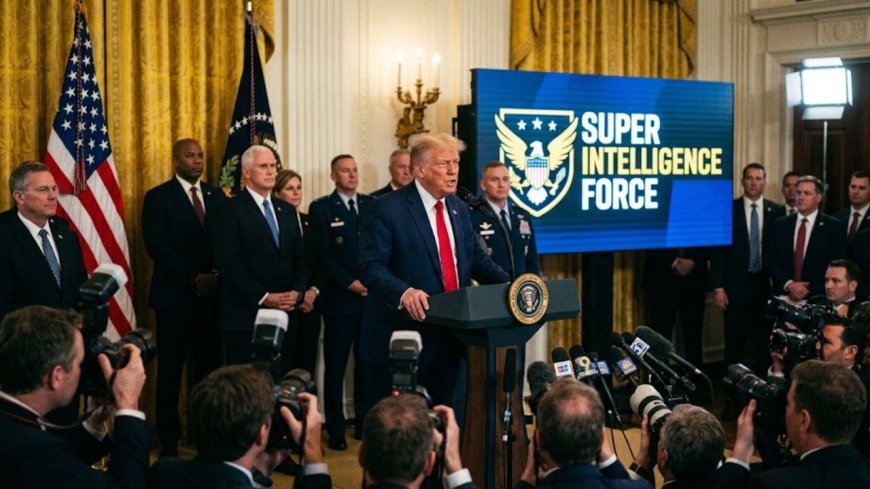
President Donald Trump on Sunday announced the creation of the "Super Intelligence Force," a new White House task force designed to govern the United States' approach to artificial intelligence, naming Director of National Intelligence Jay Clayton as its leader. Trump revealed the decision in a post on Truth Social, confirming a selection that had been widely anticipated after CBS News and other outlets reported Clayton as the frontrunner earlier in the week. The announcement comes just days after Trump hosted the chief executives of six major AI companies at the White House, where they signed a voluntary accord on AI development. The new task force will report directly to Trump and White House Chief of Staff Susie Wiles, giving it unusual proximity to presidential authority.
Clayton, 59, brings a securities law and intelligence background to the role rather than a technical AI résumé. He previously served as chairman of the Securities and Exchange Commission under Trump's first term, then spent time at Apollo Global Management before being nominated as Director of National Intelligence in June 2026 and confirmed in August. Trump has tapped three additional officials to serve alongside Clayton: Federal Trade Commission Chairman Andrew Ferguson, Office of Personnel Management Director Scott Kupor, and Emil Michael, the Pentagon's Chief Technology Officer and Undersecretary of War for Research and Engineering. Together, their portfolios span trade enforcement, workforce policy, defense research, and intelligence — a lineup that signals the force will prioritize economic competition and national security above technical safety regulation.
The Super Intelligence Force is not the first attempt by the Trump administration to install an AI policy leader. Venture capitalist David Sacks served as the administration's AI and crypto czar from the beginning of Trump's second term but concluded his role as a special government employee in March 2026. The gap in centralized AI leadership since Sacks' departure has left critics and industry stakeholders questioning how coherently the federal government has been coordinating its position on a technology that Trump himself has described as "bigger than the Industrial Revolution, and the Internet." The new task force has a 120-day mandate to research AI's risks and opportunities and produce recommendations on the federal government's responsibilities.
What Is the Super Intelligence Force and What Will It Actually Do?
According to Trump's Truth Social announcement, the Super Intelligence Force is "tasked with coordinating the effort of the Federal Government to ensure that America continues to lead the World in Super Intelligence." The phrase "Super Intelligence" is itself a deliberate rebranding effort — Trump has been pushing federal agencies and diplomats to use the term instead of "artificial intelligence," a shift the State Department formalized in guidance to its staff earlier this year. The force will coordinate the federal government's engagement with consumers, public interest groups, religious organizations, critical infrastructure providers, and AI developers. Its stated mission positions it as a steering committee rather than a regulatory body, consistent with the administration's broader anti-regulatory stance on technology policy.
The 120-day research and reporting deadline gives the force a concrete early deliverable, but the task force's exact powers remain undefined as of Sunday's announcement. What is clear is that it sits above any existing agency-level AI initiative, reporting directly to the President rather than through a department. The last comparable White House AI structure was the National AI Initiative Office established under the Biden administration, which Trump's executive orders in early 2025 significantly restructured. Analysts note that placing a former intelligence director — rather than a technologist or a regulator — at the head of an AI policy body suggests the administration sees national security and geopolitical competition with China as the primary frame for AI governance.
Why Critics Say Self-Policing AI Is a Familiar and Dangerous Gamble
The Super Intelligence Force announcement draws its authority in part from a voluntary accord that major tech companies signed at last week's White House summit — a set of commitments to build internal controls, develop detection capabilities, and self-police AI development. Critics were quick to note that voluntary self-regulation has a poor track record in the technology sector. The social media industry operated under similarly loose frameworks for years before congressional hearings, state legislation, and public backlash forced more formal accountability. The parallel is not lost on observers watching an administration that simultaneously dismisses AI safety concerns as overblown while creating a task force specifically to oversee them.
None of the four officials named to lead the Super Intelligence Force — Clayton, Ferguson, Kupor, or Michael — have deep backgrounds in AI safety research. Ferguson is a regulatory attorney with antitrust experience. Kupor is a venture capital executive and former Andreessen Horowitz managing partner who now leads the OPM. Michael is a defense and technology executive. The composition of the team suggests the administration's priorities are economic competitiveness, workforce implications, and military applications of AI — not the technical safety questions that researchers at organizations like OpenAI, Anthropic, and DeepMind have been raising publicly for years. Whether that gap matters will depend on what the task force recommends after its 120-day window closes.
The US-China AI Race Driving Every Decision
Behind the policy language and task force appointments is a blunt strategic calculation: the Trump administration views artificial intelligence as a two-horse race between the United States and China, and it intends to win by moving fast rather than by building regulatory guardrails. Trump said at last week's White House AI summit that the technology would be "very, very safe" through a combination of self-policing and what he called "group-policing," without elaborating on enforcement mechanisms. The administration has consistently framed AI safety advocates as obstacles to American competitiveness, with Trump at one point suggesting in a September social media post that AI fears were a political hoax. The Super Intelligence Force, despite its oversight framing, is unlikely to shift that underlying philosophy.
The Super Intelligence Force announcement represents the Trump administration's most concrete AI governance action since revoking Biden's October 2023 AI executive order on the first day of the second term. Whether it produces meaningful policy or functions primarily as a political signal will become clearer when the task force delivers its 120-day report. What is already clear is that the US government's posture on AI — voluntary industry commitments, competition-first leadership appointments, and an explicit rejection of precautionary regulation — sets it on a fundamentally different path from the European Union's binding AI Act and several other international frameworks. For Americans working in technology, using AI-powered services, or simply watching how governments handle the most consequential technology in decades, the Super Intelligence Force will be a structure worth watching closely.
Frequently Asked Questions
What is Trump's Super Intelligence Force?
The Super Intelligence Force is a new White House task force announced by President Trump on October 4, 2026, to coordinate the federal government's approach to artificial intelligence. It is led by Director of National Intelligence Jay Clayton and includes three other officials from the FTC, OPM, and Pentagon. The force has a 120-day mandate to research AI risks and opportunities and report recommendations directly to the President.
Who is Jay Clayton and why was he chosen as AI czar?
Jay Clayton, born July 11, 1966, is a corporate attorney who previously chaired the Securities and Exchange Commission from 2017 to 2020 and was confirmed as Director of National Intelligence in August 2026. He was selected to lead the Super Intelligence Force because of his intelligence and regulatory background, though he has no formal AI research or engineering experience. Trump confirmed the appointment via Truth Social on October 4, 2026.
What happened to David Sacks, Trump's previous AI czar?
David Sacks, a Silicon Valley venture capitalist and member of the so-called PayPal Mafia, served as Trump's AI and crypto czar as a special government employee starting in early 2025. He concluded that role in March 2026, leaving the administration without a central AI leadership figure for several months until Sunday's announcement of the Super Intelligence Force and Clayton's appointment.
What's Your Reaction?
 Like
0
 Dislike
0
 Love
0
 Funny
0
 Angry
0
 Sad
0
 Wow
0