Roman-Era Savings Revealed as 40,000 Coins Unearthed in France - Bio Points News
Archaeologists in France uncover over 40,000 Roman coins stored in ancient jars, revealing rare insights into everyday savings habits nearly 1,800 years ago.
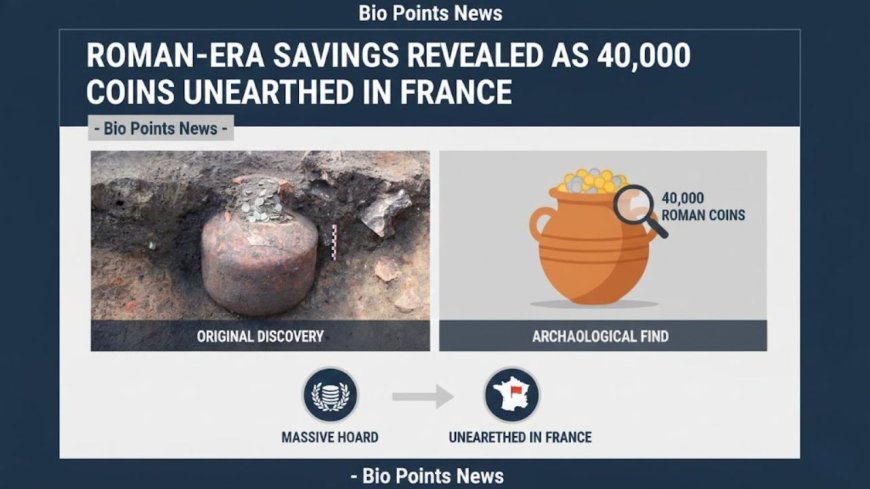
Archaeologists in France have made a remarkable discovery after unearthing more than 40,000 Roman-era coins buried beneath the floor of a home. The find, dating back nearly 1,800 years, is shedding new light on how people in Roman Gaul saved and managed their money during a turbulent period of history.
Discovery at the Ancient Settlement
The coins were found during an archaeological excavation in northeastern France, where researchers uncovered three large ceramic jars, known as amphorae, hidden beneath the floor of a former house. Unlike many coin hoards linked to war or sudden danger, experts believe these jars were deliberately placed for long-term storage and personal savings.
Inside the Coin Hoard
The three jars together contain more than 40,000 coins, most made from bronze and silver alloys commonly used in the Roman Empire. Analysis shows that the coins date from around 280 to 310 A.D., a period marked by political instability and economic change. The jars were carefully positioned and appear to have been filled gradually, suggesting regular deposits over time.
What the Coins Reveal
According to archaeologists, this was not a hidden treasure meant to be retrieved quickly. Instead, the discovery points to a structured savings system, similar to a personal bank. Some coins were still stuck together, indicating they were placed into the jars while already buried, reinforcing the idea of ongoing use rather than a single emergency burial.
Background: Roman Life in Gaul
During the late third century, Gaul was part of the Roman world and briefly belonged to the breakaway Gallic Empire. Daily life continued despite political uncertainty, and households still relied on currency for trade, wages, and savings. Finds like this help historians better understand how ordinary people handled their finances during uncertain times.
Recent Research and Ongoing Analysis
Specialists are now cataloging and cleaning the coins to identify emperors, mints, and circulation patterns. Early findings suggest the collection could offer valuable data on regional trade and economic behavior before the settlement was destroyed by fire, which likely ended the use of the home and its hidden savings.
The discovery of thousands of Roman coins in France is more than an archaeological curiosity. It provides a rare, personal glimpse into everyday economic life nearly two millennia ago. As research continues, the hoard is expected to deepen understanding of Roman financial habits and the resilience of communities living through historical upheaval.
What's Your Reaction?
 Like
0
 Dislike
0
 Love
0
 Funny
0
 Angry
0
 Sad
0
 Wow
0