Israel Intercepts Gaza Aid Flotilla: Global Outrage and Legal Questions Arise - Bio Points News
Israel’s 2025 interception of a humanitarian flotilla headed to Gaza has sparked global backlash. Read how world leaders, the UN, and activists—including Greta Thunberg—are responding.
🚢 Humanitarian Flotilla to Gaza Intercepted: Global Reactions and Diplomatic Fallout
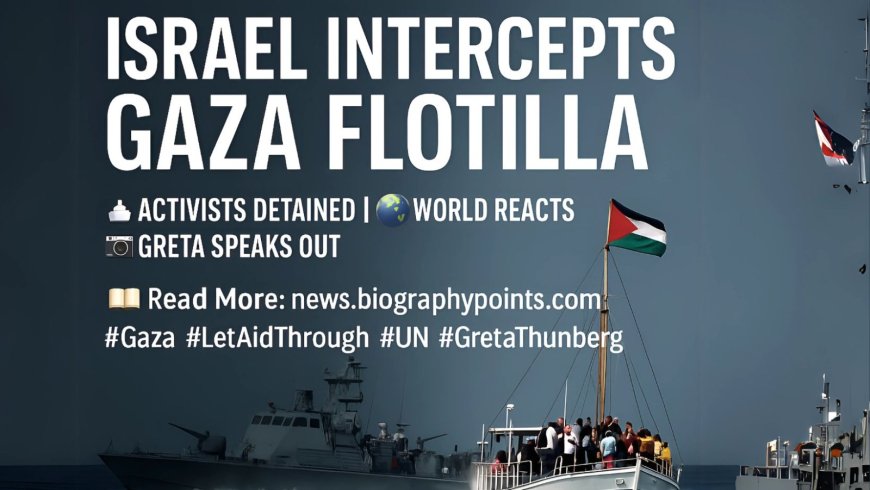
The international outcry was swift and widespread after Israeli naval forces intercepted a humanitarian flotilla headed toward Gaza on June 9, 2025. The ship, loaded with essential medical supplies, food, and water, was part of a civilian-led initiative to break the Israeli blockade and bring relief to war-torn Gaza. Onboard were dozens of human rights activists — including environmental icon Greta Thunberg, clergy, journalists, and medical workers from across Europe.
As footage of the confrontation went viral, it reignited global debate over Israel’s blockade policy and its legality under international maritime and humanitarian law. The incident is now being seen as more than a blockade — it has become a test case for global moral conscience and international diplomacy.
🌍 A Civilian Mission with Global Significance
This flotilla was not backed by any government or political party. It was a civilian-led effort, organized by European humanitarian groups and global activists. Organizers claimed the mission was peaceful and solely intended to deliver aid to starving civilians trapped in Gaza under continuous airstrikes and limited access to resources.
Despite warnings from Israel, the vessel sailed from Cyprus and entered waters close to Gaza. Israeli naval units intercepted it approximately 50 nautical miles offshore, reportedly in international waters, which has added a new layer of diplomatic controversy. Activists reported being detained, with some alleging mistreatment during interrogation.
While Israel maintains that the blockade is necessary for security reasons, flotilla organizers argue that starving an entire population is a war crime, not a defensive measure.
🇺🇳 International Reactions: A Wave of Condemnation
The United Nations, the European Union, and several major NGOs have condemned the interception. UN Secretary-General António Guterres expressed "deep concern" over the violation of maritime law and reiterated that humanitarian aid must not be obstructed. The European Parliament held an emergency session in Brussels, where multiple MEPs called for an independent investigation.
Countries such as Spain, Ireland, Norway, and South Africa summoned Israeli ambassadors to formally protest the action. Spain’s Foreign Minister called the act “a direct assault on human rights and international humanitarian law.” Meanwhile, Turkey—recalling the 2010 Mavi Marmara flotilla raid—labeled the move as piracy and warned of "serious consequences."
The United States, a close ally of Israel, struck a more cautious tone. While reaffirming Israel’s right to self-defense, US State Department officials emphasized the importance of allowing humanitarian aid to reach civilians.
📸 Greta Thunberg’s Role: Spotlighting Gaza’s Crisis
Perhaps the most symbolic element of this flotilla was the presence of Greta Thunberg, the globally recognized climate activist. Her participation in the mission added unprecedented visibility to the cause. Social media exploded with the hashtag #LetAidThrough, and millions of posts supported the flotilla, framing the event as a non-violent act of humanitarian resistance.
Greta, who was briefly detained and later released, shared a video statement:
“I came here not as a politician or a strategist, but as a human being witnessing a silent genocide. We must speak. We must act.”
Her involvement shifted the narrative from politics to humanity, encouraging millions — especially youth — to re-engage with the Palestinian humanitarian crisis.
⚖️ Legal and Political Fallout: A Challenge to Global Norms
Legal experts around the world are now analyzing whether Israel’s interception in international waters violates the UN Convention on the Law of the Sea and other maritime codes. Several NGOs are planning to file complaints at the International Criminal Court (ICC) and the International Maritime Organization (IMO).
At the same time, the political consequences are beginning to unfold. European parliaments are under pressure to review arms deals and trade relationships with Israel. Activist groups are calling for economic boycotts, while others demand that governments do more than just issue statements.
If international legal institutions fail to act, critics fear it will signal a dangerous precedent — that humanitarian action can be criminalized under political pressure.
🧭 What This Means for the World
The Gaza flotilla incident has become a litmus test for global diplomacy, humanitarian values, and media integrity. While past flotillas have faded from the headlines, the presence of globally recognized figures and the rise of digital awareness have turned this moment into a worldwide reckoning.
If international law is to mean anything, then blocking aid to civilians must be investigated and condemned. And if global leaders are serious about protecting human rights, then they must ensure that those trying to help, not harm, are protected — not punished.
What's Your Reaction?
 Like
0
 Dislike
0
 Love
0
 Funny
0
 Angry
0
 Sad
0
 Wow
0