Prichard Colon Dies at 33 After 2015 Boxing Brain Injury
Prichard Colon died at 33 after years of severe complications from his 2015 fight with Terrel Williams. Here is what happened and what his case changed.
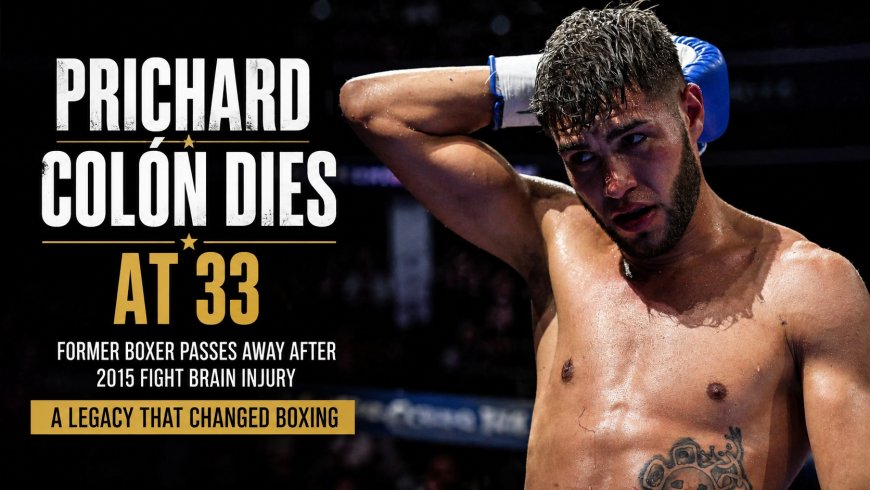
Prichard Colon died at age 33 on August 13, 2026, nearly 11 years after a catastrophic brain injury suffered during his 2015 professional boxing match against Terrel Williams. His father, Richard Colon, confirmed the death on social media, bringing an end to a decade-long story that had drawn worldwide attention to the dangers of illegal blows to the back of the head and the responsibilities of boxing officials. Recent reports say no separate acute cause of death has been publicly disclosed; the circumstances described by major outlets connect his death to the severe long-term complications that followed the 2015 brain injury.
Colon had entered that fight as one of Puerto Rico's promising young boxing prospects. He was 16-0 with 13 knockouts and was widely regarded as a fighter with a significant future. Instead, the October 17, 2015 bout in Fairfax, Virginia, became the final professional fight of his career. What followed was an emergency brain operation, 221 days in a coma and years of intensive care from his family.
What happened to Prichard Colon in the 2015 fight?
Colon faced Terrel Williams at EagleBank Arena in Fairfax in a bout that was scheduled for 10 rounds. During the fight, Colon complained about punches landing to the back of his head, an area where rabbit punches are prohibited because of the serious neurological risks involved. The referee eventually deducted a point from Williams for a rabbit punch, while Colon also received a two-point deduction for a low blow.
The fight took another unusual turn after the ninth round. Colon's corner began removing his gloves, apparently believing the contest had ended. There was still a tenth round to come, and the referee ultimately disqualified Colon after the delay. He had also been knocked down twice in the ninth round, with the second knockdown coming shortly before the bell.
Colon left the ring but soon became seriously ill in the dressing room. He experienced dizziness and vomiting before being rushed to Inova Fairfax Hospital. Doctors found bleeding in his brain and performed emergency surgery to relieve pressure inside his skull. Contemporary reporting from ESPN and The Washington Post documented the immediate medical crisis and the beginning of a recovery battle that would last for the rest of his life.
Why did Prichard Colon spend years dealing with the injury?
The injury was not a short-term concussion that Colon could simply recover from with rest. He suffered a severe traumatic brain injury and a subdural hematoma that required emergency surgery. He remained in a coma for 221 days. After eventually emerging from the coma, he was left with profound neurological and physical disabilities and required extensive assistance and rehabilitation.
His family became central to his care. His mother, Nieves Meléndez, and father, Richard Colon, spent years supporting his rehabilitation and sharing updates about his condition. The World Boxing Council later described the family's commitment as an extraordinary example of perseverance and recognized Colon as an honorary champion.
Colon also underwent additional medical treatment years after the original injury. In 2021, the WBC reported that he successfully underwent surgery after doctors found that a collapse of part of his skull was pressing on his brain. The organization said a fragment was removed and replaced with a plate.
What is known about Prichard Colon's cause of death?
There is an important distinction between the documented cause of Colon's original medical crisis and the cause of his death. His 2015 injury is well documented: he suffered a brain bleed after the fight and required emergency surgery. However, as of the latest reports on his death, authorities and his family had not publicly announced a separate acute medical cause of death.
News reports describe Colon's death as coming after years of severe complications associated with the traumatic brain injury he suffered in the Williams fight. That is why searches such as “Prichard Colon cause of death,” “how did Prichard Colon pass away” and “what happened to Prichard Colon” have surged following the announcement. It would be premature to state a more specific medical cause without an official statement from his family or medical authorities.
How did the Prichard Colon case change boxing?
One of the least discussed parts of Colon's story is how his injury became part of the broader conversation about referee responsibility and rabbit punches. The World Boxing Council later referred specifically to the “Prichard Colon Rule” and called on referees to apply the rules against punches to the back of the head much more rigorously. The WBC explained that the lower back of the head and neck area contains structures connected to the brainstem and spinal system, making such blows especially dangerous.
The WBC says it created the rule in 2016, using Colon's case as a catalyst for stricter enforcement. Its stated approach was zero tolerance toward rabbit punching, with referees urged to act decisively rather than treating repeated illegal blows as ordinary roughness inside a boxing match.
That legacy is significant because Colon's name became associated not only with a tragic fight, but also with a safety issue that boxing officials were already aware of. The WBC's later statements made clear that his case helped reinforce the importance of stopping repeated illegal punches before they could produce catastrophic consequences.
What happened with the Prichard Colon lawsuit?
Colon’s family also pursued legal action over the circumstances surrounding the fight. In 2017, his parents filed a lawsuit in the District of Columbia seeking more than $50 million in damages. The complaint named ringside physician Richard Ashby, his medical practice and the promoters Headbangers Promotions and DiBella Entertainment, alleging negligence connected to the handling of Colon during the bout.
The legal case is important because it focused attention on what officials and medical personnel should do when a boxer reports symptoms during a fight. The lawsuit alleged that Colon had complained of head pain and that the ringside doctor failed to take appropriate action. Those allegations were claims made by the plaintiffs and should not be presented as judicially established facts. Court records confirm the case was filed in 2017.
The Virginia Department of Professional and Occupational Regulation also investigated the 2015 event. In 2016, the agency determined there was no wrongdoing by the event organizers, illustrating the difference between the family's allegations in later litigation and the findings of the regulatory investigation.
Who was Prichard Colon before the injury?
Before becoming known worldwide because of his injury, Colon was a highly regarded young boxer with an undefeated professional record. He was born in Maitland, Florida, on September 19, 1992, and was closely connected with Puerto Rico, where he developed his boxing career. He won gold at the 2010 Pan American Youth Championship and turned professional in 2012. By the time he met Williams, he had won all 16 of his previous professional fights, including 13 by knockout.
The 2015 fight therefore represented a dramatic interruption to a career that appeared to be moving toward major championship opportunities. Colon was only 23 when the injury changed his life. His story subsequently became known far beyond boxing because it combined the dangers of professional combat sports with a family's prolonged effort to care for a severely injured son.
What is Prichard Colon's legacy?
Colon’s legacy extends beyond his 16 victories and 13 knockouts. His name became associated with boxing safety, the dangers of rabbit punches and the importance of medical intervention when a fighter shows neurological symptoms. The WBC named him an honorary champion in 2021, an acknowledgment that was intended to honor his courage and the years of effort made by his family.
His death at 33 has now brought renewed attention to a case that had already influenced discussions about fighter safety. For many fans, Colon will be remembered not simply for the fight that ended his career, but for the years he survived afterward and for the changes his story helped push boxing organizations to emphasize.
As tributes emerge following his death, the most accurate account is also the simplest: Prichard Colon was a promising undefeated boxer whose life was permanently altered by a catastrophic brain injury in 2015, and he spent the following decade living with its consequences. His family's long campaign of care and the boxing community's recognition of his struggle became an enduring part of his story.
What's Your Reaction?
 Like
0
 Dislike
0
 Love
0
 Funny
0
 Angry
0
 Sad
0
 Wow
0