Global AI Regulation 2025: How the World Is Controlling Artificial Intelligence - Bio Points News
Discover how countries like the US, China, and the EU are regulating Artificial Intelligence in 2025. Learn how global AI laws impact privacy, ethics, and innovation.
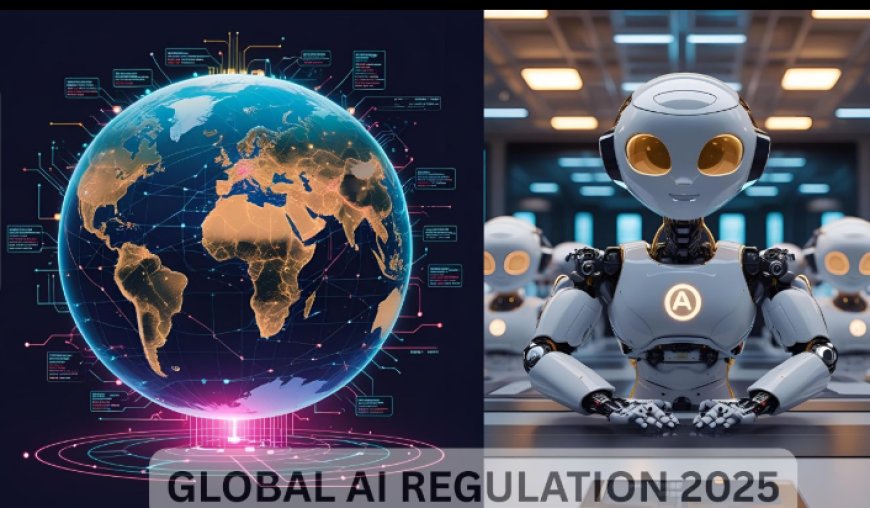
🌍 Global Impact of AI Regulation: How Countries Are Shaping the Future of Artificial Intelligence
Artificial Intelligence (AI) is no longer something we imagine for the future. It’s already here, and it's transforming the way we work, communicate, shop, learn, and even make decisions. From voice assistants like Alexa and Siri to smart algorithms that drive business strategies, AI is playing a major role in our daily lives.
But with rapid innovation comes significant risk. AI systems can be used in harmful ways — spreading fake news, invading privacy, making biased decisions, and even replacing human jobs. To avoid such consequences, countries around the world are stepping up to create rules and regulations that ensure AI is developed and used responsibly.
Each country has a different approach, depending on its values, priorities, and political structure. In this blog, we’ll explore how various nations are addressing AI regulation, what challenges they face, and what it means for ordinary people like you and me.
🤖 Why Do We Need AI Regulation?
AI can be incredibly helpful, but it also has a dark side if not properly controlled. For example, if AI systems are trained on biased data, they can make unfair hiring decisions or wrongly profile individuals in security checks. That’s why regulation is not optional — it’s essential to protect fairness, privacy, and human rights.
One of the biggest concerns is privacy. AI thrives on data, and without regulation, it can collect, analyze, and misuse personal data without the user's knowledge. Regulations create boundaries for how data can be collected and processed, ensuring that people’s rights are respected.
Another concern is job displacement. As AI becomes more advanced, it is capable of replacing many human tasks — from customer support to data entry. Regulation helps control this shift and ensure that workers are protected and retrained for the future.
Liability is also a key issue. What happens if an AI system causes harm — like a self-driving car crashing, or an AI chatbot giving dangerous advice? Who is responsible — the developer, the company, or the user? Legal frameworks are necessary to answer such questions clearly and fairly.
Most importantly, regulation builds public trust. People are more likely to use AI tools if they know there are clear rules that protect them. It’s about making sure AI serves humanity — not the other way around.
🇪🇺 Europe: Setting the Standard with the AI Act
The European Union is leading the way in global AI regulation. In 2024, the EU officially passed the AI Act, becoming the first region to implement a comprehensive legal framework for artificial intelligence. Their approach is focused on ethics, human rights, and consumer protection.
The AI Act divides AI systems into four risk categories: minimal risk, limited risk, high risk, and unacceptable risk. Systems considered “unacceptable,” like those used for social scoring or emotion detection in schools, are outright banned. This ensures that harmful technologies are stopped before they can impact society.
For high-risk systems — like those used in healthcare, law enforcement, or education — companies must follow strict rules. These include transparency, data accuracy, and human oversight. The aim is to make sure that AI is safe, fair, and accountable in sensitive areas.
Transparency is another major pillar. Companies are required to clearly inform users when they’re interacting with an AI system. This builds awareness and prevents AI from deceiving or manipulating people unknowingly.
By enforcing these rules, Europe has positioned itself as a global ethical leader in AI development. While critics argue that strict regulation may slow innovation, the EU believes that responsible innovation is the only sustainable path forward.
🇺🇸 United States: Encouraging Innovation While Catching Up
The United States has taken a more flexible and innovation-friendly approach to AI. Instead of strict laws, the U.S. has introduced soft guidelines like the “AI Bill of Rights” in 2022 — a document that outlines principles like privacy, fairness, and transparency, but isn't legally binding.
In America, most of the responsibility still falls on tech companies themselves. Giants like Google, Microsoft, and OpenAI are expected to follow ethical practices, though there’s little enforcement from the government at the federal level.
That said, some individual states are beginning to take action. For example, California and New York have proposed local legislation to regulate AI, especially in areas like facial recognition, data privacy, and algorithmic bias.
The U.S. strongly believes in free-market innovation, which has led to some of the world’s most advanced AI tools. However, the lack of nationwide regulation is raising concerns, especially as AI systems become more powerful and harder to control.
Many experts argue that without a proper legal framework, the U.S. risks falling behind in ethical leadership, even if it stays ahead in technology. Balancing innovation with safety is the real challenge the country must now face.
🇨🇳 China: Control, Speed, and Surveillance
China’s approach to AI regulation is rooted in strict government control. The country has rapidly advanced in AI development — particularly in areas like facial recognition, social monitoring, and smart cities. However, these advancements are closely monitored and regulated by the state.
Before launching any AI product, Chinese companies are required to submit their systems for government review. The main goal is to ensure that AI tools align with national values, public security, and political stability.
Surveillance is a key component of China’s AI infrastructure. The government widely uses AI to monitor citizens’ behavior, maintain order, and enforce laws. This has led to international criticism regarding human rights and privacy, but China maintains that such systems are essential for safety and governance.
China also enforces data localization laws, which require that Chinese user data be stored within the country. This gives the government complete access and control over how data is handled — a model that other countries are hesitant to follow.
While China's model raises ethical concerns globally, it serves as a powerful example of how AI can be used to achieve state goals. It also shows what could happen if AI regulation becomes more about control than protection.
🇮🇳 India and Emerging Nations: Building Responsibly
India, along with several other developing nations like Brazil, Pakistan, and the UAE, is working to strike a balance between innovation and regulation. These countries see AI as a powerful tool for economic growth, but they also recognize the risks involved.
India is in the process of shaping its AI policies, focusing on responsible AI development, open-source technology, and inclusive growth. The government has proposed guidelines that encourage transparency and data protection while supporting startups and researchers.
In countries like Pakistan and Brazil, regulatory frameworks are still evolving. Limited resources and infrastructure pose challenges, but the potential for AI in sectors like healthcare, agriculture, and education is massive. These nations need agile, affordable, and fair policies to harness AI’s benefits without exposing their populations to risks.
Privacy laws are slowly being introduced to support AI regulation. India’s Digital Personal Data Protection Act is one example, aimed at giving users more control over their personal data and how it's used by AI tools.
For these emerging nations, regulation isn’t just about catching up — it's about building a future that includes everyone. If implemented properly, these policies can help create a more balanced, fair, and inclusive digital economy.
🌐 The Global Challenge: Many Visions, One Future
AI is a global issue, but every country has its own vision for how it should be managed. Europe values ethics and human rights, the U.S. prioritizes innovation, China focuses on control, and developing countries aim for inclusive growth. These differences make global cooperation difficult but necessary.
Technology is evolving faster than the laws meant to control it. A regulation created today might be outdated tomorrow. That’s why flexible, future-proof laws are critical to manage AI responsibly over time.
Another major issue is accountability. If an AI system makes a harmful decision, who should be held responsible? The developer? The platform? The end user? Right now, there’s no universal answer, which makes legal cases difficult to resolve.
While there have been international discussions — like those led by the UN and G7 — there’s still no single global agreement on AI regulation. Political and economic interests often clash, slowing progress on creating shared rules.
To manage AI effectively, countries need to collaborate, not compete. Only through mutual understanding and shared goals can we build a global AI ecosystem that serves humanity — not divides it.
✅ Final Thoughts: Why It Matters to You
Even if you’re not a tech expert, AI regulation affects your life. It determines how your data is used, what jobs will be available, how decisions are made about you, and what kind of world you’ll live in tomorrow.
If there are no regulations, your personal data could be used without your consent. AI systems could make biased or unfair decisions, and no one would be accountable. That’s why being aware of AI laws is important — for your safety, your rights, and your future.
Ordinary people should not just use technology — they should understand it. The more you know about how AI is managed, the better you can protect yourself and your community.
The future of AI doesn’t belong to governments or companies alone — it belongs to all of us. And only when we regulate it wisely can we ensure it becomes a force for good.
Written by: Zulfiqar Ali
Entrepreneur | Software Engineer | AI Enthusiast
💡 "Regulation isn’t about stopping AI. It’s about making sure AI moves in the right direction — for everyone."
What's Your Reaction?
 Like
0
 Dislike
0
 Love
0
 Funny
0
 Angry
0
 Sad
0
 Wow
0