Meta’s $18B Teen Safety Deal Puts TikTok, YouTube on Spot
Meta’s $18B teen safety deal brings new limits for young users and pressures TikTok and YouTube to follow. Here’s what changes and why it matters.
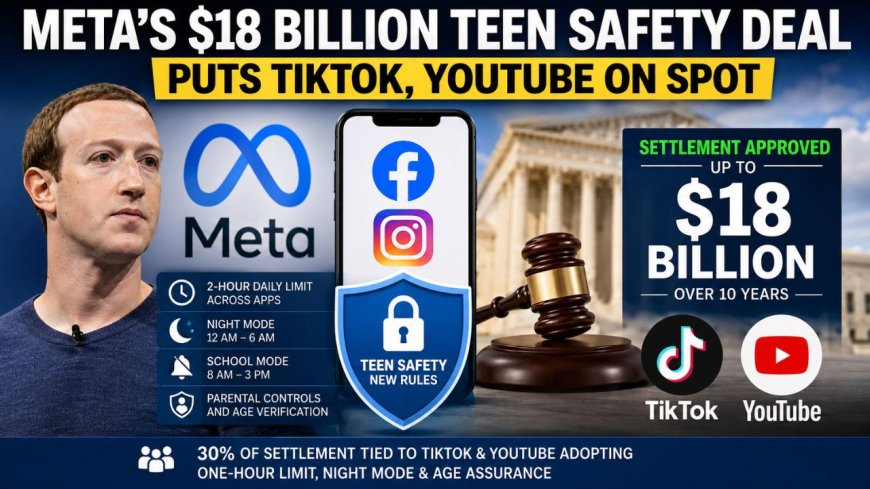
Meta’s $18 billion teen safety deal has moved beyond a proposed settlement and is now approved, putting new limits on how teenagers use Facebook and Instagram while creating an unusual financial incentive for TikTok and YouTube to adopt similar protections. The agreement was announced on August 26, 2026, by a bipartisan coalition of attorneys general and was approved by U.S. District Judge Yvonne Gonzalez Rogers later that day. The headline figure is commonly described as approximately $18 billion by Meta, while state attorneys general have characterized the settlement as worth up to $17.1 billion. The difference reflects how the contingent portion of the agreement is calculated.
The settlement resolves allegations that Meta designed Facebook and Instagram with features that encouraged compulsive use among children and teenagers, exposed young users to harmful experiences and misled the public about the risks. Meta did not admit wrongdoing as part of the agreement. Instead, the company agreed to extensive changes affecting users under 18 in participating U.S. states and territories, including usage limits, nighttime restrictions, stronger age-assurance technology and additional parental controls.
What makes the agreement particularly significant is that part of its financial structure reaches beyond Meta. About 70% of the payment, roughly $12.7 billion under Meta’s description, is allocated to participating states over 10 years. The remaining roughly $5.3 billion is conditional on YouTube and TikTok implementing specified safeguards and making matching payments, turning a settlement with one company into a potential mechanism for broader changes across the social media industry.
What does Meta’s $18 billion teen safety deal actually change?
The immediate changes focus on making Facebook and Instagram less available and less engaging for younger users by default. Teens will face a combined two-hour daily time limit across the two apps, and they cannot disable that limit themselves; parental permission is required. Meta will also block access to major parts of its platforms from midnight to 6 a.m., while push notifications will generally be muted during school hours from 8 a.m. to 3 p.m.
The agreement goes beyond screen-time controls. Meta says teens will receive prompts after every 15 minutes of continuous use and additional alerts at 60 and 90 minutes. Young users will also have access to a non-algorithmic feed option, while parents receive expanded supervision tools. Like and reaction counts will be hidden by default for teens, and Meta will strengthen protections against suspicious adult interactions and harmful content.
Age assurance is another major part of the agreement. Meta must invest in technology designed to identify accounts that may belong to children under 13 or teenagers who registered with an adult birthday. Reuters reported that the new approach raises an important privacy challenge because effective age verification can require information that is also regulated under U.S. children's privacy laws. An independent auditor will monitor Meta’s compliance, while an independent research foundation will be established to study youth well-being.
Why are TikTok and YouTube part of Meta’s settlement?
Meta’s most unusual move is using the settlement to push competitors toward the same basic safety framework. Under the agreement, about 30% of the settlement amount, roughly $5.3 billion, remains conditional. YouTube and TikTok must implement a one-hour daily limit, Night Mode and age-assurance measures for that portion to be released, while the two companies would also be required to make matching payments under the agreement’s structure.
Meta argues that restrictions on one platform are less effective if teenagers can simply move to another app. Its chief legal officer, C.J. Mahoney, has therefore called for TikTok and YouTube to adopt the framework immediately. The practical question now is whether those companies will accept a model that could significantly change how young users access their services.
What happens if TikTok and YouTube adopt the same rules?
The consequences would be stronger than the initial Meta restrictions. Meta says its two-hour daily limit and midnight-to-6 a.m. Night Mode begin with a five-year commitment. If industry peers join the framework, the daily limit would become one hour per app and Night Mode would expand from 10 p.m. to 7 a.m., with the relevant commitments extending to 10 years.
That distinction matters because the settlement could create a new baseline for how major platforms handle teenagers. Instead of each company deciding independently how much screen time, nighttime access or age verification is appropriate, the agreement offers a common framework that could spread through additional settlements and regulatory actions. State attorneys general have already described the deal as a potential transformation of how the technology industry designs products for young users.
Is the full $18 billion payment guaranteed?
No. The widely reported approximately $18 billion figure includes a contingent component. Meta says participating states will receive approximately $12.7 billion, or about 70%, over 10 years, while roughly $5.3 billion is tied to conditions involving YouTube and TikTok. State announcements have generally described the overall agreement as worth up to $17.1 billion, which is why different headlines use slightly different figures.
The settlement also does not mean every social media company is immediately bound by Meta’s restrictions. The agreement directly imposes the new protections on Meta’s platforms, while the TikTok and YouTube provisions are designed to encourage those companies to enter comparable arrangements. Some states also remained outside the agreement, meaning separate litigation over youth safety continues.
What does the settlement mean for parents and teens?
For families using Instagram and Facebook in the United States, the biggest practical changes are the two-hour combined limit, overnight blocking, school-hour notification restrictions, stronger parental supervision and additional age checks. Direct messaging remains outside the time-limit, Night Mode and School Mode restrictions so teenagers can continue communicating with friends and family. Meta will also give parents more information about usage and changes to protective settings.
The agreement therefore represents more than a financial settlement. It establishes a concrete set of rules around screen time, age assurance and recommendation features, while testing whether one company can persuade its largest competitors to follow the same model. TikTok and YouTube’s response will determine whether the agreement remains primarily a Meta reform or becomes a much broader shift in the way social platforms treat young users.
Frequently Asked Questions
How much is Meta paying in the teen safety settlement?
Meta describes the agreement as approximately $18 billion, paid over 10 years. State attorneys general generally describe it as worth up to $17.1 billion because part of the total is contingent on TikTok and YouTube adopting specified protections and making matching payments.
What new limits will teens face on Facebook and Instagram?
Teens will have a combined two-hour daily limit across Facebook and Instagram, subject to parental override. The agreement also includes a midnight-to-6 a.m. Night Mode, muted school-hour notifications, usage prompts, hidden like counts and stronger age-assurance measures.
Are TikTok and YouTube required to adopt Meta’s rules?
The settlement does not simply impose Meta’s rules directly on TikTok and YouTube. Instead, roughly 30% of the settlement is conditional on those platforms implementing a one-hour daily limit, Night Mode and age-assurance measures, along with matching payments under the agreement’s terms.
What's Your Reaction?
 Like
0
 Dislike
0
 Love
0
 Funny
0
 Angry
0
 Sad
0
 Wow
0