Japan Earthquake: 5.9 Quake Shakes Tokyo and Kanto
Japan earthquake update: A magnitude 5.9 quake struck southern Ibaraki early Sunday, shaking Tokyo and Kanto. No tsunami threat was issued.
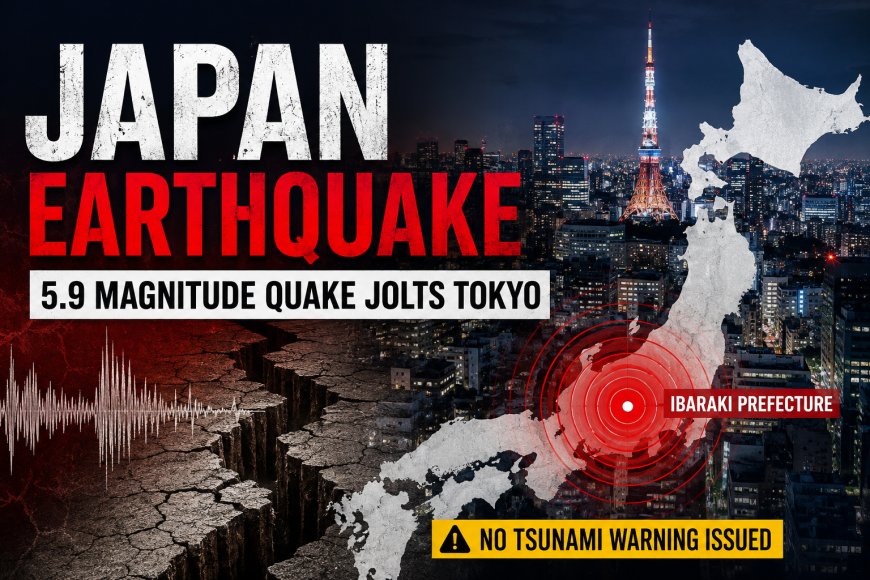
Japan Earthquake: 5.9 Quake Shakes Tokyo and Kanto
A japan earthquake measuring magnitude 5.9 struck southern Ibaraki Prefecture early Sunday, August 23, shaking Tokyo and a broad area of the Kanto region. The Japan Meteorological Agency said the quake occurred at about 2:00 a.m. local time at a depth of roughly 70 kilometers, with no tsunami threat reported after the event.
The strongest shaking reached lower 5 on Japan's seven-level seismic intensity scale. Tokyo's Adachi Ward was among the locations where lower-5 shaking was observed, while many other parts of the capital recorded intensity 4. The shaking was also reported across Ibaraki, Saitama, Chiba, Kanagawa, Tochigi, Gunma and parts of Fukushima.
For residents in the Tokyo metropolitan area, the most immediate question was whether the overnight tremor created a tsunami danger. Authorities said there was no concern about a tsunami from this earthquake, and early reports did not identify injuries or significant structural damage. Public broadcasters nevertheless advised people to remain calm, check their surroundings and watch for hazards caused by falling objects or damaged roads.
What happened in the Japan earthquake near Tokyo?
The earthquake was centered in southern Ibaraki Prefecture, north of Tokyo, at a depth of about 70 kilometers. Japan's monitoring agencies recorded a magnitude of 5.9 and a maximum seismic intensity of lower 5. The relatively deep location helps explain why the shaking was felt across a wide section of the Kanto region rather than being confined to communities immediately around the epicenter.
Japan's seismic-intensity scale measures how strongly the ground shakes at a particular location, rather than simply describing the overall energy released by an earthquake. A lower-5 reading means shaking can be strong enough for people to feel significant fear and for unsecured objects, dishes or books to fall. That distinction matters because a magnitude number alone does not tell residents how strongly their particular area experienced an earthquake.
Tokyo was among the areas affected. Japanese reporting showed that all 23 Tokyo wards experienced shaking, with some locations reaching intensity 4 and Adachi Ward recording lower-5 shaking. The event therefore became a significant overnight disruption for people across the capital even though the epicenter was outside Tokyo itself.
Was there a tsunami warning after the Tokyo earthquake?
No. Authorities reported that there was no tsunami concern following the earthquake. That is an important distinction for people near Japan's coastline because not every earthquake produces a tsunami; the risk depends heavily on factors such as the earthquake's location, depth and movement of the seafloor.
The earthquake's roughly 70-kilometer depth was also an important part of the event's characteristics. The epicenter was in southern Ibaraki rather than beneath the open ocean, and authorities did not issue a tsunami warning. Residents should still rely on official Japanese emergency information rather than social-media claims when assessing any later earthquake or tsunami risk.
The absence of a tsunami warning does not mean residents should ignore earthquake safety. After strong shaking, people can face secondary dangers from broken glass, unsecured furniture, damaged utilities and unstable structures. Emergency officials also urged caution about possible landslides, rockfalls and road cracks in areas where ground conditions may have been weakened by recent rain.
Which areas felt the strongest shaking?
The strongest reported intensity was lower 5, with locations in Ibaraki, Saitama and northwestern Chiba among the areas recording that level. Tokyo's Adachi Ward also reached lower 5, while much of the capital recorded intensity 4. The shaking extended across a much wider part of the Kanto region, demonstrating how an earthquake outside Tokyo can still be felt throughout the metropolitan area.
Other areas reporting intensity 4 included parts of Fukushima, Tochigi, Gunma and Kanagawa. Japanese earthquake information also listed intensity-3 observations in additional areas, showing that the event was felt well beyond the immediate epicentral region.
Early reports indicated that transportation remained broadly normal and that there were no immediate reports of major damage or injuries. Those assessments can change as authorities inspect infrastructure, so residents and travelers should treat early damage reports as preliminary rather than as a final assessment.
What should Tokyo residents do after the shaking?
Residents should first check for immediate hazards inside homes and workplaces, particularly fallen furniture, broken glass and damaged electrical or gas equipment. People should avoid entering visibly damaged buildings and should follow instructions from local authorities if an evacuation order or other emergency warning is issued.
It is also sensible to keep phones charged and monitor official emergency announcements because additional tremors can occur after an earthquake. Japan's emergency-information systems are designed to provide rapid updates, while local governments and broadcasters can issue area-specific instructions when conditions change.
The most important point from this event is that the earthquake affected a large population without producing a reported tsunami emergency or major initial damage. That combination makes accurate official updates especially important: widespread shaking can generate fear even when the immediate physical consequences remain limited.
What is known about damage and injuries?
Initial reports available after the earthquake said there were no reported injuries or structural damage. The Japan Meteorological Agency and Japanese emergency-information reporting confirmed the earthquake's magnitude, location, depth and maximum intensity, while news reports said there were no immediate reports of serious damage.
Because the earthquake happened during the early morning, residents were awakened by strong shaking and emergency alerts. Reports from Tokyo described buildings swaying for several seconds and mobile emergency alarms sounding as people were alerted to the event.
Damage assessments following an earthquake are often updated gradually. A lack of immediate reports should therefore be understood as the status of early reporting, not as a guarantee that every affected location has already been inspected.
Why is an earthquake in Ibaraki significant for Tokyo?
Ibaraki is part of the wider Kanto region surrounding Tokyo, so seismic activity there can produce noticeable shaking in the capital. The latest event illustrates why residents of Tokyo can experience strong shaking even when an earthquake's epicenter is outside the city's administrative boundaries.
Japan is one of the world's most earthquake-prone countries because it sits in a highly active tectonic region. That long-term geological setting means earthquake preparedness is a routine part of life in Japan rather than something reserved only for rare major disasters.
The current event should not be interpreted as proof that a larger earthquake is about to strike Tokyo. Earthquake scientists cannot reliably use one moderate earthquake to predict that a major quake will follow at a specific time or place. Residents should instead focus on official warnings and standard earthquake preparedness.
Japan earthquake today: what happens next?
Authorities will continue monitoring the area for additional seismic activity and updating earthquake information as more observations become available. The key confirmed facts remain the magnitude 5.9 event in southern Ibaraki, the approximately 70-kilometer depth, strong shaking across Kanto and the absence of a tsunami threat.
For people in Tokyo, Ibaraki, Saitama, Chiba and nearby prefectures, the safest approach is to follow official emergency information and avoid spreading unverified claims about casualties or damage. Reports can change quickly during the first hours after an earthquake, particularly when the event affects a densely populated metropolitan region.
As of the latest available reports, the earthquake caused significant shaking but no reported tsunami threat, injuries or major structural damage. Further official assessments will determine whether that initial picture changes as authorities complete inspections across the affected areas.
FAQ: Japan Earthquake and Tokyo Shaking
Was there an earthquake in Japan today?
Yes. A magnitude 5.9 earthquake struck southern Ibaraki Prefecture at around 2:00 a.m. on August 23, 2026, Japan local time. The earthquake was felt across the Kanto region, including Tokyo.
Did Tokyo experience the earthquake?
Yes. Tokyo experienced noticeable shaking, with Adachi Ward recording lower-5 intensity and many other Tokyo locations recording intensity 4.
Was there a tsunami warning?
No. Authorities reported that there was no tsunami concern following the earthquake.
How strong was the earthquake?
The earthquake had a magnitude of 5.9 and produced a maximum seismic intensity of lower 5 on Japan's seven-level intensity scale.
Were there injuries or major damage?
Initial reports said there were no reported injuries or structural damage. Because assessments can continue after an earthquake, later official updates should be checked for changes.
Where was the earthquake's epicenter?
The epicenter was in southern Ibaraki Prefecture, north of Tokyo, at a depth of approximately 70 kilometers.
What's Your Reaction?
 Like
0
 Dislike
0
 Love
0
 Funny
0
 Angry
0
 Sad
0
 Wow
0