Iran Strikes US Bases in Kuwait and UAE
Iran strikes US bases in Kuwait and UAE as air defenses intercept missiles and drones, while a deadly wedding strike adds to fears of wider escalation.
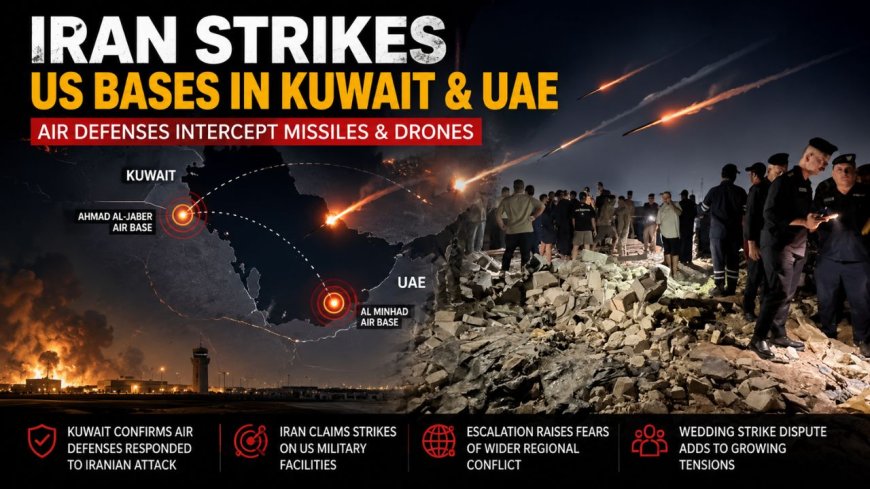
Iran struck U.S. military positions in Kuwait and the United Arab Emirates with missiles and drones on September 3, 2026, opening another dangerous phase in the widening U.S.-Iran conflict. Iran's army said it targeted American military infrastructure at Ahmad al-Jaber Air Base in Kuwait and Al Minhad Air Base in the UAE. Kuwait confirmed that its air defenses were responding to Iranian missiles and drones and condemned the attack as a violation of its sovereignty. The strikes are significant because they put U.S. military facilities inside key Gulf states directly in the line of fire.
Iranian military statements said missiles and attack drones hit satellite communications systems, equipment warehouses and fighter aircraft hangars at Ahmad al-Jaber, claiming damage to communications infrastructure and a hangar. Tehran also said it attacked U.S. troop positions and radar systems at Al Minhad in the UAE. Those damage claims remain Iranian assertions and should not be treated as independently verified assessments of the attacks. The UAE-related claim also came amid a broader series of Iranian attacks on U.S. facilities and American partners across the region.
The immediate concern is no longer limited to the battlefield inside Iran. Kuwait and the UAE are major U.S. security partners and host important American military infrastructure, making them strategically sensitive locations. Iran's decision to target facilities connected to the U.S. presence increases the risk that Gulf governments could face repeated attacks even while trying to avoid becoming direct participants in the conflict. Analysts have warned that Gulf states are increasingly exposed as Washington and Tehran use regional territory and military positions to impose costs on each other.
Why Iran Strikes US Bases in Kuwait and UAE Matter
The most important development is the changing geography of the conflict. Iran is not only responding to U.S. operations against targets inside Iran; it is also trying to demonstrate that American forces in the Gulf remain vulnerable. Kuwait's Ahmad al-Jaber Air Base and the UAE's Al Minhad Air Base are therefore more than individual military locations. They are part of the regional network that supports American operations and logistics, making them valuable pressure points for Tehran.
Kuwait's response also highlights the dilemma facing Gulf governments. The country said its air defenses were confronting hostile Iranian missiles and drones while its Foreign Ministry described the attacks as a direct threat to regional security and stability. That language shows that Kuwait views the attacks as an assault on its own sovereignty, even though the stated targets were U.S. military facilities. The same problem could become more serious if Iranian attacks continue against bases in countries that have not formally entered the conflict.
Was the Iranian Wedding Strike Caused by the US?
The wedding strike has become a major part of the escalation because Iran presented the deaths as evidence of civilian harm from recent American operations. U.S. Vice President JD Vance said Washington was investigating and initially expressed skepticism about whether the United States had struck the wedding. However, a Reuters review published September 3 found that weapons experts who examined verified photographs and video concluded the destruction was consistent with a direct hit from a U.S. munition rather than an Iranian air-defense missile.
The findings do not mean the U.S. government has formally acknowledged responsibility. The Pentagon and U.S. military investigation remained ongoing, and the precise circumstances surrounding the intended target and civilian deaths were still being examined. Reuters reported that five people were killed and nearly 70 wounded in the September 1 incident, while Iranian officials have provided broader casualty figures for the latest U.S. attacks. The distinction between independent evidence, Iranian claims and official U.S. findings is important when assessing the incident.
What Happens Next in the Gulf?
The immediate question is whether the attacks remain a limited exchange around U.S. bases or develop into a broader regional confrontation. The renewed fighting began after U.S. forces attacked Iranian military assets associated with operations around the Strait of Hormuz, ending an approximately month-long lull. Iran then expanded its retaliation to U.S. positions and allied territory across the region, increasing pressure on Washington and Gulf governments alike.
The Strait of Hormuz makes the escalation especially consequential. It is one of the world's most important energy corridors, and prolonged military activity around the Gulf can affect shipping, insurance costs and oil prices even when individual attacks cause limited physical damage. Reuters reported Brent crude moving above $96 a barrel during the latest escalation, illustrating how quickly military developments can create economic consequences beyond the immediate battlefield.
For Kuwait and the UAE, the central challenge is protecting national territory while maintaining relationships with Washington. For Iran, attacks on U.S. positions offer a way to retaliate without limiting the conflict to its own territory. For the United States, protecting bases and personnel across the Gulf now carries a greater risk of drawing additional regional governments into the confrontation. That makes the latest strikes important not simply as another exchange of missiles and drones, but as a test of whether the conflict can remain contained.
Frequently Asked Questions
Did Iran attack U.S. bases in Kuwait?
Yes. Iran's army said it launched missiles and drones against U.S. military facilities at Ahmad al-Jaber Air Base in Kuwait on September 3, 2026. Kuwait separately confirmed that its air defenses were responding to Iranian missile and drone attacks, although the full extent of damage reported by Iran has not been independently established.
Did Iran also target a U.S. base in the UAE?
Yes. Iran's army said its missiles and drones targeted U.S. troop positions and radar systems at Al Minhad Air Base in the United Arab Emirates. The claim was part of Iran's announcement describing its latest retaliatory operation, but the available reporting does not independently verify every Iranian claim about damage at the facility.
Who was responsible for the Iranian wedding strike?
The United States has not formally accepted responsibility, and its military investigation remains ongoing. However, Reuters reported that weapons experts reviewing verified evidence found the destruction consistent with a direct hit from a U.S. munition, rather than an Iranian air-defense missile.
What's Your Reaction?
 Like
0
 Dislike
0
 Love
0
 Funny
0
 Angry
0
 Sad
0
 Wow
0