Florida Primary Results: Donalds, Jolly Win Governor Nominations
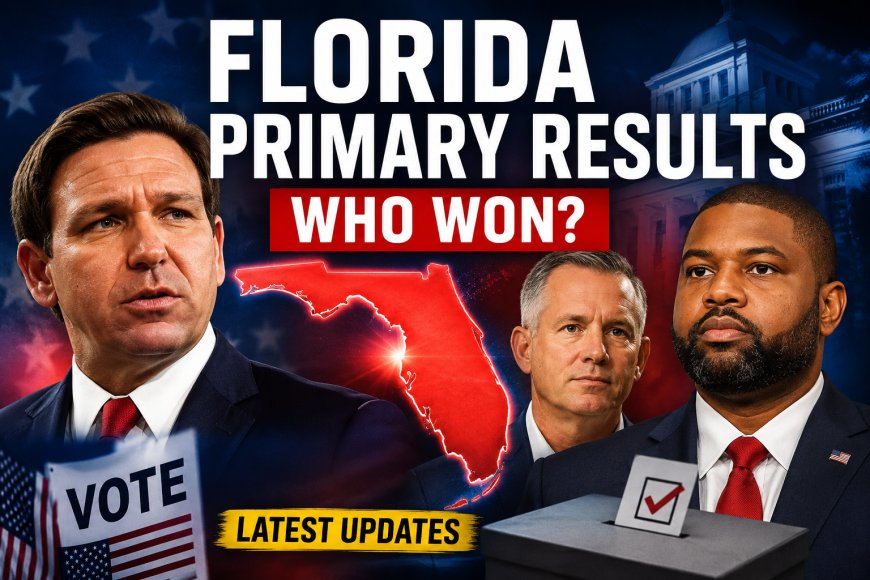
Florida primary results are in: Byron Donalds and David Jolly won governor nominations, setting up a November race to replace Ron DeSantis.
Florida Primary Results: Donalds, Jolly Win Governor Nominations
Florida primary results have set the November governor race: Republican U.S. Rep. Byron Donalds won the GOP nomination, while former U.S. Rep. David Jolly won the Democratic nomination on August 18, setting up a contest to succeed term-limited Gov. Ron DeSantis. With nearly all expected votes reported, Donalds was at about 48% in the Republican contest and Jolly at about 61% in the Democratic race, according to election-night reporting. The general election is now headed toward a Donalds-Jolly matchup.
The result is significant because Florida's next governor will inherit a state shaped politically by DeSantis, who cannot seek another consecutive term because of term limits. The primary also revealed a more complicated political picture: while Republicans remain dominant statewide, Democrats produced an unexpected Senate result that gives the November campaign a second major storyline.
Florida primary results: Who won the governor nominations?
Byron Donalds emerged as the Republican nominee after defeating a crowded field that included Lt. Gov. Jay Collins and other candidates. Donalds entered the primary with the backing of President Donald Trump and ultimately won with roughly 48% of the vote, according to election-night results reported by multiple outlets. Jay Collins finished well behind, while James Fishback also drew attention during the campaign but did not seriously threaten Donalds' lead.
David Jolly won the Democratic nomination with roughly 61% of the vote. Jolly is a former Republican congressman who later joined the Democratic Party, giving him a political profile that differs sharply from the progressive candidates who have gained attention in other states. His campaign has emphasized a more moderate approach designed to appeal beyond the traditional Democratic base.
The two nominees will now turn from primary voters to the broader electorate. The November race will determine who succeeds DeSantis and controls the governor's office after his departure.
Why Byron Donalds' win matters for Florida Republicans
Donalds' victory reinforces the strength of the Trump-aligned wing of the Florida Republican Party. His endorsement from Trump was an important part of the primary story, but Donalds also presented himself as a candidate capable of leading the state beyond the DeSantis era. His campaign highlighted issues including affordability and property taxes while the primary field debated the direction of the state's Republican coalition.
The November race could also carry historical significance. If Donalds wins, he would become Florida's first Black governor. That possibility gives the contest importance beyond the normal succession battle and places Donalds at the center of a national political story.
Still, the primary result should not be interpreted as a prediction of the general election. Florida has become one of the country's strongest Republican states, and recent statewide Republican victories give Donalds an advantage. But Jolly's moderate positioning gives Democrats a candidate who can attempt to compete for independents and voters dissatisfied with the direction of state government.
David Jolly changes the shape of the Democratic strategy
Jolly's nomination represents a different strategy from the progressive campaigns that have attracted attention elsewhere in the Democratic Party. His political history as a former Republican gives him an unusual biography for a Democratic nominee, and his campaign has sought to make the governor's race about issues that can reach voters outside the Democratic base.
That approach matters in Florida because Democrats face a difficult statewide environment. The party has not won a Florida gubernatorial election since 1994, making the November contest a substantial uphill challenge even before the general-election campaign begins. Jolly therefore needs to turn his primary victory into a broader coalition rather than simply consolidating Democratic voters.
The central question for Democrats will be whether Jolly can convert dissatisfaction with costs, housing and state policy into enough support among independents and moderate Republicans to overcome the state's Republican advantage.
Florida's Senate primary produced the night's biggest Democratic surprise
The governor's race was not the only major result from Tuesday. Democratic state Rep. Angie Nixon defeated former Army Lt. Col. Alexander Vindman in the Democratic primary for U.S. Senate, an upset that reshaped another important Florida race.
Nixon won about 56% of the Democratic vote, according to election-night reporting, despite Vindman's much stronger fundraising operation. Nixon will now face Republican Sen. Ashley Moody in November. The Senate contest is expected to be difficult for Democrats because Florida's statewide electorate has moved strongly toward Republicans in recent election cycles.
The Nixon result nevertheless matters because it demonstrates that Florida Democrats cannot be described entirely through the moderate gubernatorial contest. Voters simultaneously selected Jolly, a centrist-leaning Democrat with a former Republican background, and Nixon, a progressive Democratic socialist, for two of the state's most prominent November races.
What other Florida primary results stood out?
Several congressional contests added to the significance of the primary. Republican Rep. Cory Mills lost his primary in Florida's 7th Congressional District to former television news anchor Ryan Elijah. With nearly all votes counted in that contest, Elijah held a clear advantage, ending Mills' bid for another term.
Democratic former House leader Debbie Wasserman Schultz also won her primary in a redrawn district, while Democratic Rep. Jared Moskowitz survived his primary challenge. The new congressional map has altered the political landscape in several parts of Florida and is expected to make the state's House delegation even more favorable to Republicans.
Those results mean the August 18 election was about more than selecting a governor. Florida voters also determined which incumbents survived, which challengers broke through and which candidates will carry their parties into the November midterms.
What happens after the Florida primaries?
The next phase is the general-election campaign. Byron Donalds and David Jolly will compete for governor, while Ashley Moody and Angie Nixon will face each other for a U.S. Senate seat. Congressional nominees will also begin preparing for November 3, when Florida voters return to the polls for the general election.
The Florida Department of State lists August 18 as the 2026 primary election date and provides official election information and results resources. County-level figures can continue to be updated or certified after election night, so readers looking for precinct-specific totals should rely on the Florida Division of Elections and their county Supervisor of Elections.
The immediate political takeaway is clear: Donalds has secured the Republican path to succeed DeSantis, Jolly has secured the Democratic nomination, and Florida's November races now have their principal matchups. But the Senate upset involving Nixon shows that the state's political story is not entirely settled by the Republican dominance visible in statewide polling and recent elections.
Frequently Asked Questions About Florida's Primary
Who won the Florida governor primary?
Byron Donalds won the Republican primary for Florida governor, while David Jolly won the Democratic primary. They will face each other in the November general election to replace term-limited Gov. Ron DeSantis.
Who is running for governor of Florida in November?
Republican Byron Donalds and Democrat David Jolly are the major-party nominees for Florida governor following their August 18 primary victories.
Did Ron DeSantis win the Florida governor primary?
No. Ron DeSantis is the sitting Florida governor, but he is term-limited and was not a candidate in the 2026 governor primary.
Who won the Florida Republican governor primary?
Byron Donalds won the Republican governor primary with roughly 48% of the vote based on election-night reporting with nearly all expected votes counted.
Who won the Florida Democratic Senate primary?
State Rep. Angie Nixon won the Democratic Senate primary and will face Republican Sen. Ashley Moody in the November general election.
When is the Florida general election?
Florida's 2026 general election is scheduled for November 3. The governor and Senate nominees selected in the August primary will compete in those November contests.
What's Your Reaction?
 Like
0
 Dislike
0
 Love
0
 Funny
0
 Angry
0
 Sad
0
 Wow
0