FDA Class I Egg Recall: Brands, Codes and States Affected
FDA Class I egg recall affects nearly 19.1 million eggs over Salmonella risk. See recalled brands, carton codes, dates and affected states.
FDA Class I Egg Recall: Brands, Codes and States Affected
The FDA Class I egg recall now covers nearly 19.1 million individual eggs recalled by Midwest Poultry Services because of possible Salmonella Enteritidis contamination. The U.S. Food and Drug Administration has placed the recall in its highest-risk category, meaning the agency considers exposure to the affected products capable of causing serious health consequences or death.
The recall was originally announced by Midwest Poultry Services on July 22 after testing at two Texas farms raised concerns about Salmonella. Federal investigators later connected the recalled eggs to a multistate outbreak involving 98 reported illnesses in 17 states and 26 hospitalizations. No deaths had been reported in the FDA's July 24 outbreak update.
What eggs are included in the FDA Class I egg recall?
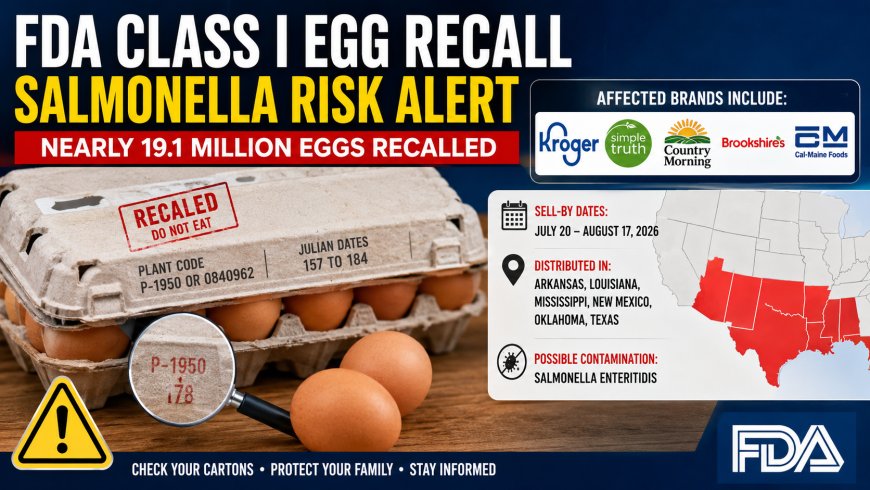
The affected products are white shell eggs and brown cage-free shell eggs produced at farms in Texas between June 6 and July 3, 2026. They were distributed through retail and food-service channels, with confirmed product distribution in Arkansas, Louisiana, Mississippi, New Mexico, Oklahoma and Texas. The FDA has cautioned that recalled products could have reached additional locations.
The eggs were sold in several package sizes, ranging from six-count cartons to larger packages. Brands identified by federal health authorities include Kroger, Simple Truth, Brookshire's, Cal-Maine and Country Morning. Because the same production source supplied different labels, consumers should rely on the carton coding rather than assuming that a brand name alone determines whether an egg is recalled.
The recall covers eggs with sell-by or best-by dates from July 20 through August 17, 2026. The federal identification information is more specific than the date alone: affected cartons carry plant code P-1950 or 0840962 and a Julian date from 157 through 184 on the side of the carton.
How can shoppers identify recalled eggs?
The carton code is the most useful check for consumers who still have eggs at home. Shoppers should look at the date-coding ink printed on the side of the carton and determine whether it shows either P-1950 or 0840962, together with a Julian production date between 157 and 184. The FDA says only products matching those identification details are included in this recall.
A Julian date is a numerical day-of-year code. For example, a number in the 150s represents a date in early June, while a number in the 180s falls in late June or early July. Consumers do not need to calculate the date themselves if the carton already contains the FDA-listed code range, but understanding the format can help when checking older packaging.
Consumers should not eat eggs that match the recalled identification information. The CDC recommends throwing recalled eggs away or returning them to the place of purchase. People should also wash and sanitize surfaces, utensils and other items that may have touched the recalled eggs, using hot soapy water or a dishwasher.
Why did the FDA give the egg recall a Class I designation?
A Class I designation is the FDA's most serious recall classification. It is used when there is a reasonable probability that exposure to a recalled product could cause serious adverse health consequences or death. The classification therefore signals the potential severity of the hazard; it does not mean that every person who consumed the recalled eggs will become seriously ill.
In this case, the classification follows evidence gathered during a broader Salmonella investigation. The FDA says epidemiological, laboratory and traceback information identified Midwest Poultry Services shell eggs as a likely source of illnesses. Testing performed by the company at its Texas farms also found Salmonella, and some samples matched the outbreak strain through whole-genome sequencing performed by a third-party laboratory.
There is an important distinction in the federal findings: Midwest Poultry Services has been identified as a likely source, but the FDA says the producer does not account for every illness in the outbreak. Additional investigation is continuing to determine whether other sources contributed to the reported cases. That distinction matters because a Class I recall should not be interpreted as proof that every Salmonella case currently under investigation came from one producer.
How serious is the Salmonella outbreak linked to the eggs?
The FDA's July 24 outbreak update reported 98 people infected with the outbreak strain across 17 states. Of the reported cases, 26 people had been hospitalized, while no deaths had been reported. Illness onset dates ranged from November 21, 2025, through June 30, 2026, showing that the investigation covers infections occurring over a much longer period than the July recall itself.
The federal investigation also found a strong egg-consumption signal among interviewed patients. Forty of 44 people for whom food-history information was available reported eating eggs before becoming ill, equivalent to 91 percent of that group. Investigators used that epidemiological information alongside laboratory and traceback evidence when identifying the recalled eggs as a likely source.
Salmonella commonly causes diarrhea, fever and stomach cramps. Children younger than 5, adults 65 and older, and people with weakened immune systems can face a greater risk of severe illness or hospitalization. The CDC advises medical attention for warning signs such as bloody diarrhea, prolonged diarrhea, a fever above 102 degrees Fahrenheit, repeated vomiting that prevents fluid intake or signs of dehydration.
Which states received the recalled eggs?
The FDA has confirmed distribution of the recalled products in Arkansas, Louisiana, Mississippi, New Mexico, Oklahoma and Texas. The eggs moved through both retail and food-service channels, so consumers should not assume that the absence of a particular supermarket from a news report means the product could not have reached their area.
Kroger stores in Texas and Louisiana carried affected eggs, while Brookshire Grocery stores carried recalled products in Texas, Oklahoma, Arkansas and Louisiana. Smaller retail and food-service outlets in the affected states also received products. Federal investigators have warned that distribution may have extended beyond the states currently confirmed in the FDA's records.
This is why checking the physical carton is more reliable than relying only on a store name. A recalled egg may be sold under a different brand or through a food-service channel, while the plant code and Julian date provide the specific identification information listed by federal authorities.
What should consumers do with recalled eggs?
Consumers who find eggs matching the recalled codes should not eat them, even if the eggs look or smell normal. The safest action is to discard the product or return it to the retailer for a refund, following the FDA and CDC guidance. Businesses that have recalled eggs in inventory should not sell or serve them.
After handling recalled eggs, consumers should clean any surfaces or equipment that may have come into contact with the shells or contents. The CDC specifically recommends hot soapy water or a dishwasher for affected items. Cleaning is important because Salmonella can spread from contaminated food or surfaces to other foods and household areas.
Anyone who develops symptoms after possible exposure should monitor their condition and contact a health professional when symptoms are severe or persistent. Federal guidance highlights bloody diarrhea, dehydration, significant fever, prolonged diarrhea and severe vomiting as reasons to seek medical care promptly.
What happens next in the egg recall investigation?
The FDA and CDC investigation remains active. Federal investigators have established that the recalled Midwest Poultry Services eggs are a likely source of illnesses, but they have also made clear that the producer does not explain every case in the broader outbreak. That means the investigation could produce additional findings about other possible sources or affected products.
For consumers, the immediate priority is narrower: identify any recalled eggs still in the refrigerator, do not eat them, and clean surfaces that may have been exposed. The FDA's Class I designation makes the recall particularly important because it reflects the agency's assessment that exposure to the affected products could lead to serious health consequences or death.
As of the latest federal information available for this report, the outbreak stands at 98 illnesses, 26 hospitalizations and no reported deaths. Further updates from the FDA and CDC could change the case count or identify additional information as investigators continue their work.
Frequently Asked Questions About the Egg Recall
Which eggs are recalled in August 2026?
The recalled products are white shell eggs and brown cage-free shell eggs from Midwest Poultry Services produced in Texas. Affected cartons carry plant code P-1950 or 0840962 and Julian dates 157 through 184, with sell-by or best-by dates from July 20 through August 17, 2026.
What brands of eggs are included in the recall?
Federal information identifies brands including Kroger, Simple Truth, Brookshire's, Cal-Maine and Country Morning among the recalled products. Consumers should check the carton codes and Julian dates rather than relying on the brand name alone.
How many eggs were recalled?
Midwest Poultry Services recalled 1,589,577 dozen shell eggs, which is approximately 19.1 million individual eggs. The recall covers white shell and brown cage-free shell eggs produced at Texas farms.
What does Class I mean in an FDA recall?
Class I is the FDA's highest-risk recall classification. It applies when there is a reasonable probability that using or being exposed to a violative product could cause serious adverse health consequences or death.
What should I do if I ate recalled eggs?
Do not eat any remaining recalled eggs and clean surfaces that may have contacted them. Monitor for Salmonella symptoms such as diarrhea, fever and stomach cramps, and seek medical care promptly for severe symptoms such as bloody diarrhea, significant dehydration, persistent diarrhea, high fever or repeated vomiting.
How many people have been sickened by the Salmonella outbreak?
The FDA reported 98 illnesses across 17 states, including 26 hospitalizations and no deaths, in its July 24 outbreak update. Investigators said Midwest Poultry Services eggs were a likely source but did not account for all illnesses in the outbreak.
What's Your Reaction?
 Like
0
 Dislike
0
 Love
0
 Funny
0
 Angry
0
 Sad
0
 Wow
0