Canadian Businesses Adapt as CUSMA Tensions Rise - Bio Points News
Trade uncertainty under Donald Trump’s administration pushed Canadian businesses to rethink strategy, adapt supply chains, and boost local production.
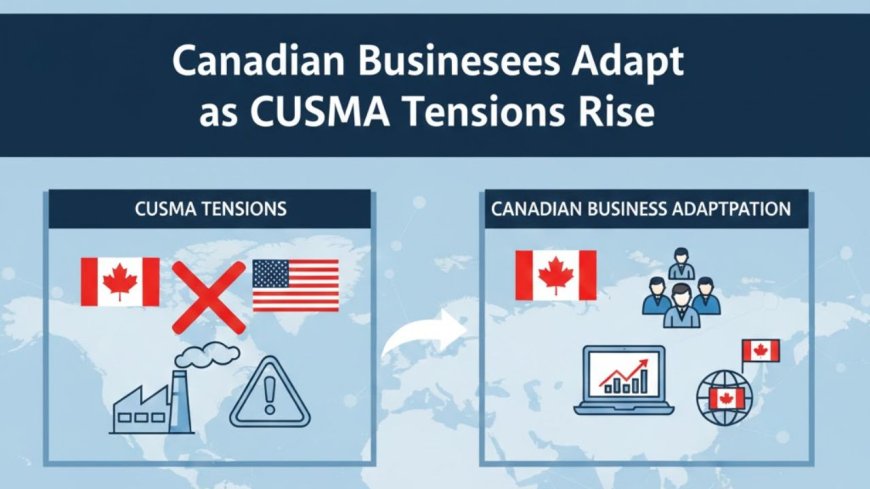
Trade tensions between the United States and Canada have once again highlighted how political decisions can reshape business strategies. During Donald Trump’s administration, the threat to withdraw from the Canada-U.S.-Mexico Agreement (CUSMA) created uncertainty across Canadian industries, forcing many entrepreneurs to rethink how they operate and grow.
Trade Threats Shake Business Confidence
Business leaders in Canada became concerned when the US administration signaled it could exit CUSMA, the core trade framework linking Canada, the United States, and Mexico. The agreement supports billions of dollars in cross-border trade each year, making stability critical for manufacturers, exporters, and small businesses alike.
Alongside these threats, tariffs imposed during the same period increased costs for Canadian firms, particularly those dependent on US supply chains.
Economic Impact and Job Concerns
The uncertainty surrounding trade policy had real economic consequences. Tariffs on goods such as steel and aluminum raised production expenses and reduced competitiveness for some companies. In several sectors, businesses reported layoffs and reduced investment plans as they tried to manage higher costs and unpredictable market conditions.
Industry groups warned that continued instability could weaken long-term growth and damage investor confidence.
How Canadian Entrepreneurs Responded
Despite these challenges, some Canadian businesses chose adaptation over retreat. Entrepreneurs began sourcing more materials locally to reduce reliance on US imports. Others expanded domestic manufacturing capacity, aiming to serve Canadian customers and diversify away from export-heavy models.
This shift helped certain firms stabilize operations, protect jobs, and build resilience against future trade disruptions.
Understanding CUSMA
CUSMA replaced the long-standing NAFTA agreement and was designed to modernize trade rules between Canada, the US, and Mexico. It covers manufacturing, agriculture, digital trade, and labor standards. Any threat to its stability naturally creates concern, as countless supply chains depend on its rules.
Past trade disputes underlined how quickly policy changes can ripple through interconnected economies.
Recent Developments
While the US ultimately did not withdraw from CUSMA, the episode left a lasting mark on Canadian business thinking. Companies have become more cautious and more focused on building flexible supply chains. Many experts say this strategic shift toward local sourcing and domestic growth could help Canada weather future trade challenges more effectively.
The threat to CUSMA served as a wake-up call for Canadian businesses. While trade tensions caused disruption and uncertainty, they also encouraged innovation and adaptation. By strengthening local supply chains and expanding domestic production, some Canadian entrepreneurs turned a period of risk into an opportunity for long-term resilience.
What's Your Reaction?
 Like
0
 Dislike
0
 Love
0
 Funny
0
 Angry
0
 Sad
0
 Wow
0