Trump Signals Uncertainty Over USMCA Future as Key Hearings Begin - Bio Points News
President Trump has raised doubts about renewing the USMCA trade deal with Canada and Mexico, prompting U.S. business and agriculture groups to urge its extension during ongoing Washington hearings. The agreement faces a critical review in 2026.
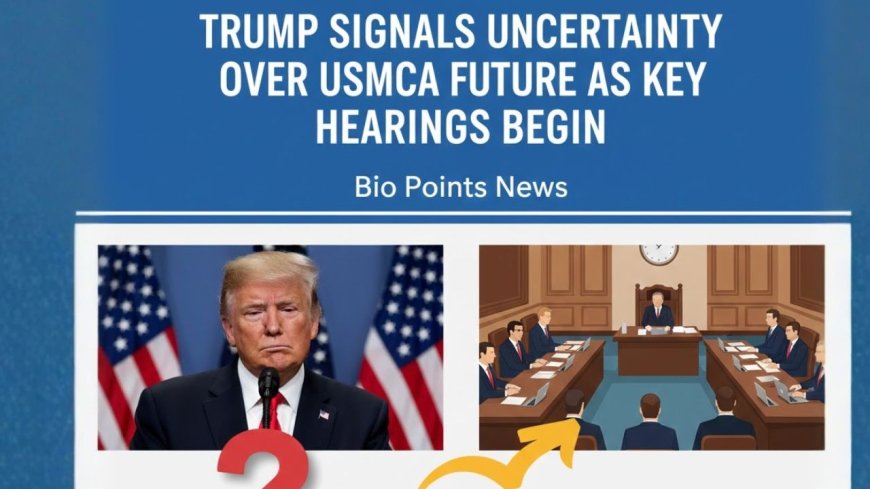
The future of the United States-Mexico-Canada Agreement (USMCA) is under scrutiny as President Donald Trump questions whether the deal benefits America fairly. During recent statements, Trump accused Canada and Mexico of taking advantage of the U.S., sparking concerns about the trade pact's renewal. This week, hearings in Washington have brought together agriculture and business leaders who are pushing to preserve the agreement, highlighting its role in supporting jobs and economic growth across North America.
Background of the USMCA
The USMCA replaced the North American Free Trade Agreement (NAFTA) in 2020, during Trump's first term. It was designed to modernize trade rules, strengthen labor protections, and boost manufacturing in the region. The deal covers nearly $2 trillion in annual trade and allows most goods to move tariff-free between the three countries if they meet specific origin requirements.
A key feature is the six-year joint review, set for July 1, 2026. At that point, the U.S., Canada, and Mexico must decide whether to extend the agreement for another 16 years, renegotiate terms, or let it expire in 2036. If any country opposes the extension, annual meetings would continue until a resolution or expiration.
Recent Developments and Hearings
Hearings organized by the Office of the U.S. Trade Representative (USTR) began on December 3 and run through December 5, 2025. Over 150 stakeholders, including farmers, manufacturers, and policy experts, are testifying. Many have criticized Trump's tariffs on Canadian and Mexican goods, arguing they harm American exporters.
For instance, representatives from the agriculture sector warned that failing to renew the USMCA could devastate industries reliant on cross-border markets. One corn grower noted that Mexico buys billions in U.S. corn annually, and prolonged tariff battles would be unsustainable. Business groups, like the U.S. Chamber of Commerce, called the tariffs a violation of the deal's commitment to duty-free trade and urged their removal.
U.S. Trade Representative Jamieson Greer told reporters that Trump could decide to withdraw as early as next year. Greer mentioned discussions about splitting the agreement into separate bilateral deals with Canada and Mexico. Trump himself said the USMCA might expire or be replaced with new arrangements.
Trump's Tariffs and Regional Tensions
Since early 2025, Trump has imposed 25% tariffs on many imports from Canada and Mexico, citing issues like migration and drug trafficking. While USMCA-compliant goods are largely exempt, the measures have strained relations. Canada and Mexico have threatened retaliation, and leaders like Canadian Prime Minister Mark Carney have stressed the need for stable trade.
Despite the tensions, the deal has proven resilient. It has increased U.S. exports to Mexico by over $10 billion and to Canada by nearly $8 billion in recent years. Integrated supply chains in autos, energy, and agriculture continue to benefit all three economies.
The USMCA has delivered real economic gains for American workers and businesses, but Trump's skepticism and ongoing tariffs create real uncertainty ahead of the 2026 review. Extending the agreement without major disruptions would protect jobs and keep costs down for consumers. As hearings wrap up, the input from stakeholders could influence the administration's final stance, reminding leaders that strong North American ties remain essential for competitiveness in a global economy.
What's Your Reaction?
 Like
0
 Dislike
0
 Love
0
 Funny
0
 Angry
0
 Sad
0
 Wow
0