Trump News Today: Carney Trade Fight Raises New Questions
Trump news today: Mark Carney escalates the Canada trade dispute as tariffs hit, while Trump faces pressure over Iran and seeks talks with Kim Jong Un.
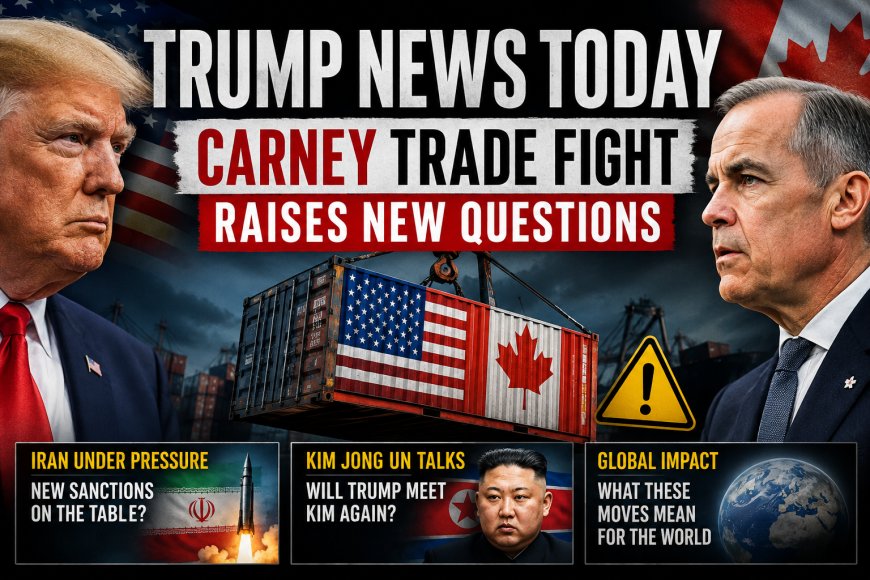
Trump news today is being dominated by a sharp escalation in the U.S.-Canada trade dispute, with President Donald Trump and Canadian Prime Minister Mark Carney now publicly confronting each other after negotiations collapsed. The dispute has moved beyond difficult diplomacy: new U.S. tariffs on Canadian goods are in effect, Canada has announced retaliatory measures, and the breakdown is raising broader questions about Trump's pressure-based approach to allies. Reuters reports that Canada plans dollar-for-dollar retaliation against U.S. goods beginning September 8, after Washington imposed 50% tariffs on about $20 billion worth of Canadian exports. Reuters and other current reports confirm that the talks ended without an agreement.
Why Trump and Mark Carney are now in a trade fight
The immediate dispute centers on the failure of recent U.S.-Canada negotiations. After several days of signs that Washington and Ottawa were moving toward an agreement, the talks broke down shortly before the deadline for the new U.S. tariffs. Canadian officials said the final U.S. demands were unacceptable, while the Trump administration blamed Canada for failing to accept terms that Washington considered necessary for a deal.
The result is a much more serious confrontation between two countries whose economies are deeply connected. The United States and Canada conduct enormous amounts of cross-border trade, while companies and workers in industries such as steel, agriculture, manufacturing and energy depend heavily on that relationship. The current dispute therefore has implications beyond the political argument between Trump and Carney.
Carney has taken a notably firm public position. He has promised to protect Canadian workers and businesses and announced reciprocal measures against U.S. products. Reuters reported that Canada's retaliation will affect sectors including steel, electronics, dairy and other goods, with the new measures scheduled to begin September 8.
What Trump said after the negotiations collapsed
Trump responded publicly after Carney announced the Canadian retaliation. In a social-media post, Trump accused Canada of benefiting from its relationship with the United States while imposing tariffs on American farmers. The comments marked a further deterioration in the tone between the two governments.
The significance is not simply the language being used. The breakdown demonstrates how quickly negotiations can move from cooperation to confrontation when the Trump administration uses tariffs as leverage. Earlier this month, Trump had temporarily delayed the new Canadian tariffs while both sides worked toward an agreement. At that stage, Carney said progress had been made, although important differences remained.
That temporary optimism has now disappeared. The latest developments show that the dispute remains highly fluid, and another round of negotiations could still occur. For businesses, however, the immediate concern is that tariffs and retaliation create additional costs and uncertainty.
Why the Canada dispute matters beyond tariffs
The deeper story is the pressure this confrontation puts on Trump's broader foreign-policy and economic strategy. The administration has increasingly relied on tariffs, sanctions and economic pressure to persuade other governments to accept U.S. demands. Canada is particularly important because it is not a distant adversary; it is one of America's closest economic and security partners.
That makes the failed negotiations a useful test of whether aggressive tariff pressure can deliver fast agreements even when Washington is dealing with an established ally. Current reporting shows that the collapse has already raised concerns about the future of the wider U.S.-Mexico-Canada trade framework.
The consequences could also spread to consumers and companies. When tariffs increase the cost of imported products, businesses have to decide whether to absorb those costs, change suppliers or pass some of the increase to customers. Retaliatory tariffs can create another layer of pressure by making American exports more expensive in Canada.
Trump is also facing a major Iran test
The Canada confrontation is only one part of a much larger foreign-policy challenge. Trump is simultaneously pursuing an intensified economic campaign against Iran as tensions surrounding the Strait of Hormuz remain high.
Iranian security chief Mohsen Rezaei has warned neighboring countries against joining U.S.-led economic measures and threatened consequences for countries that participate. The warnings come as Washington considers additional sanctions and economic pressure on Tehran.
There is also a diplomatic dimension. Pakistan's army chief, Field Marshal Asim Munir, is scheduled to visit Tehran on Monday as Pakistan attempts to support regional diplomacy. Reuters reports that the visit comes amid heightened tensions over Trump's threats of additional sanctions and the continuing disruption around the Strait of Hormuz.
This creates a complicated strategic picture for the Trump administration. Washington is applying economic pressure against Iran while simultaneously dealing with trade tensions with Canada and other allies. Each dispute has different causes, but together they place significant demands on U.S. diplomacy.
Why Kim Jong Un is part of the latest Trump story
Trump is also attempting to reopen a diplomatic channel with North Korean leader Kim Jong Un. Trump has said he expects to meet Kim again this year, although neither the White House nor Pyongyang has confirmed a new summit.
Reuters reported that Trump has expressed interest in renewed engagement, while North Korea has responded cautiously and continues to demand significant changes in U.S. policy. The two leaders previously held high-profile meetings during Trump's first term, but those negotiations failed to produce an agreement limiting North Korea's nuclear weapons program.
Trump has also ordered a reduction in U.S.-South Korea military exercises. The decision has attracted attention because Washington's military relationship with Seoul is a central part of the U.S. security position in East Asia. North Korea has not treated the reduction as sufficient to remove its objections, while South Korean officials have faced questions about the future direction of the alliance.
The North Korea development therefore adds another layer to the current Trump foreign-policy picture: economic pressure against Iran, a worsening trade dispute with Canada and an attempt to reopen personal diplomacy with Kim Jong Un.
What happens next in the Trump-Carney dispute?
The immediate deadline to watch is September 8, when Canada's announced dollar-for-dollar retaliatory tariffs are scheduled to take effect. Until then, both governments have an opportunity to return to negotiations, although the public confrontation makes a quick breakthrough more difficult.
The economic impact will depend partly on how long the tariffs remain in place and whether companies can find alternatives. The political impact could be broader. Canada is demonstrating that it is prepared to resist Washington rather than accept an agreement it considers unfair, while the Trump administration is signaling that it remains willing to use tariffs as a negotiating weapon.
That makes the Canada dispute one of the clearest tests yet of Trump's current trade strategy. The question is no longer simply whether tariffs can force another government to negotiate. It is whether sustained economic pressure can produce a durable agreement without creating a larger political and economic conflict with a key U.S. ally.
What is the bigger picture in today's Trump news?
The most important development is that several major Trump foreign-policy stories are now moving at the same time. The Canada dispute has entered a retaliatory phase; pressure on Iran is intensifying; and Trump is seeking another meeting with Kim Jong Un.
For readers following Trump news today, the common thread is the administration's reliance on pressure and direct presidential diplomacy to pursue U.S. objectives. Whether that approach produces agreements or generates longer-running disputes will become clearer as the Canada tariff deadline approaches, Iran negotiations evolve and Washington tests whether diplomacy with Pyongyang can be restarted.
For now, the Canada confrontation is the clearest immediate development. Carney has rejected Washington's terms and promised retaliation, while Trump has publicly attacked Canada's position. With tariffs already in place and another round scheduled for September, the dispute is no longer just a negotiation—it is an active trade conflict with consequences for both countries.
What's Your Reaction?
 Like
0
 Dislike
0
 Love
0
 Funny
0
 Angry
0
 Sad
0
 Wow
0