Narayana Murthy’s 72-Hour Workweek Remark Rekindles National Debate - Bio Points New
Infosys co-founder Narayana Murthy’s call for a 72-hour workweek sparks debate across India, raising concerns about labor laws, health, and workplace culture.
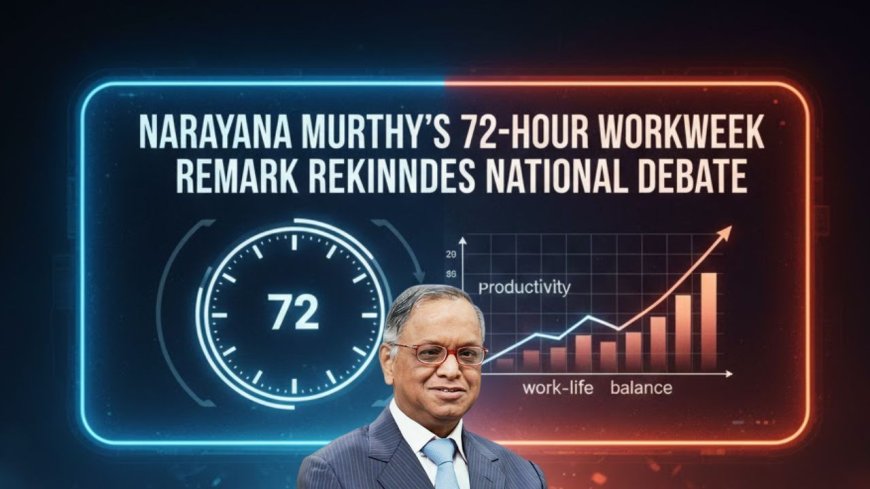
Narayana Murthy’s 72-Hour Workweek Remark Rekindles National Debate
Infosys co-founder N. R. Narayana Murthy has once again stirred nationwide discussion after reiterating his belief that young professionals should be willing to work a 72-hour week to boost India’s productivity. His remarks, referencing China’s controversial “996” culture, have drawn strong reactions from industry experts, employees, health professionals, and labor-rights advocates.
Murthy’s Statement and Its Implications
Murthy stated that India needs a more committed workforce to stay globally competitive and argued that long working hours could accelerate economic progress. He pointed to China’s previously common “996” schedule — 9 a.m. to 9 p.m., six days a week — as an example of extreme dedication that contributed to China's rapid growth.
However, China’s 996 practice has faced heavy criticism for years and has been discouraged by Chinese authorities due to health concerns and worker exploitation issues. This contrast has fueled further debate in India about whether long hours truly lead to sustainable progress.
Public Reaction and Criticism
Murthy’s comments triggered widespread discussion across social media and news platforms. Many professionals argued that promoting 72-hour workweeks disregards the growing global emphasis on work-life balance and mental health. Critics pointed out that burnout, reduced creativity, and declining job satisfaction are well-documented outcomes of excessive working hours.
Health experts also note that extended weekly hours increase the risk of cardiovascular disease, stress disorders, and overall reduced well-being. Younger workers, especially in the tech industry, expressed concerns that such expectations normalize unhealthy workplace culture.
India’s Labor Law Framework
Under India’s current labor regulations, the standard workweek is capped at 48 hours, with overtime permitted only under specific conditions. A 72-hour workweek is far beyond what the law defines as acceptable for regular employment. This legal reality has intensified scrutiny of Murthy’s remarks, raising questions about feasibility, enforcement, and ethics.
Background: The 996 Debate
China’s 996 model became globally known through major tech companies, where employees routinely worked 72 hours per week. Over time, employee pushback, lawsuits, and government interventions led to public acknowledgment that the practice violates labor rules. By contrast, India has seen a gradual movement toward flexible and hybrid working styles, particularly after the pandemic, making Murthy’s suggestion feel out of step with current workplace trends.
Recent Developments
Interestingly, some reports suggest that companies like Infosys have implemented internal monitoring systems that alert employees and HR when daily work hours exceed recommended limits. This is perceived as contradictory to Murthy’s personal stance, though he is no longer involved in day-to-day management.
Meanwhile, several global studies show that shorter or flexible workweeks — such as four-day models — can increase productivity while improving employee wellbeing. These findings further challenge the idea that longer hours necessarily lead to better outcomes. Narayana Murthy’s renewed call for a 72-hour workweek has revived an important conversation about the balance between economic ambition and employee well-being. While his intentions focus on national progress, the broader response highlights modern expectations around fair labor practices, health, and sustainable productivity. As India’s workforce evolves, the debate underscores a crucial question: what kind of work culture will truly drive long-term growth?
What's Your Reaction?
 Like
0
 Dislike
0
 Love
0
 Funny
0
 Angry
0
 Sad
0
 Wow
0