Israeli Reservists Demand Gaza Ceasefire as Hostage Crisis Deepens. Bio point news
Over 12,000 Israeli reservists, including senior commanders, are calling for an immediate Gaza ceasefire and hostage release deal. Growing dissent challenges Netanyahu’s war policy.
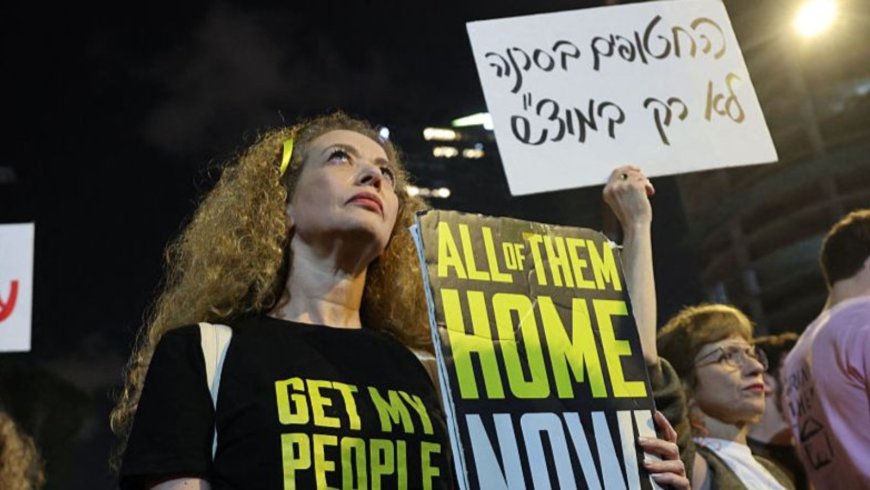
Israeli Reservists Pressure Netanyahu for Gaza Ceasefire: ‘Every Moment of Delay Is Shameful’
As Israel’s ongoing war in Gaza extends into its 18th month, a powerful movement is rising from within the country itself — not from protesters in the streets, but from the very people who once served on the front lines. Thousands of Israeli military reservists are now openly demanding a ceasefire, urging Prime Minister Benjamin Netanyahu’s government to change course and prioritize the return of hostages held in Gaza over continued military action.
Growing Dissent Among Israeli Reservists
In recent weeks, over 12,000 reservists from all branches of the Israeli military — including elite combat and intelligence units — have signed open letters calling for an immediate ceasefire and the urgent negotiation of a hostage release deal with Hamas. The most recent letter, signed by hundreds of decorated soldiers and retired officers, starkly warned that “every moment of delay is shameful” and places the remaining hostages’ lives in greater danger.
The letters represent a striking reversal from the national unity that followed Hamas’s surprise attack on Israel on October 7, 2023. At the time, millions of reservists volunteered to defend the country. But as the conflict has dragged on, support for the war has eroded.
Among the critics is Danny Yatom, former head of the Israeli Mossad intelligence agency, who has become an outspoken opponent of Netanyahu’s war strategy.
"We believe Netanyahu is more concerned with his own interests than anything else," Yatom told local media. "His priorities are to preserve his government, not to release the hostages."
Yatom insists his involvement in the open letters is apolitical.
"I have signed not for any political purpose but in the national interest," he said. "I am deeply concerned that my country is going astray."
Ceasefire Deal Hopes Dashed
After a January 2025 ceasefire agreement briefly halted fighting and led to the release of more than 30 hostages, many hoped the war might soon end. However, the Israeli government resumed combat operations in mid-March, dashing those expectations.
The decision has faced fierce backlash. Critics argue that the war’s declared goals — defeating Hamas and rescuing hostages — are no longer achievable through continued military action. A letter from 1,000 Air Force reservists in early April bluntly stated that "continuing the war does not achieve any of its declared goals and will lead to the death of the hostages."
The signatories urged the public to support their position before “the time limit for the 24 possibly living hostages in Gaza runs out.”
Military Morale Crisis as Reserve Attendance Plummets
The Israeli military, which has long relied heavily on reservists to bolster its ranks in times of war, now faces a serious crisis in morale and manpower. According to reports, attendance at reserve call-ups has dropped by 50 to 60 percent in recent months.
This echoes challenges faced by the Israeli military after the 1982 Lebanon War, where public and military support waned amid prolonged combat and rising casualties.
In an interview conducted in a park in Jerusalem, an infantry reservist identifying himself only as Yoav revealed his personal disillusionment.
"I felt I had to go and help my brothers and sisters," he said. "At the time, I believed I was doing something good. But now, I don’t see the situation the way I used to."
Yoav expressed frustration over the government’s decision to prolong the war while hostages remain trapped in Gaza’s underground tunnels.
"We are very strong and we can defeat Hamas, but it’s not about defeating Hamas," he said. "The point is, we are losing our country."
Warnings from Senior Commanders and Legal Risks
Prominent military voices have also sounded alarms over the long-term consequences of the conflict. Retired General Amiram Levin, writing in a column for Israeli newspaper Haaretz, called on commanders to consider the moral and legal implications of their actions.
"The risk of irreparable damage to the IDF and our social ideals from war crimes allegations is such that it is no longer possible to remain silent," Levin wrote.
Some legal experts and international critics argue that Israel’s military conduct in Gaza has already crossed legal and ethical boundaries. Cases have been filed at both the International Criminal Court (ICC) and the International Court of Justice (ICJ) accusing Israel of war crimes.
Netanyahu Dismisses Critics as 'Anarchists'
Prime Minister Benjamin Netanyahu has categorically rejected these criticisms, labeling them as propaganda spread by a “small, uncoordinated group of anarchic, noisy retirees.”
According to Netanyahu, the war remains necessary to dismantle Hamas’s military infrastructure and ensure the safety of Israeli citizens.
What's Your Reaction?
 Like
0
 Dislike
0
 Love
0
 Funny
0
 Angry
0
 Sad
0
 Wow
0