Jason Arday Dies at 41 After Cambridge Resignation
Jason Arday, the former Cambridge professor, has died at 41 after resigning amid plagiarism allegations. Police say his death was unexpected, not suspicious.
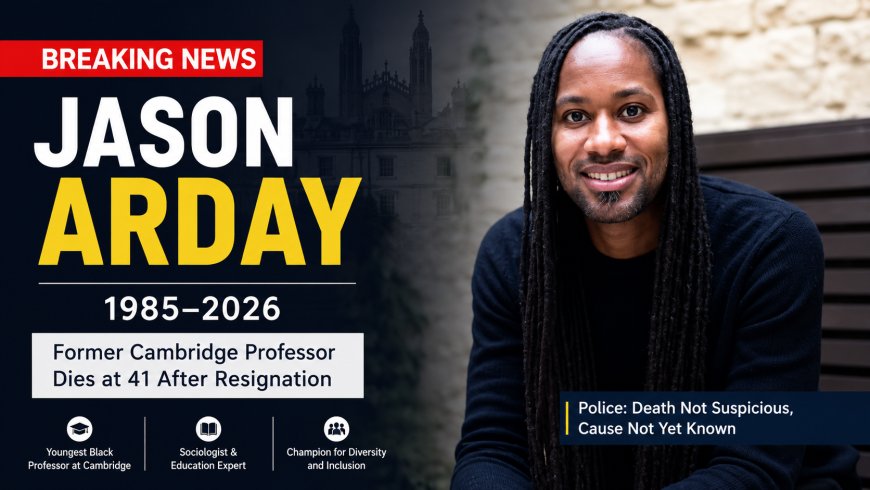
Jason Arday Dies at 41 After Cambridge Resignation
Jason Arday, the former University of Cambridge professor who became the university’s youngest Black professor in 2023, has died at the age of 41. Arday was found unresponsive at a property in Battersea, south London, on August 14, shortly after resigning from his Cambridge position amid a public controversy involving allegations of plagiarism and questions about his academic record. Police have described his death as unexpected but are not treating it as suspicious. The cause of death has not been publicly confirmed.
The circumstances leave several important questions unanswered. While authorities continue their investigation and a report is expected for the coroner, there is currently no verified public evidence establishing how Arday died. That distinction is important because speculation about a cause of death has circulated rapidly online following the announcement.
What happened to Jason Arday?
Arday’s death came only days after a dramatic change in his professional life. He had resigned from his role as Professor of Sociology of Education at the University of Cambridge on August 5, ending a tenure that had made him a prominent figure in British higher education. Reuters reported that he was later found unresponsive by ambulance personnel at a property in Battersea.
The Metropolitan Police has said the death is being treated as unexpected but not suspicious. That means investigators have not publicly indicated evidence suggesting that another person caused his death, but it does not establish a medical cause. Until a coroner or other competent authority releases further information, claims about exactly what happened remain unconfirmed.
The timing has intensified public interest because Arday had been under significant scrutiny before his resignation. Cambridge had been reviewing allegations concerning his academic work and aspects of the information associated with his appointment. The university also announced plans for an independent examination of the appointment process, including how senior academic credentials and allegations of research misconduct are assessed.
Why was the former Cambridge professor facing scrutiny?
Before his death, Arday had become the subject of allegations about plagiarism and questions concerning statements associated with his academic and professional background. These allegations generated a major public controversy and prompted scrutiny from Cambridge. Arday denied intentional wrongdoing, while reporting around the dispute highlighted disagreements over the interpretation of his academic record and earlier claims.
It is important to separate allegations from established findings. Current reporting does not justify describing every accusation against Arday as proven misconduct. The University of Cambridge had initiated a review, and an independent investigation into the appointment process was announced as the controversy developed.
The controversy also expanded beyond individual papers. Questions were raised about how Arday had been assessed before receiving one of the most prestigious academic appointments in Britain. That institutional question is likely to remain relevant even after his death because Cambridge’s review concerns the processes surrounding his appointment rather than simply the allegations made against him.
How did Jason Arday become a Cambridge professor?
Arday’s career had previously been presented as an extraordinary story of overcoming substantial barriers. He had been diagnosed with developmental difficulties during childhood and did not begin speaking until he was 11. Reports also describe him as having experienced significant educational challenges before progressing through higher education and eventually earning a doctorate.
His appointment at Cambridge in 2023 attracted national attention because he became the university’s youngest Black professor. His academic work focused heavily on sociology, race, inequality and diversity in higher education, making him an important public voice on representation within British universities. Reuters and other outlets have highlighted the significance of his appointment in Cambridge’s history.
That earlier success is now being considered alongside the controversy that preceded his death. Tributes from academics and public figures have emphasized his influence on discussions about race and inclusion, while the questions surrounding his academic record remain matters for institutional review rather than assumptions based on his death.
What is known about the circumstances of his death?
The most firmly established information is limited. Arday was 41, he had recently resigned from Cambridge, and he was found unresponsive at a property in Battersea, south London, on August 14. Emergency personnel attended, and police have said the death is unexpected but not suspicious.
No verified report has established a cause of death at the time of publication. That means reports or social-media posts claiming to know whether Arday died from illness, suicide, an accident or another specific cause should not be treated as confirmed unless supported by the police, coroner, family or another authoritative source.
The distinction is particularly important in a case receiving unusually high online attention. His recent resignation and the controversy surrounding it have created an obvious temptation to connect separate events, but a connection cannot responsibly be stated without evidence. Investigators and the coroner will determine what can eventually be established about the death.
What did Arday’s family and colleagues say?
Arday’s death has prompted tributes from people who knew him professionally and followed his work in race equality and higher education. Coverage has emphasized the contrast between the historic significance of his Cambridge appointment and the intense scrutiny that surrounded the final weeks of his career.
His family has also spoken about the pressure surrounding him during the controversy. The Guardian reported that relatives described a sustained campaign of abuse and misinformation as deeply distressing for Arday and his family. Those statements represent the family’s account of the pressure he experienced and should not be interpreted as an official determination about the cause of his death.
The wider response has consequently moved beyond the immediate circumstances of his death. Academics and public figures are reflecting both on Arday’s contribution to discussions about equality and on the need for universities to maintain rigorous standards when appointing senior academics.
What happens next in the Cambridge investigation?
Cambridge’s examination of the appointment process is separate from the investigation into Arday’s death. The university announced an independent probe intended to examine how the appointment was made and how concerns about qualifications and research were handled. The review could therefore continue even though Arday is no longer alive to respond to its findings.
That process matters because the controversy raised questions about institutional safeguards as well as individual conduct. Cambridge has indicated that the review will consider its procedures, while the wider academic community is watching how the university responds to allegations involving a senior appointment.
At the same time, the death investigation will follow its own path. Until the coroner or police provide additional information, the responsible position is to report only what has been established: Arday died unexpectedly, his death is not currently being treated as suspicious, and the cause remains unknown.
Jason Arday’s legacy is now being reassessed
Arday’s career cannot be reduced to either his Cambridge appointment or the controversy that preceded his resignation. His rise from major childhood educational difficulties to senior academic positions was widely regarded as inspirational, and his research and advocacy centered on racial inequality and access to higher education.
His death now places two parts of his public story side by side: the historic achievement of becoming Cambridge’s youngest Black professor and the serious questions that emerged around his academic career. A fair assessment requires both realities to be reported without turning allegations into proven facts or allowing the controversy to obscure information that remains unknown.
For now, the central unanswered question is the cause of death. Police have not indicated that it was suspicious, and no authoritative source has publicly established what caused the 41-year-old former professor to die. Further information from investigators or the coroner could clarify the circumstances in the days ahead.
Frequently Asked Questions
What happened to Jason Arday?
Jason Arday, the former University of Cambridge professor, was found unresponsive at a property in Battersea, south London, on August 14. Police are treating his death as unexpected but not suspicious, and his cause of death has not been publicly confirmed.
Was Jason Arday’s death suspicious?
Police have said the death is not currently being treated as suspicious. That does not establish the cause of death, which remains subject to further investigation and the coroner’s process.
Why did Jason Arday resign from Cambridge?
Arday resigned from his Cambridge professorship on August 5 after becoming the subject of allegations concerning plagiarism and questions about aspects of his academic record. He denied intentional wrongdoing, while Cambridge was reviewing the issues surrounding his appointment.
Was Jason Arday found dead after the plagiarism controversy?
Yes. Arday died shortly after his resignation, which followed weeks of public and institutional scrutiny involving allegations of plagiarism and questions about his credentials. However, the timing alone does not establish any connection between the controversy and his death.
How old was Jason Arday when he died?
Jason Arday was 41 years old when he died. Reuters and other current reports identify him as 41 at the time of his death.
What's Your Reaction?
 Like
0
 Dislike
0
 Love
0
 Funny
0
 Angry
0
 Sad
0
 Wow
0