Class I Salmonella Egg Recall: What to Check in Your Fridge
The FDA has given a Class I warning to a Salmonella egg recall. Check affected brands, carton codes, dates and what consumers should do next.
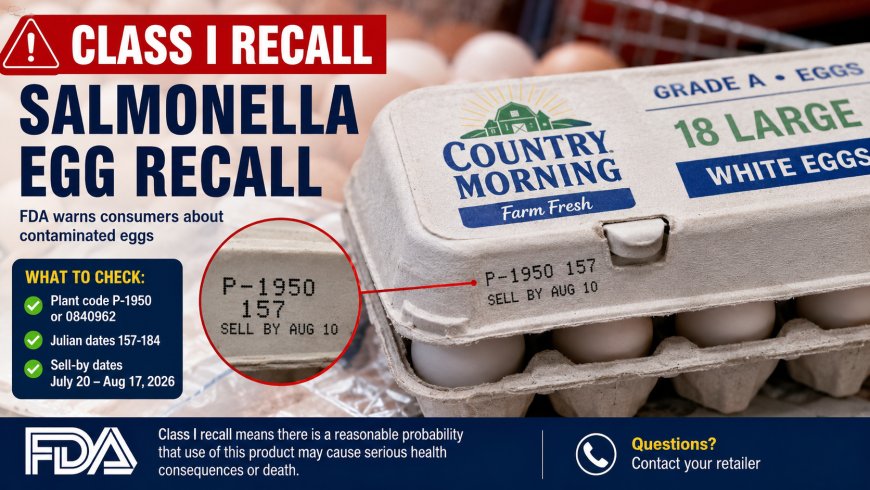
The class i salmonella egg recall involving Midwest Poultry Services has become a major food-safety concern after the U.S. Food and Drug Administration gave the recall its highest-risk classification. The affected eggs were produced at Texas farms and were sold under several brand names, making the carton identification codes more important than the brand name alone. Federal investigators have linked the recalled eggs to part of a multistate Salmonella Enteritidis outbreak involving 98 reported illnesses and 26 hospitalizations across 17 states. No deaths had been reported in the FDA's July 24 outbreak update.
The recall covers white shell eggs and brown cage-free shell eggs produced and distributed between June 6 and July 3, 2026. The affected packages have sell-by or best-by dates ranging from July 20 through August 17, 2026. Consumers should not rely only on the date or brand printed on a carton because specific plant codes and Julian dates are used to identify the recalled products.
Why the FDA Class I designation matters
A Class I recall is the FDA's most serious recall category. It is used when there is a reasonable probability that exposure to a violative product could cause serious adverse health consequences or death. The classification therefore signals a significant potential public-health risk; it does not mean that every egg in the recall has been proven contaminated or that every person who ate one will become sick.
In this case, the elevated concern comes alongside federal investigation into a Salmonella Enteritidis outbreak. The FDA says epidemiological, laboratory and traceback information identified Midwest Poultry Services eggs as a likely source of illnesses. However, the agency also cautioned that the producer does not account for all illnesses in the outbreak and that the investigation is continuing.
That distinction is important. A recall can cover products because of a potential contamination hazard before contamination is established in every individual package. Consumers should therefore follow the recall instructions even if the eggs look, smell or taste normal.
How to check whether your eggs are recalled
The most useful step for consumers is to inspect the side of the egg carton. According to the FDA, recalled eggs can carry plant identification code P-1950 or 0840962, together with a Julian date ranging from 157 through 184. The identifying information is printed in date-coding ink on the left or right side of the carton.
The recalled products have sell-by or best-by dates between July 20 and August 17, 2026. The products include multiple sizes and brands, including Kroger, Simple Truth, Brookshire's, Country Morning and Sunups. The recall also covers certain bulk foodservice egg packages.
Because several brands are involved, shoppers should use a combination of identifiers rather than assuming every egg from one brand is affected. A matching brand by itself is not enough. The safest approach is to compare the plant code, Julian date, product description and date information with the FDA's official recall list.
Which states and stores received the recalled eggs?
The FDA says the recalled eggs were shipped to retail and foodservice customers in Texas, Oklahoma and Louisiana. At the retail level, they were available through Kroger stores in Texas and Louisiana and Brookshire Grocery locations in Texas, Oklahoma, Arkansas, Louisiana, New Mexico and Mississippi. Other smaller retail outlets were also involved.
The distribution footprint means consumers should not assume that the recall applies only to Texas. Even shoppers in another listed state may have purchased an affected carton, while the FDA has warned that the confirmed distribution states may not represent every location the product reached.
What should you do if you have recalled eggs?
Consumers who identify a recalled carton should not eat the eggs. The FDA advises consumers, restaurants and retailers to throw the affected eggs away or return them to the place of purchase for a refund. People should also clean and disinfect surfaces that may have come into contact with the recalled eggs.
It is also important not to give recalled eggs to another person, donate them or use them in cooking. Cooking eggs thoroughly reduces the risk of Salmonella infection from properly handled eggs, but a product that has been specifically recalled should be removed from use rather than treated as safe simply because it will be cooked.
Consumers who are unsure about a carton should compare its details against the official FDA product table rather than relying on social-media posts or general lists of affected brands. The FDA recall notice provides the detailed product descriptions and UPC information needed for a more precise check.
What are the symptoms of Salmonella?
Salmonella infection can cause diarrhea, fever, abdominal cramps, nausea and vomiting. The FDA says symptoms can be more serious in young children, older adults and people with weakened immune systems. In some cases, Salmonella can spread beyond the intestines and cause severe illness.
The existence of a recall does not mean that every person who consumed the product will become ill. Anyone who develops concerning symptoms after possible exposure should seek medical advice, particularly if symptoms are severe, persistent or involve signs of dehydration or other complications.
Why this recall is connected to a larger Salmonella investigation
The egg recall is more significant than a routine product withdrawal because federal investigators are examining it alongside a multistate Salmonella Enteritidis outbreak. In the FDA's July 24 update, 98 people in 17 states had been identified with the outbreak strain, with 26 hospitalizations and no reported deaths. Illnesses began between November 21, 2025, and June 30, 2026.
Among 44 ill people for whom information was available, 40 reported eating eggs before becoming sick. Investigators then used epidemiological, laboratory and traceback information to identify the Midwest Poultry Services eggs as a likely source for some illnesses. Testing performed on samples collected at Texas farms also found Salmonella, with some samples matching the outbreak strain according to information provided to the FDA.
That evidence explains why the latest Class I designation is attracting renewed attention. The original recall was already serious, but the combination of an identified outbreak, hospitalizations and additional investigative evidence makes the warning particularly important for consumers who may still have eggs in their refrigerators.
What consumers should remember about the egg recall
The most important point is simple: check the carton before eating eggs covered by the recall period. Look for plant code P-1950 or 0840962 and Julian dates 157 through 184, then compare the complete product information with the FDA's official list.
The FDA's investigation remains ongoing, so the information can change if investigators identify additional products, distribution locations or sources. Consumers should rely on updated federal recall information rather than assuming that an old list is complete.
For now, anyone with a confirmed recalled product should not consume it and should follow the FDA's return or disposal guidance. The Class I designation is a warning to take the recall seriously, not a reason to panic: the practical response is to identify the carton, remove it from use and follow official food-safety instructions.
Frequently asked questions
What eggs are included in the Class I Salmonella recall?
The recall covers specific white shell eggs and brown cage-free shell eggs produced by Midwest Poultry Services at Texas farms. Affected cartons can have plant codes P-1950 or 0840962 and Julian dates from 157 through 184, with sell-by or best-by dates from July 20 through August 17, 2026. Several brands and package sizes are included.
What does a Class I egg recall mean?
Class I is the FDA's highest-risk recall classification. It means there is a reasonable probability that exposure to the affected product could cause serious adverse health consequences or death. It does not mean every recalled egg is contaminated.
How many people have been affected by the Salmonella outbreak?
The FDA's July 24 update reported 98 people infected with the outbreak strain across 17 states, including 26 hospitalizations and no deaths. Investigators said the recalled Midwest Poultry Services eggs were a likely source of some illnesses, while the investigation continued into other possible sources.
What should I do if I have a recalled carton?
Do not eat the eggs. The FDA advises consumers to throw them away or return them to the place of purchase for a refund and to clean areas that may have contacted the recalled eggs.
Where can I find the complete recalled-egg list?
The FDA's official outbreak investigation page contains the detailed product table, brand information, package sizes, UPCs, plant codes and Julian-date range. Consumers should use that official information when checking a carton.
What's Your Reaction?
 Like
0
 Dislike
0
 Love
0
 Funny
0
 Angry
0
 Sad
0
 Wow
0