Boeing 737 Ryanair Engine Damage: NTSB Findings
Boeing 737 Ryanair engine damage caused a window breach and serious injury. New NTSB findings reveal fatigue evidence, bird remains and inspection details.
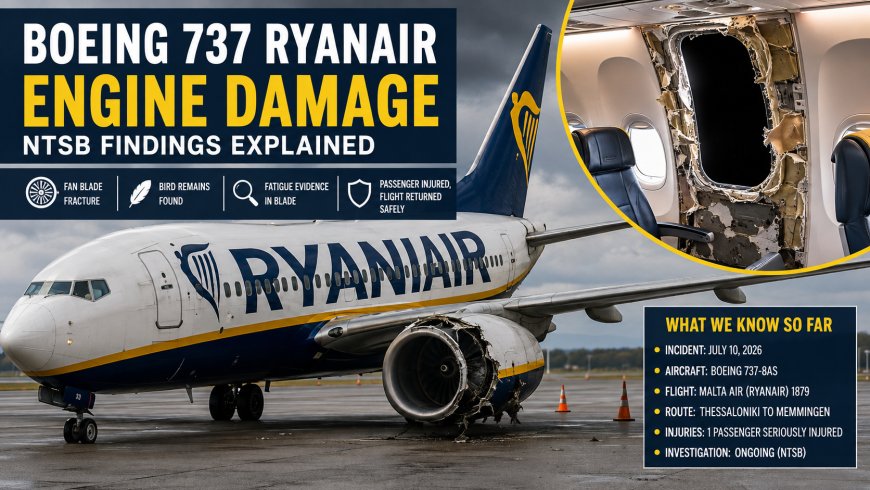
Boeing 737 Ryanair engine damage on a July flight over Greece was more complicated than an initial report of a broken airplane window suggested. A preliminary investigation by the U.S. National Transportation Safety Board (NTSB) found that a fan blade in the aircraft's right engine fractured during climb, sending engine fragments into the fuselage and causing cabin depressurization. One passenger suffered serious injuries after being partially lodged through the damaged window, while the aircraft returned safely to Thessaloniki.
The most significant new detail is that investigators found evidence consistent with fatigue at the fracture origin of the No. 10 fan blade. At the same time, bird remains and feathers were recovered from the engine, and the aircraft had experienced four suspected bird strikes involving the same engine during the previous 12 months. The preliminary report does not establish that a bird strike caused the blade failure, making the interaction between fatigue, previous impacts and engine loading a central question in the continuing investigation.
What happened to the Ryanair Boeing 737?
Malta Air, operating for Ryanair as Flight 1879, departed Thessaloniki International Airport in Greece for Memmingen, Germany, on July 10. The Boeing 737-8AS, registration 9H-QEU, was climbing through approximately 16,000 feet near Polykastro when the crew received a high-vibration indication from the No. 2, or right-hand, engine. The pilots reduced engine power and began the appropriate non-normal procedure. The vibration initially decreased, but later increased sharply.
The crew then heard a loud bang and disconnected the autopilot. Shortly afterward, the cabin altitude warning activated, indicating that the aircraft had lost pressurization. The pilots put on their oxygen masks, declared an emergency and began an immediate descent. The NTSB report says flight attendants heard continuous vibration and saw a small amount of fog or smoke before the passenger oxygen masks deployed.
Inside the cabin, the situation became especially serious because engine debris had penetrated the fuselage at row 11. The entire window at seat 11F was missing, and the passenger seated there was partially lodged in the opening. Other passengers helped pull the injured traveler back into the cabin. A passenger who was a doctor then assisted the injured man, while crew members retrieved first-aid equipment.
Why did the airplane window break?
The window did not simply fail on its own, according to the preliminary evidence. Investigators found that fragments from the right engine's fan blade failure struck the aircraft's fuselage. The impact penetrated the pressurized cabin area through the passenger window at row 11 and also caused additional damage to the lower fuselage skin behind the right wing-to-body fairing. Damage was also recorded around the right horizontal stabilizer.
This distinction is important because the initial public focus was on the dramatic window failure. The NTSB's findings indicate that the window breach was part of a larger sequence involving an engine fan-blade separation and the release of high-energy debris. The investigation is still determining exactly why the blade fractured and how the resulting fragments traveled into the fuselage.
The unusual inspection finding behind the engine failure
One of the most important safety questions is how a fan blade showing evidence consistent with fatigue could fail after undergoing recent inspections. NTSB records show that the engine's fan blades received ultrasonic inspections on November 11, 2025, and again on May 24, 2026, only 253 flight cycles before the accident flight. No findings were reported during those inspections.
Investigators later examined the fractured No. 10 fan blade and found that the break occurred through the blade's dovetail at the root. About 37% of the fracture surface showed relatively smooth characteristics consistent with fatigue. Microscopic examination also identified fatigue striations, with investigators describing the fracture as consistent with high-amplitude fatigue.
That does not mean the recent inspection was necessarily incorrect or that maintenance personnel missed a known defect. The NTSB preliminary report is not a final determination of cause. Instead, the finding raises a technical question that investigators must resolve: whether the fatigue damage developed to a detectable level after the last inspection, whether other forces contributed to the failure, or whether another mechanism accelerated the fracture.
Did a bird strike cause the Ryanair engine failure?
Bird activity is another important part of the investigation, but it would be premature to describe a bird strike as the confirmed cause. Investigators recovered bird remains, including feathers, from several areas of the No. 2 engine. The aircraft's records also show four suspected bird strikes involving that engine during the 12 months before the accident, with bird remains reportedly found in two of those earlier events.
The presence of bird remains establishes that birds entered or contacted the engine at some point, but investigators still have to determine whether a bird impact directly caused the No. 10 blade fracture or whether it contributed to an already developing structural problem. Samples from the engine and blade components were sent for further examination, including analysis by specialists at the Smithsonian Institution's Feather Identification Lab.
Another safety issue: engine hardware upgrades
The preliminary report also identifies a separate issue that could become important to the wider aviation-safety discussion. Several structural enhancements specified in Federal Aviation Administration airworthiness directives had not yet been incorporated on the aircraft's engine inlet cowl, fan cowl and exhaust nozzle hardware. The NTSB report says the compliance deadline for all three directives is July 2028.
These findings do not establish that the absence of those modifications caused the accident. The NTSB is still examining the relationship between the engine failure, the damaged cowl structures and the fuselage penetration. Investigators have specifically noted previous fan-blade-out events involving similar engine models and are assessing whether there are relevant similarities.
How did the crew and passengers get the plane back safely?
The response inside the cabin was a major factor in managing the emergency. After the decompression, oxygen masks deployed and passengers began using them. The passenger in seat 11F was pulled back inside the aircraft by people nearby. A doctor traveling on the flight then treated the injured passenger while flight attendants coordinated with the cockpit and secured the cabin.
The pilots descended rapidly after declaring the emergency. Once the aircraft was below 10,000 feet, the crew shut down the damaged No. 2 engine and continued the return to Thessaloniki. The airplane landed uneventfully and was met by first responders. The NTSB records one serious passenger injury and no other passenger or crew injuries.
The sequence also explains why aviation experts continue to emphasize seatbelt use even when an aircraft is cruising normally. A sudden cabin breach can create extremely dangerous conditions within seconds. In this case, the passenger's proximity to the damaged window and the rapid response of fellow travelers and crew became critical parts of the outcome.
What happens next in the Ryanair investigation?
The NTSB is leading the investigation after Greece's Hellenic Air and Railway Safety Investigation Authority delegated the investigation to the U.S. agency. Investigative teams are examining the powerplant, aircraft structures, survival factors and materials. The flight data recorder and cockpit voice recorder have also been sent for specialist analysis.
The engine and damaged components are being examined in greater detail, while investigators continue to study the fan-blade fracture, bird material, previous inspections and the aircraft's maintenance history. The preliminary report explicitly states that the information is subject to change and that the investigation remains ongoing.
For passengers, the incident is a reminder of how quickly a rare aviation emergency can develop after takeoff. For airlines, manufacturers and regulators, the more significant issue may be what the final investigation says about fatigue detection, repeated bird-strike exposure and the effectiveness and timing of structural modifications. Those conclusions could determine whether additional inspections or safety measures are considered for other Boeing 737 aircraft using similar engine configurations.
What the NTSB has confirmed — and what it has not
The NTSB has confirmed that the Ryanair-operated Boeing 737 suffered a No. 2 engine fan-blade separation during climb, that engine fragments breached the fuselage, and that the cabin depressurized. Investigators also confirmed serious injury to one passenger, fatigue-consistent features in the fractured fan blade and the presence of bird remains in the engine.
What remains unresolved is the exact chain of causation. The preliminary evidence does not yet establish whether bird strikes, fatigue, another form of damage, or a combination of factors caused the blade to fail. The investigation will also determine whether the aircraft's unmodified engine hardware played any role in how the event developed. Until those questions are answered, claims assigning responsibility to Boeing, Ryanair, maintenance personnel or bird activity would go beyond the evidence currently available.
Frequently Asked Questions
What happened to the Ryanair Boeing 737?
A Malta Air Boeing 737 operating Ryanair Flight 1879 suffered a right-engine fan-blade separation while climbing from Thessaloniki. Engine fragments penetrated the fuselage, shattered a passenger window and caused cabin depressurization. The aircraft returned safely to Thessaloniki.
Did a bird strike cause the Ryanair engine failure?
Investigators found bird remains and feathers inside the affected engine, and four suspected bird strikes involving that engine had been reported in the previous year. However, the NTSB has not concluded that a bird strike caused the fan-blade fracture.
Why did the airplane window break?
The NTSB found that fragments from the failed right engine struck and penetrated the fuselage at the row 11 passenger window. The resulting breach caused cabin depressurization and left one passenger partially lodged in the damaged window opening.
Was the Ryanair Boeing 737 recently inspected?
Yes. The engine fan blades underwent ultrasonic inspections in November 2025 and again on May 24, 2026. No findings were reported during those inspections, although the later investigation found fatigue-consistent features on the fractured blade.
Is the Ryanair Boeing 737 investigation finished?
No. The NTSB preliminary report states that the investigation is ongoing. Investigators are continuing to examine the engine, blade fracture, bird remains, maintenance records, flight data and other evidence before determining the probable cause.
What's Your Reaction?
 Like
0
 Dislike
0
 Love
0
 Funny
0
 Angry
0
 Sad
0
 Wow
0