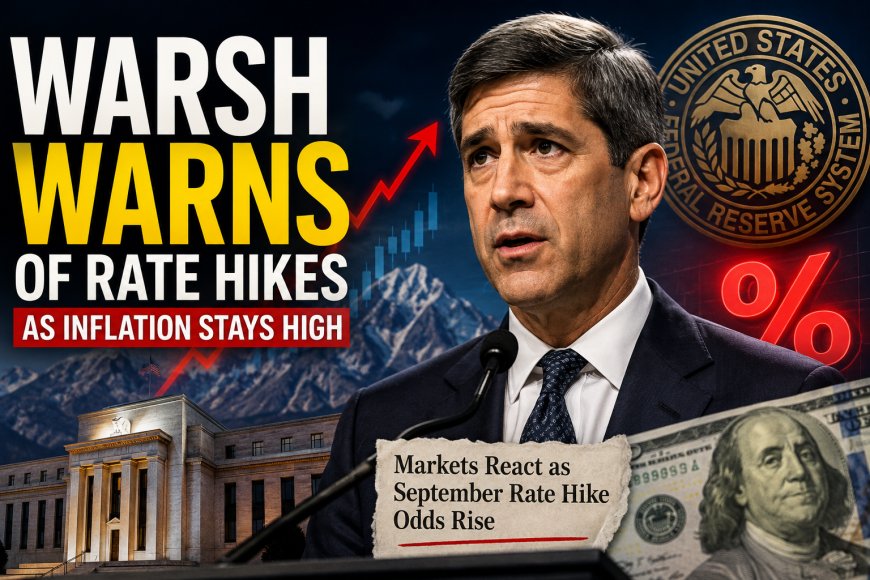
Warsh Warns of Rate Hikes as Inflation Stays High
Warsh warned inflation remains too high and higher rates may be needed, reshaping September Fed expectations after his Jackson Hole speech in Wyoming.
Warsh Warns of Rate Hikes as Inflation Stays High
Warsh warned at Jackson Hole that the Federal Reserve may need to raise interest rates if inflation does not move convincingly back toward the central bank's 2% target, giving investors a clearer signal that another hike remains possible. His first keynote speech as Fed chair also revealed a broader change in how the central bank plans to communicate with financial markets: less forward guidance, more reliance on incoming economic data.
The message immediately changed the market conversation around the Federal Reserve's September meeting. Reuters reported that traders increased their expectations for a September rate increase following the speech, while financial markets also reacted through Treasury yields, equities and other interest-rate-sensitive assets.
What did Warsh signal about September rates?
The Fed chair did not announce that rates will definitely rise in September. Instead, he made clear that policymakers remain prepared to tighten monetary policy if inflation continues to show insufficient progress. That distinction matters because the next policy decision will depend heavily on economic data released between Jackson Hole and the September meeting.
The Federal Reserve has been holding its benchmark rate steady, but persistent inflation has kept the possibility of another increase alive. By emphasizing that the central bank still has work to do if underlying inflation does not improve, the chair effectively kept a rate hike on the table without committing the committee to a specific outcome.
That leaves investors watching upcoming inflation, employment and economic-growth reports much more closely. A stronger-than-expected inflation reading could strengthen the case for another increase, while convincing evidence of cooling price pressures could reduce the need for additional tightening.
The bigger change: a quieter Federal Reserve
The most important part of the speech may extend beyond the September rate decision. The new chair is challenging the traditional role of forward guidance, in which investors try to interpret Fed statements to determine where interest rates are heading next.
Warsh argued for a more restrained central bank that does not encourage markets to depend on every public comment for their next trading decision. The Federal Reserve's official transcript shows that his Jackson Hole address was also designed to discuss broader changes in monetary policy and the economy rather than simply provide a conventional roadmap for future rate moves.
This creates an unusual problem for markets. Less guidance may give policymakers more flexibility, but it can also make financial markets more sensitive to every new inflation or employment report. Instead of knowing what the Fed is likely to do weeks in advance, investors may have to wait for each new piece of evidence and rapidly adjust their expectations.
For ordinary consumers, this approach means the next inflation report may matter more than another carefully worded speech. Mortgage rates, credit costs and other borrowing conditions can respond quickly when markets change their expectations for future Fed policy.
Why markets reacted so quickly
Investors had entered Jackson Hole looking for clues about the Fed's reaction function. Instead, they received a combination of caution on inflation and a warning that the central bank does not want markets to rely excessively on forward guidance.
That combination produced an immediate repricing. Reuters reported that expectations for a September rate hike increased after the speech. Gold also came under pressure as higher-rate expectations made a non-yielding asset less attractive, while Treasury and equity markets moved as traders reassessed the path of monetary policy.
The reaction demonstrates why the communication strategy matters. When investors believe rates could remain higher or rise again, bond yields can increase and financial conditions can tighten even before the Fed actually changes its benchmark rate.
Longer-term Treasury yields are especially important because they influence borrowing costs throughout the economy. Higher government bond yields can feed into mortgage rates, corporate financing and other forms of credit, creating broader financial consequences beyond Wall Street.
What happens next before the September meeting?
The Jackson Hole speech does not settle the September decision. The next phase will be driven by economic data. Inflation readings will be particularly important because the central bank's latest message places price stability at the center of its decision-making process.
If inflation remains stubbornly above target, policymakers could face stronger pressure to raise rates. If price pressures cool materially while the labor market weakens, the argument for holding rates steady could become more persuasive.
The unusual part of the new approach is that investors may receive fewer clues directly from the Fed chair before the meeting. That makes economic releases more important and could increase volatility around each major report.
There is also a global dimension. U.S. interest-rate expectations influence the dollar, international capital flows and borrowing conditions in other economies. A renewed expectation of higher U.S. rates can put pressure on emerging-market currencies and raise financing costs outside the United States.
For consumers, however, the immediate takeaway is simpler: the Fed has not closed the door on higher rates. Borrowers should not assume that the next policy move will automatically be a cut simply because financial markets have previously expected easier monetary policy.
What Warsh's speech means for investors and consumers
The clearest message from Jackson Hole is that inflation remains the key obstacle to an easier monetary-policy path. The chair did not promise a September hike, but he made clear that the option remains available if the data fail to show sufficient improvement.
At the same time, the Fed's communication strategy is changing. Investors may have to rely less on predictions from the chair and more on actual economic evidence. That could make the next several weeks particularly important for markets because every major inflation, employment and growth report may influence expectations for the September decision.
The result is a Federal Reserve that appears willing to tolerate more uncertainty in financial markets in exchange for greater flexibility over monetary policy. For Wall Street, that means more attention to data. For households, it means borrowing costs may remain sensitive to inflation for longer.
In short, the Jackson Hole message was not a guaranteed rate hike. It was a warning: if inflation refuses to cooperate, the Fed is prepared to act. And with less forward guidance coming from the central bank, the economic data may now speak louder than the Fed chair.
What's Your Reaction?
 Like
0
 Dislike
0
 Love
0
 Funny
0
 Angry
0
 Sad
0
 Wow
0