Farmer News: Trump Pushes New Meat Processing Plan
Farmer news is rising as Trump backs easier rancher meat processing, while new U.S. farm policies could reshape markets, competition and rural businesses.
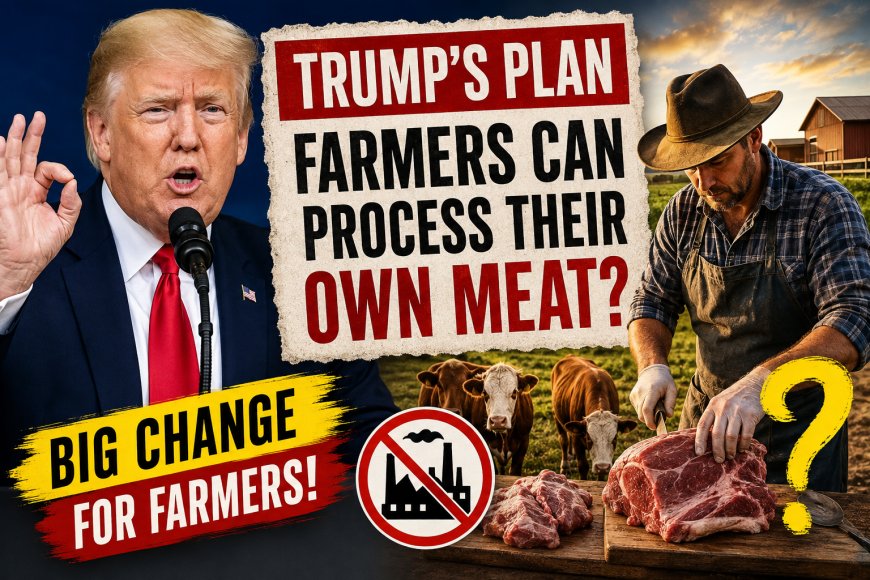
Farmer news is gaining attention after President Donald Trump announced a plan to make it easier for U.S. farmers and ranchers to process their own meat, targeting the power of major meatpacking companies. Trump said on August 28 that legal documents were being prepared to give farmers and ranchers the right to process their own food, while Agriculture Secretary Brooke Rollins indicated the administration would work to reduce regulatory barriers and expand opportunities for smaller processors.
What Trump’s farmer and rancher plan actually changes
The proposal is aimed at one of the most important pressure points in the U.S. cattle industry: access to meat-processing facilities. Farmers and ranchers generally depend on processors to slaughter, package and prepare livestock for commercial sale. That dependence can become especially important when processing capacity is limited or concentrated among a relatively small number of large companies.
Trump has described the largest meat processors as a “nasty Monopoly” and argued that farmers and ranchers need more control over how their products reach consumers. Reuters reported that the four major companies identified in the debate — Cargill, Tyson Foods, JBS USA and National Beef Packing Co. — account for about 85% of U.S. meat processing.
The administration’s stated objective is therefore broader than simply allowing a farmer to butcher an animal. The policy discussion centers on creating more competition by making it easier for smaller and regional processors to operate and potentially allowing producers greater access to consumers across state lines.
However, farmers should not assume that the announcement immediately removes federal inspection requirements. The exact legal documents, regulatory changes and enforcement rules have not yet been fully explained. Current federal meat-inspection requirements remain an important part of the system, particularly for meat entering interstate commerce.
Why farmers want more processing options
For many producers, the issue is not simply who owns a processing plant. It is whether farmers have enough alternatives when they are ready to sell livestock. If a producer has only a limited number of practical processing options, the farmer may have less flexibility over timing, pricing and the route used to reach customers.
More small and regional processors could potentially change that equation. A farmer who can work with a nearby processor may have additional opportunities to sell directly to consumers, restaurants or local businesses, depending on the final rules. That could strengthen the connection between farms and local food markets while keeping more economic activity in rural communities.
The administration has already taken steps to support smaller processing businesses. In June, USDA Secretary Brooke Rollins announced the Strengthening Processing for U.S. Ranchers program, which provides up to $500 million in payments to eligible beef-processing establishments. USDA said the program was designed to support stronger and more stable market opportunities for American ranchers.
This makes the latest announcement significant because it appears to build on an existing policy direction rather than representing an entirely new focus on small processors.
The biggest question is whether the plan can become practical
The difficult part may come after the political announcement. Meat processing is heavily regulated because slaughtering and handling meat involve food-safety risks. Any expansion of producer-controlled processing must still address sanitation, inspection, labeling, traceability and consumer protection.
The Washington Post reported that the White House had not immediately provided details on which existing food-safety regulations Trump intended to change or how the proposed documents would work. That uncertainty matters because a presidential announcement alone does not automatically rewrite every federal requirement governing commercial meat sales.
There is also a major difference between allowing more local processing and allowing unrestricted interstate sales. Smaller processors may need additional equipment, trained workers, inspection capacity, cold-storage facilities and financing before they can handle substantially more livestock.
That means the real test for farmers will not simply be whether Washington announces new rules. It will be whether those rules produce enough additional processing capacity to give producers meaningful alternatives.
How this could affect consumers and beef prices
The farmer-processing debate comes at a difficult moment for the U.S. beef industry. The domestic cattle herd has been unusually tight, contributing to higher beef prices. The administration has also moved toward increasing access to imported beef as it looks for ways to ease consumer prices.
That creates a policy tension. Consumers want affordable beef, while cattle producers need prices high enough to justify the cost and risk of raising livestock. Expanding processing competition could potentially help farmers by giving them more selling options, but it is unlikely to solve the underlying shortage of cattle by itself.
Increasing the number of processing choices may improve competition over time, but rebuilding a cattle herd takes much longer. The industry therefore faces two separate challenges: improving the structure of the processing market and increasing the supply of cattle.
For consumers, the eventual effect could depend on how successfully smaller processors scale up. More competition could create efficiencies and new local supply chains, but new regulatory requirements and operating costs could also affect the final price of meat.
What farmers should watch next
The next important development is the administration’s actual regulatory or legal action. Farmers will need to know whether the proposal changes federal inspection requirements, expands state-level processing options, increases interstate sales opportunities, or creates new pathways for direct-to-consumer meat sales.
The legislative side also matters. Supporters of small-scale meat processing have promoted measures such as the PRIME Act, which would allow states to establish certain frameworks for local sales of custom-processed meat. But executive action and permanent legislation are not the same thing, and the long-term structure of the market could ultimately depend on Congress.
Another issue is capacity. USDA has spent roughly $1 billion since 2021 helping expand small processing operations, according to DTN. That suggests the government recognizes that simply changing regulations may not be enough; the country also needs physical facilities capable of processing livestock at commercial scale.
Why the farmer story is bigger than meat processing
The current debate illustrates a broader issue facing American agriculture: farmers do not operate in isolation. Their earnings can be affected by processors, fuel costs, transportation, trade policy, environmental rules, interest rates and consumer demand.
That is also why other agricultural policy decisions are attracting attention. For example, the Environmental Protection Agency announced decisions in August on six small-refinery exemption petitions under the Renewable Fuel Standard. The agency granted one full exemption, two partial exemptions and found three petitions ineligible.
Biofuel policy matters to farmers because corn and soybean demand can be affected by how much renewable fuel the market requires. Reuters reported this week that farm and biofuel groups were concerned about potentially expanded refinery exemptions and their effect on crop demand.
Taken together, these developments show why today's farmer story is not only about cattle. Agricultural producers are watching a collection of policy decisions that can influence where they sell, what they grow, how much they earn and how much control they have over the supply chain.
What happens next for U.S. farmers?
For now, the most important point is that Trump's announcement is the beginning of a policy process, not proof that every farmer can immediately process and sell meat under a new nationwide system. The administration still needs to explain the legal mechanism, regulatory changes and inspection framework that would make the proposal operational.
If the changes genuinely increase the number of competitive processors and make it easier for producers to reach customers, farmers could gain more bargaining power and new business opportunities. If regulatory barriers remain too high or new processing facilities fail to scale, the practical effect could be much smaller than the political announcement suggests.
That makes the coming regulatory details more important than the headline itself. For farmers, ranchers, processors and consumers, the question is no longer simply whether Washington wants more competition. It is whether the new rules can create a safer, larger and genuinely more competitive food-processing market.
Frequently asked questions about farmers and the new policy
What did Trump announce about farmers and ranchers?
Trump said he was authorizing legal documents intended to give farmers and ranchers greater ability to process their own food and reduce dependence on large meat processors. The administration has not yet provided every operational detail of the proposed changes.
Can farmers immediately sell their own processed meat across state lines?
Not automatically. Existing federal inspection and interstate-sale requirements remain relevant until specific regulatory or legislative changes take effect. The administration has indicated that expanding interstate opportunities is part of its broader policy direction, but the final rules will determine what farmers can actually do.
Why are small meat processors important to farmers?
Small and regional processors can give farmers more alternatives for handling livestock. More processing capacity may reduce dependence on a limited number of large facilities and create additional routes to local consumers, restaurants and markets.
Why are people searching for “10 importance of a farmer”?
Farmers have a central role in food production, rural economies and agricultural supply chains. They produce crops and livestock, support related businesses, contribute to food security and help supply raw materials used by many industries. Current policy debates also show how strongly farmers depend on transportation, processing and market rules.
What's Your Reaction?
 Like
0
 Dislike
0
 Love
0
 Funny
0
 Angry
0
 Sad
0
 Wow
0