Fed Rate Decision: Why the Fed Held Interest Rates Steady
The Fed rate decision kept interest rates unchanged at 3.50%-3.75% as officials debated inflation, signaling uncertainty over future policy moves.
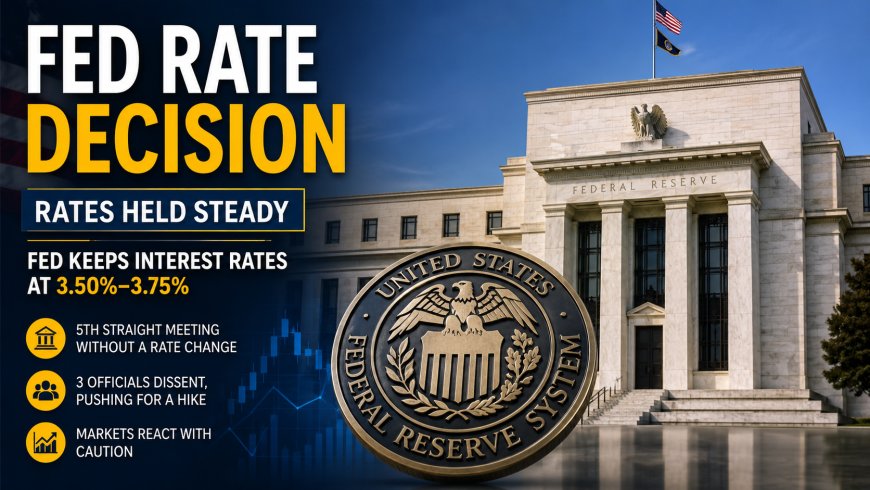
The latest Fed rate decision left the federal funds target range unchanged at 3.50% to 3.75%, extending the Federal Reserve's pause for a fifth straight meeting. While the decision itself matched many economists' expectations, the unusual split among policymakers and Chairman Kevin Warsh's cautious messaging became the biggest story, highlighting growing debate over how quickly inflation can return to the central bank's 2% goal.
Federal Reserve keeps interest rates unchanged despite inflation concerns
The Federal Open Market Committee (FOMC) voted 9-3 to leave interest rates unchanged, keeping borrowing costs within the 3.50% to 3.75% range. It is the fifth consecutive meeting in which policymakers decided against changing rates.
Although inflation has slowed considerably from its previous peak, officials continue to believe that price pressures remain higher than their long-term objective. Maintaining current rates allows policymakers more time to study incoming inflation, employment and consumer spending data before making another move.
The decision signals that the central bank remains committed to restoring price stability while trying to avoid unnecessary damage to economic growth and the labor market.
Why the three dissenting votes mattered more than the rate decision
The biggest surprise from this meeting was not the unchanged interest rate but the unusually high level of disagreement inside the Federal Reserve.
Three policymakers voted against the majority, arguing that inflation remains persistent enough to justify another immediate increase in borrowing costs. Such a large number of dissenting votes is relatively uncommon and suggests that officials are becoming increasingly divided over the pace of future policy.
For investors, this division matters because it may indicate that future meetings could produce more difficult debates if inflation remains stubborn or economic growth unexpectedly strengthens.
Kevin Warsh's communication strategy is changing market expectations
Chairman Kevin Warsh continued his recent approach of providing less detailed forward guidance than previous Federal Reserve leaders. Rather than signaling what policymakers might do next, he repeatedly emphasized that every future decision will depend on incoming economic data.
This strategy is intended to give the Federal Reserve greater flexibility as economic conditions evolve. However, it has also created more uncertainty for investors, who now have fewer clues about the timing of future policy changes.
Financial markets reacted cautiously after the announcement. Treasury yields remained elevated while traders reassessed expectations for upcoming meetings, reflecting uncertainty about whether another rate increase could still occur later this year.
What today's decision means for consumers and businesses
For households, keeping rates unchanged means borrowing costs are unlikely to change immediately. Mortgage rates, auto loans and many business loans may remain relatively high compared with the historically low levels seen several years ago.
Savers could continue benefiting from higher interest paid on savings accounts and certificates of deposit, while businesses may still face elevated financing costs when expanding operations or investing in new projects.
Because monetary policy influences the economy gradually, today's decision does not produce instant changes in consumer borrowing but reinforces the higher-rate environment that has existed throughout much of the past year.
What the Federal Reserve will watch before its next meeting
The next several weeks will be especially important for policymakers. Officials will closely monitor inflation reports, labor market conditions, wage growth, consumer spending and overall economic activity before deciding whether additional action is necessary.
If inflation continues moving toward the Fed's 2% target, policymakers may be comfortable maintaining current policy for longer. However, stronger-than-expected inflation or unexpectedly rapid economic growth could strengthen the case made by officials who favored another rate increase.
For now, the Federal Reserve continues to emphasize patience, flexibility and data-driven policymaking while acknowledging that inflation risks have not completely disappeared.
Want to know more about the people involved? Read complete biographies at BiographyPoints.com
Frequently Asked Questions
What was today's Fed rate decision?
The Federal Reserve kept the federal funds target range unchanged at 3.50% to 3.75%, extending its policy pause while officials continue monitoring inflation and broader economic conditions.
Why did some Fed officials oppose the decision?
Three policymakers believed inflation remains high enough to justify another interest rate increase immediately. Their dissent reflected concern that delaying additional action could make inflation harder to control over the longer term.
When is the next interest rate decision expected?
The Federal Reserve will announce another policy decision after its next scheduled FOMC meeting, with officials evaluating inflation, employment and economic growth before determining whether any rate adjustment is necessary.
What's Your Reaction?
 Like
0
 Dislike
0
 Love
0
 Funny
0
 Angry
0
 Sad
0
 Wow
0