Why Trump Embraced White South African Farmers: The Untold Story Behind U.S.-South Africa Relations - Bio Points News
Discover the surprising reasons behind President Trump's support for white South African farmers, the diplomatic tensions with South Africa, and the complex history shaping this unprecedented U.S. policy shift.
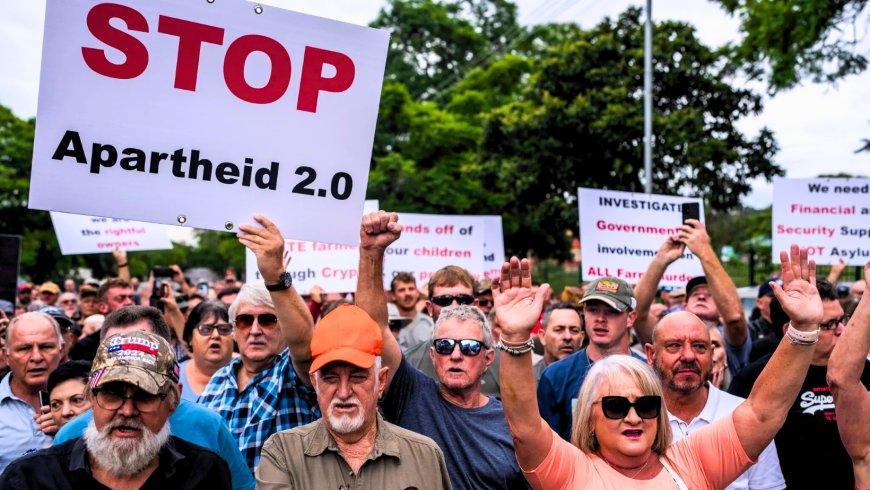
The Road to Trump’s Embrace of White South Africans: A Clear and Detailed Explanation
In May 2019, during a serious national security meeting focused on Iran, something unexpected happened. President Donald Trump suddenly changed the topic. Instead of discussing national security issues, he brought up white South African farmers. Specifically, he wanted to talk about granting them asylum and citizenship in the United States.
This was surprising to many, including John R. Bolton, who was Trump’s national security adviser at the time and was present at the meeting. Bolton later said that President Trump had mentioned the issue of white South African farmers before. Trump believed that these farmers were a persecuted minority who were being unfairly driven off their land. However, Bolton thought little of it at the time. He believed that Trump was just fixating on a fringe idea, one pushed by some white Afrikaner activists.
Bolton described it as a typical Trump move — hearing something from a random source and then becoming obsessed with it. But what seemed like a passing interest in 2019 eventually turned into real U.S. policy under Trump’s second term as president.
What Changed? How Did This Become U.S. Policy?
Fast forward to 2025. The Trump administration has taken dramatic steps that show its support for white South Africans — especially the Afrikaners, a white ethnic minority in South Africa who historically ruled the country during apartheid. On a recent Monday, the first group of Afrikaners arrived in Washington, D.C. They were welcomed by the administration after a refugee program had been suspended for almost everyone else, including people fleeing war, famine, or political persecution from other countries in Africa and Afghanistan.
This shift reflects a significant change in U.S. policy and a growing diplomatic rift between the United States and South Africa.
The Diplomatic Breakdown
In early 2025, President Trump signed an executive order that stopped all foreign aid to South Africa. He claimed that the South African government was practicing “race-based discrimination,” and he expressed support for white South Africans who felt persecuted.
In March, the U.S. administration expelled South Africa’s ambassador to the United States after the ambassador criticized Trump’s focus on “white grievance” politics. The ambassador warned that a “global protective movement” was emerging to defend embattled white communities worldwide, a movement that Trump seemed to be supporting.
What fueled this tense atmosphere? Several factors combined to push the Trump administration toward a hostile stance against South Africa’s current government:
-
Meetings with Afrikaner activists: Trump’s team held talks with groups representing white Afrikaners who said they were victims of discrimination and violence.
-
Political disagreements: South Africa’s government took a strong stand against Israel during a conflict in Gaza, which angered Trump’s aides, some of whom are close allies of Israel.
-
Focus on “white victimhood”: Some of Trump’s top advisers promote the idea that white people are being unfairly targeted by diversity and inclusion programs, both in the U.S. and abroad.
Influential People and Stories Behind Trump’s Interest
A key moment that brought the plight of Afrikaners to Trump’s attention was a conversation with Gary Player, a famous South African golfer. While practicing golf swings with Player, Trump reportedly heard about the struggles of white Afrikaner farmers being “driven from their land.” Two former administration officials confirmed that Trump’s interest in Afrikaner farmers partly came from hearing about their situation from Player.
However, Gary Player himself has denied talking politics with Trump or influencing U.S. policy. His adviser said Player considers golf course discussions private and does not get involved in politics.
When asked about Trump’s interest, White House officials did not clearly explain how the president’s views became official policy. Instead, they emphasized their concerns about the Afrikaners. According to Karoline Leavitt, the White House press secretary, Afrikaner refugees shared “harrowing stories of discrimination and persecution” in South Africa — including violent attacks, vandalism, death threats, racial slurs, and government laws they say make it hard for them to find work.
She criticized news reports that tried to downplay the suffering of Afrikaners, calling it a “long-persecuted minority group.”
Why Does Trump Care About White South Africans?
To understand why Trump cares about Afrikaners, it’s important to see how he views South Africa as a warning sign for the United States.
Back in the 1990s, when one of Trump’s advisers mentioned that nonwhite people could become the majority in America, Trump reportedly said that such a change would cause a revolution. “This isn’t going to become South Africa,” he said, warning about racial tensions.
His views were further shaped in 2018 by Tucker Carlson, a Fox News host who has been a favorite of Trump. Carlson called a South African land reform law “the definition of racism,” arguing that the government was unfairly seizing land from white farmers. He also said that the political elites ignored this “racism” while labeling Trump a racist.
Shortly after Carlson’s comments, Trump tweeted about the “large-scale killing” of white farmers in South Africa and said he had asked the State Department to “closely study” land seizures and farm expropriations in South Africa.
This was a major moment — Trump had officially taken a stance on an issue with a long and complicated history.
A Brief History of South Africa’s Land Issues
South Africa’s past is shaped deeply by apartheid, a system of racial segregation and discrimination that lasted from 1948 to 1994. Under apartheid, the white minority Afrikaner-led government denied Black South Africans access to land, quality housing, education, and economic opportunity. Land ownership was heavily skewed, with most valuable farmland and property held by white South Africans, even though they made up less than 10% of the population.
Since apartheid ended, South Africa’s government has tried to fix these historic injustices. Part of this effort has involved redistributing land to Black South Africans. Laws were introduced to allow the government to take land from white owners, sometimes without paying compensation, as long as it was for the “public interest.” However, these land seizures have been controversial and have sparked heated debate in South Africa and around the world.
Despite these changes, white South Africans still own about half of the country’s farmland, even though they are only 7% of the population.
Are White Farmers Being Targeted?
Trump and his supporters claim that white farmers are facing violent attacks and are at risk of losing their land unfairly. But South African police statistics show that farmers are not more likely to be victims of violent crime than other citizens. A U.S. State Department report during Trump’s first term said farm killings made up only 0.2% of all murders in South Africa, a very small proportion.
South Africa’s ruling party, the African National Congress (ANC), has led the country since apartheid ended but has been criticized for corruption and failing to meet citizens’ basic needs. The ANC has distanced itself from violent slogans like “Kill the Boer!” which some activists use to claim that white South Africans are being targeted. “Boer” means farmer in Afrikaans and Dutch.
Still, Afrikaner activists have long lobbied for international support. They say the South African government is ignoring their plight, and they want the U.S. and other countries to intervene.
Trump’s Powerful American Allies
The Afrikaners’ message found a receptive audience in the Trump administration, which includes advisers who see race and identity politics through the lens of “white victimhood.” Trump’s inner circle has shifted from career diplomats to loyalists who support the president’s views.
One notable ally is Senator Marco Rubio, Secretary of State under Trump’s second term, who has taken a hard stance against South Africa. For example, Rubio boycotted a Group of 20 foreign ministers’ meeting in South Africa in early 2025, criticizing the event’s focus on diversity, equity, inclusion, and climate change.
Elon Musk, the South African-born billionaire and CEO of Tesla and SpaceX, has also weighed in on social media, echoing baseless claims about a “genocide of white people” in South Africa. Musk’s influence and proximity to Trump have added fuel to the administration’s position.
In February 2025, the Trump administration met with Afrikaner activists in Washington to hear their concerns about murder rates, racial quotas, and government policies. The activists linked the Afrikaner cause to the Trump administration’s opposition to diversity, equity, and inclusion (DEI) initiatives in the U.S., arguing that only merit should matter.
The White House officials made it clear that they thought Afrikaners might be better off resettling in the United States rather than staying in South Africa. Some pointed out that many Afrikaners already worked on farms in America or were successful businesspeople. They believed Afrikaners could quickly assimilate and contribute economically.
The Fallout: South Africa’s Ambassador Expelled
South Africa’s ambassador to the U.S., Ebrahim Rasool, publicly criticized Trump’s approach to race and called it “supremacist.” This angered Trump’s aides.
In March 2025, Marco Rubio announced the expulsion of Ambassador Rasool, accusing him of being a “race-baiting politician” who hated America and Trump.
This marked a low point in relations between the two countries.
What's Your Reaction?
 Like
0
 Dislike
0
 Love
0
 Funny
0
 Angry
0
 Sad
0
 Wow
0