Stefanik vs Johnson: GOP Clash Intensifies Over NDAA - Bio Points News
Rep. Elise Stefanik says Speaker Mike Johnson removed a clause requiring FBI notice for candidate probes. The dispute threatens passage of the NDAA.
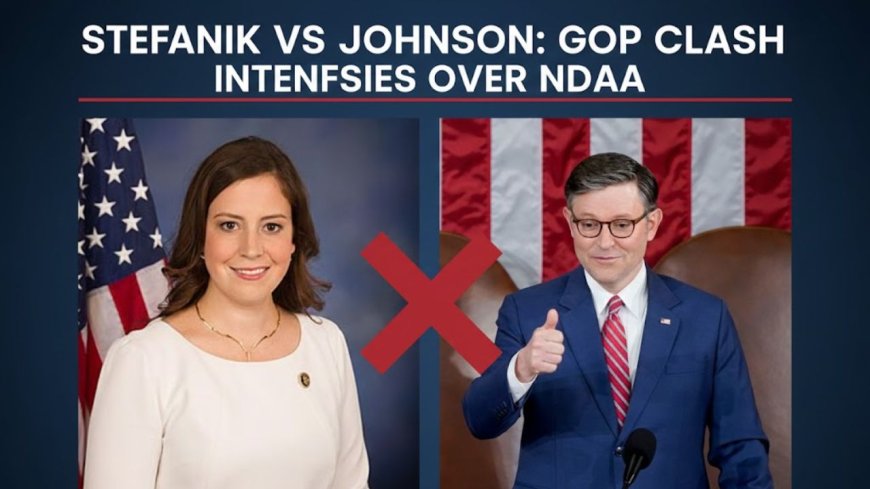
A sharp internal conflict has erupted within House Republicans as Representative Elise Stefanik publicly accused Speaker Mike Johnson of “personally torpedoing” a critical clause in the 2025 National Defense Authorization Act (NDAA). The clause would have required the FBI to notify Congress whenever it opened investigations into federal election or campaign-related candidates. With the clause removed — and its removal credited to Johnson by Stefanik — the controversy now threatens the timely passage of the defense bill.
The Dispute: What Happened
According to Stefanik, during the drafting of the NDAA, a provision intended to mandate congressional notification by the FBI when federal candidates become subjects of counter-intelligence or criminal investigations was stripped out. She claims the removal was driven by Speaker Johnson himself.
Johnson, however, denies any personal interference. He contends the clause was removed due to objections from committee leaders and ranking members who argued that it was unnecessary or problematic — and not at his direct behest. The disagreement reflects deep divisions within the party over transparency, election integrity, and federal investigative oversight.
Supporters of Stefanik — including Representatives Anna Paulina Luna and Marjorie Taylor Greene — have publicly backed her criticism of Johnson. Their backing signals a broader GOP unease with what some see as weakening accountability mechanisms in campaign oversight.
Why the Clause Mattered: Election Integrity and Oversight
The omitted clause carried serious implications for federal election oversight. Its requirement that the FBI notify Congress about investigations involving candidates aimed at preventing the misuse of investigative power for political gain. For many Republicans concerned with election integrity and fair process, it was a safeguard against partisan abuses.
Removing it has raised alarms among those who argue that without formal obligation for notice, investigations could proceed silently — potentially allowing politically sensitive probes to influence elections without congressional awareness.
Fallout: NDAA at Risk and Party Unity Tested
Stefanik has reportedly warned that if the clause is not reinstated before final passage, she may vote against the NDAA. Given that the defense bill is typically a must-pass legislation, such a move threatens both its approval and party unity.
The internal rift also risks damaging the public image of the GOP leadership, depicting it as divided on issues of oversight and election-related transparency — at a time when public confidence in election integrity is already under scrutiny.
Background: NDAA, Election Oversight and Prior Context
The NDAA is an annual — and often bipartisan — defense and security bill. Over recent years, amid growing concerns about foreign interference, campaign financing, and election-related investigations, some lawmakers pushed for greater transparency when intelligence or law enforcement agencies probe political candidates. The proposed FBI-notification clause was born out of these efforts.
While similar proposals have surfaced in prior sessions, they rarely made it into final legislation. This time, however, supporters thought public sentiment and partisan pressure might tip the balance — until the clause’s removal sparked this high-stakes confrontation.
What Comes Next: Possible Outcomes
In the coming days, party leaders may negotiate whether to restore the clause. If they refuse, Stefanik — joined by other GOP hard-liners — could withhold support, complicating the NDAA’s passage. Alternatively, Johnson and allied Republicans may push ahead, banking on broader party support and prioritizing defense funding over procedural safeguards.
What unfolds will test not only the fate of the NDAA but the GOP’s cohesion, especially on issues of transparency and election-related investigations.
The clash between Elise Stefanik and Mike Johnson over the deleted FBI-notification clause turns what might have been a routine defense bill into a flashpoint over transparency and trust in U.S. elections. As the NDAA’s fate hangs in the balance, the outcome could reshape how Congress oversees investigations into federal candidates — and define House GOP unity heading into future electoral cycles.
What's Your Reaction?
 Like
0
 Dislike
0
 Love
0
 Funny
0
 Angry
0
 Sad
0
 Wow
0