Iran Launches Missiles at US Forces, All Intercepted: CENTCOM
Iran launches missiles at US forces in Jordan as CENTCOM says every ballistic missile was intercepted, raising fresh concerns over regional tensions.
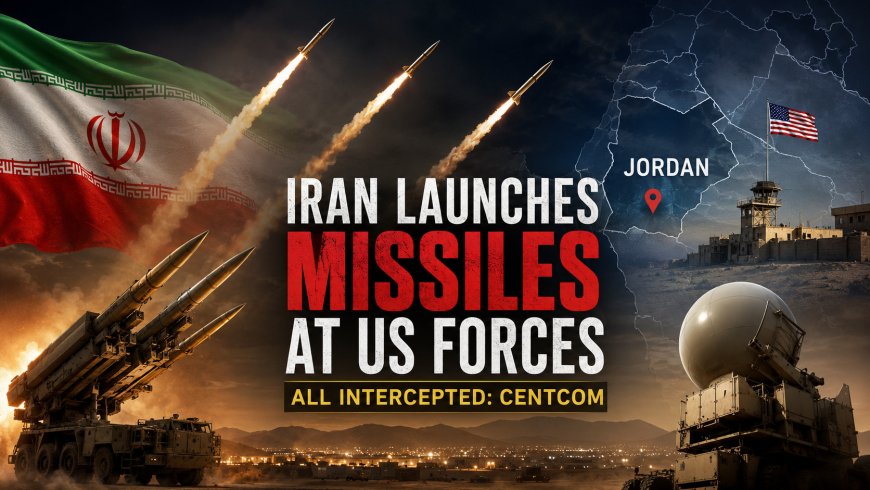
Iran's missile launches became one of the world's top breaking stories after the Islamic Revolutionary Guard Corps (IRGC) fired multiple ballistic missiles toward US forces stationed in Jordan. According to US Central Command (CENTCOM), every incoming missile was intercepted before reaching its target, preventing casualties while keeping American forces on heightened alert across the Middle East.
Iran launches missiles at US forces as tensions sharply escalate
The missile launch marked one of the most significant direct confrontations between Iran and the United States in recent months. CENTCOM said the missiles were launched during what it described as an attempted surprise attack against American personnel operating in Jordan. Air defense systems intercepted every projectile before impact, allowing military operations to continue without reported injuries or damage.
Iran's Islamic Revolutionary Guard Corps later claimed responsibility for the strike, describing it as retaliation against recent US military actions targeting Iranian facilities. The exchange comes after several weeks of increasing military activity across the region, where both countries have accused each other of escalating instability.
Why Jordan has become strategically important
Jordan has long served as one of Washington's closest security partners in the Middle East. The country hosts American military personnel supporting regional counterterrorism operations and broader security missions. Because of its location bordering Iraq, Syria, Israel, and Saudi Arabia, Jordan has become an essential logistics and intelligence hub for US operations.
Targeting American forces inside Jordan therefore carries wider geopolitical implications. Even though the missiles were intercepted, the attack signals Iran's willingness to challenge US military positions beyond direct conflict zones while testing regional missile defense capabilities.
How the interception changes the military picture
The successful interception prevented what could have become a far more serious military crisis. Modern layered missile defense systems used by US and allied forces are designed to detect, track, and destroy incoming ballistic missiles before impact. CENTCOM's announcement that every missile was intercepted suggests the defensive network functioned as intended during the attack.
Although no casualties were reported, military analysts generally view successful interceptions as reducing immediate damage rather than eliminating strategic risks. Each direct exchange increases pressure on governments to respond while raising concerns about future attacks involving larger missile salvos or coordinated operations.
Regional governments quickly respond
Several Gulf nations rapidly condemned the missile launch. Qatar and Kuwait publicly reaffirmed support for Jordan's sovereignty and regional stability, reflecting growing concern that continued military exchanges could spread beyond Iran and the United States.
Diplomatic efforts remain active despite the latest escalation. Regional governments continue urging restraint, warning that additional military action could threaten shipping routes, energy markets, and wider Middle East security.
What happened before the missile launch
The latest confrontation followed several days of rising tensions. The United States had previously conducted strikes against Iranian military facilities, while President Donald Trump had publicly warned Tehran that additional infrastructure could be targeted if diplomatic negotiations failed. Iranian officials accused Washington of changing the terms of proposed negotiations, increasing mistrust between both governments.
Just hours before the missile launch, discussions involving US and Israeli leadership reportedly focused heavily on Iran and regional security, highlighting how quickly diplomatic talks were overtaken by military developments.
What happens next
The immediate priority remains preventing further escalation. US forces across the region continue operating under heightened alert while officials monitor for additional threats. Diplomatic channels remain open, but military readiness has increased following the attempted strike.
Whether the incident develops into a broader confrontation will largely depend on the responses from Washington, Tehran, and regional allies in the coming days. For now, the successful interception has prevented immediate casualties, but it has not reduced the underlying tensions driving the crisis.
Want to know more about the people involved? Read complete biographies at BiographyPoints.com
Frequently Asked Questions
Did Iran launch missiles at US forces?
Yes. Iran's Islamic Revolutionary Guard Corps claimed responsibility for launching ballistic missiles toward US forces stationed in Jordan. According to CENTCOM, every missile was intercepted before reaching its target, and no successful strike on US personnel was reported.
Why was Jordan targeted?
Iran said the attack was aimed at an American military facility in Jordan in response to recent US military actions. Jordan hosts US personnel supporting regional security operations, making it an important strategic location.
Were there any casualties?
US Central Command reported that all incoming ballistic missiles were intercepted. As of the latest official information, no casualties or significant damage have been reported from the attempted attack.
What's Your Reaction?
 Like
0
 Dislike
0
 Love
0
 Funny
0
 Angry
0
 Sad
0
 Wow
0