Elon Musk’s White House Exit: What Did He Achieve with DOGE, and Was There Anything in It for Him? - Bio Points News
Elon Musk exits the White House after leading DOGE to cut federal waste. Explore his achievements, savings, and the Starlink controversy amid conflict-of-interest concerns.
Elon Musk’s White House Exit: What Did He Achieve with DOGE, and Was There Anything in It for Him?
As summer heat looms, Elon Musk, the world’s richest man, steps away from his role in the Trump administration’s Department of Government Efficiency (DOGE). Tasked by President Donald Trump to slash federal spending and tackle bureaucracy, Musk’s tenure has sparked both praise and scrutiny. What did he achieve, and did his business interests, particularly Starlink, benefit along the way?
A Bold Mission to Reshape Washington
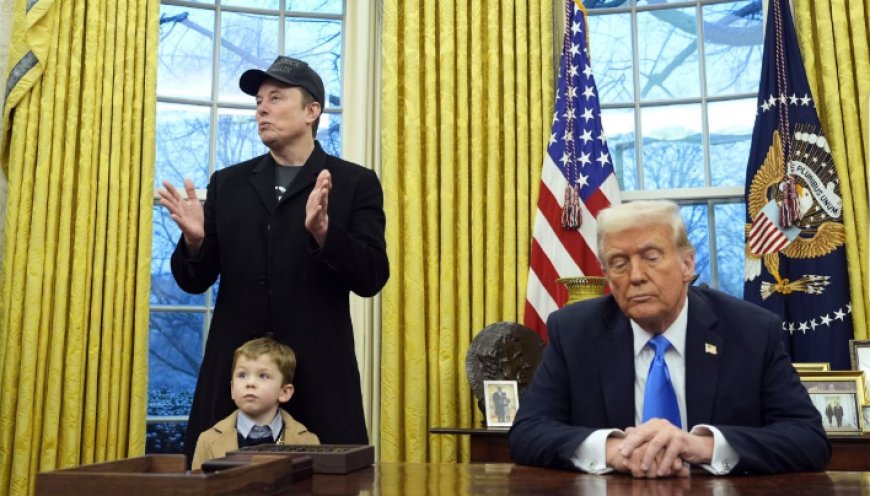
President Trump, long critical of Washington’s “deep state” and “bureaucratic corruption,” tapped Musk to lead DOGE, a new initiative aimed at dismantling unelected power structures. In an Oval Office moment, with Musk in a baseball hat and his young son by his side, he echoed Trump’s disdain: “We have this unelected fourth unconstitutional branch of government, which is the bureaucracy… It’s just something we gotta fix.”
Conservatives like Mike Gonzalez of The Heritage Foundation hailed the move as a necessary correction. “There’s a huge democratic deficit that should worry all of us,” Gonzalez said, blaming unelected bureaucrats for wielding undue power. DOGE’s mission: cut waste, reduce fraud, and deliver savings for US taxpayers facing a deficit exceeding a trillion dollars.
Targeting Waste and Fraud
Haywood Talcove, a former law enforcement official and CEO of LexisNexis Risk Solutions’ government division, underscored the urgency. “When your own government agency, the Government Accounting Office, is saying you have $521 billion in improper payments, you’ve got a problem,” he said. Talcove noted fraud rates in the public sector hit 20%, compared to 3% in private industry. “What DOGE is trying to do is stop the criminals from stealing, right?”
Musk’s claims of potential savings shifted over time. In October 2024, he pitched $2 trillion in cuts at Madison Square Garden. By February 2025, he told cabinet members $1 trillion was feasible. As his exit neared on April 30, 2025, Musk claimed DOGE identified $160 billion in savings, asserting, “All of our actions are maximally transparent.” Critics, including Trump ally Steve Bannon, demanded a forensic accounting, questioning the drop from trillions to billions.
A New Approach or a Reckoning?
DOGE wasn’t the first effort to curb waste. Post-Watergate reforms introduced inspectors general to audit agencies, saving over $100 billion annually, said Robert Storch, former Defense Department inspector general until his 2025 dismissal. “The return on investment for the American taxpayer is approximately 26 dollars for every dollar spent on IGs,” he noted. Mark Greenblatt, ex-Interior Department inspector general, initially welcomed DOGE, saying, “These are going to be good allies for us in the fight against waste, fraud and abuse.” But after Trump fired Storch, Greenblatt, and 15 others, Greenblatt lamented, “It’s just cutting government, which is a different goal.”
The firings, affecting hundreds at the FAA and beyond, sparked legal action from dismissed officials claiming illegal removals. Civil servants faced uncertainty, though Gonzalez defended the shake-up: “As an American and a taxpayer… I can be definitely very happy that we’re finally doing something about this.”
Conflict of Interest Concerns
Musk’s dual role as DOGE leader and CEO of SpaceX, Tesla, and Starlink raised alarms. Kedric Payne of the Campaign Legal Center flagged “a long list of financial conflicts of interest” with no effective checks. Don Fox, former acting head of the US Office of Government Ethics, said the post-Watergate system could work but required goodwill, often absent in Trump’s administration. “My confidence level that the system is working in the case of Mr. Musk… is quite low,” Fox added.
At the FAA, Musk criticized Verizon’s contract to overhaul air traffic control systems, pushing Starlink as a fix. Staff tested Starlink kits at non-safety-critical sites, but Payne alleged, “It appears that Elon Musk has improperly been involved in the business transactions between the Federal Aviation Administration and his company Starlink.” Democrats decried potential self-dealing, though Musk insisted he recused himself from conflicts, like a China-related meeting, per Gonzalez.
Did Musk Benefit?
Critics questioned if Musk profited. Evan Feinman, former head of the Broadband Equity, Access and Deployment program, criticized a shift under Commerce Secretary Howard Lutnick to favor Starlink over fiber-optic networks. “The practical outcome… will be that more people will get worse connections and more money will be pushed toward Elon Musk’s Starlink,” Feinman wrote. Tesla’s profits dipped 71% in Q1 2025, pressuring Musk to refocus on business, though he denied personal gain, and supporters called him a patriot.
A Legacy in Question
As Musk exits, he remains optimistic, claiming DOGE will “strengthen and continue” as a “way of life throughout the government.” Yet, with savings at $160 billion—far below initial goals— and conflict-of-interest clouds lingering, his impact divides opinion. Did he fix Washington for taxpayers, or did his firms gain an edge? If the world’s richest man couldn’t fully deliver, supporters and skeptics alike wonder: who can?
What's Your Reaction?
 Like
0
 Dislike
0
 Love
0
 Funny
0
 Angry
0
 Sad
0
 Wow
0