India-Pakistan Tensions Escalate: Fighter Jets Downed, Civilians Killed - Bio Points News
US President Donald Trump has condemned India’s missile strikes on Pakistan, calling it "a shame" and urging immediate de-escalation. The attacks, targeting civilian areas, have sparked global concern amid rising nuclear tensions between the two nations.
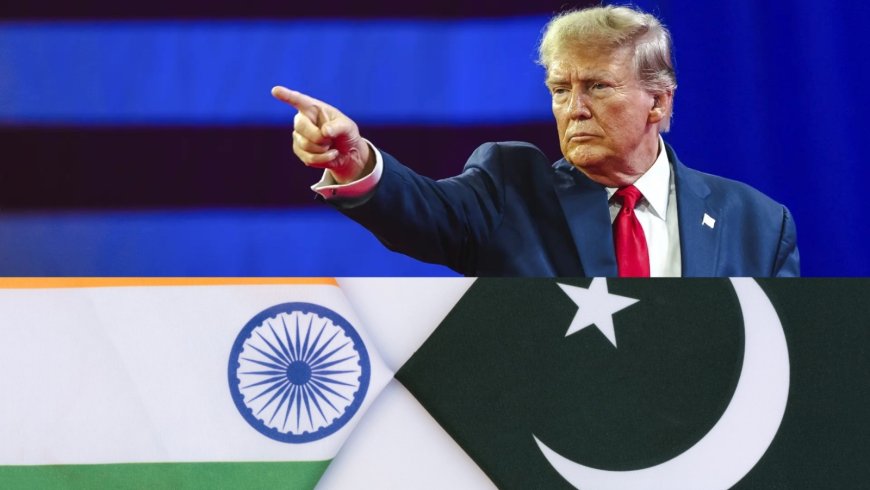
US President Trump Calls India’s Missile Strikes on Pakistan "A Shame" Amid Soaring Tensions
Washington, D.C. / Islamabad / New Delhi:
In a sharp escalation of hostilities between two nuclear-armed neighbors, tensions between India and Pakistan reached a dangerous high this week after a series of airstrikes and military engagements along the Line of Control and beyond. The conflict drew international attention when US President Donald Trump expressed concern over India’s missile attack on Pakistani territory, describing it as “a shame” and urging both nations to de-escalate immediately.
Speaking at a White House ceremony for the swearing-in of Special Envoy Steve Witkoff, President Trump addressed the unfolding situation, telling reporters:
“It’s a shame. We just heard about it as we were walking in the doors of the Oval. Just heard about it. They’ve been fighting for many, many decades. I hope it ends very quickly.”
The President’s remarks reflect growing global anxiety over the potential for a wider military conflict between India and Pakistan, whose historical rivalry over Indian Illegally Occupied Jammu and Kashmir (IIOJK) has repeatedly threatened regional stability.
The Airstrikes and Their Aftermath
The latest crisis began when Pakistan’s Director General of Inter-Services Public Relations (DG ISPR) confirmed that Indian airstrikes targeted multiple locations across Pakistan-administered areas, including Kotli, Bahawalpur, Muzaffarabad, Bagh, and Muridke.
According to security sources, the airstrikes targeted civilian areas, including a mosque in Kotli district, leading to the death of three civilians, among them a child. Dozens were reportedly injured, and several homes and public structures suffered damage. Following the attack, Muzaffarabad experienced a complete blackout.
Pakistan’s military swiftly responded, downing two Indian fighter jets while ensuring the safety of all its own aircraft. Retaliatory operations were launched along the Line of Control (LoC) and other sectors. In a press briefing, DG ISPR condemned the Indian aggression, vowing:
“Pakistan will respond at a time and place of its choosing. This cowardly act cannot go unanswered.”
Meanwhile, India’s Defense Ministry acknowledged conducting airstrikes but refrained from providing specific details, claiming they targeted nine locations linked to what they called "terror infrastructure."
Escalating Diplomatic and Military Tensions
The military confrontation follows the April 22 terrorist attack in Pahalgam, IIOJK, where 26 people were killed. India swiftly accused Pakistan-based militant groups of orchestrating the attack, though no evidence was publicly shared. Pakistan’s Foreign Office rejected the allegations, labeling them "baseless and irresponsible."
The situation deteriorated further when, in immediate retaliation:
-
India closed the Wagah land border crossing
-
Suspended the Indus Waters Treaty, a decades-old water-sharing agreement between the two nations
-
Revoked visas for Pakistani citizens
Pakistan condemned India’s actions, particularly the suspension of the water treaty, declaring any disruption to water flow as an “act of war.” In a swift countermove, Islamabad closed its side of the Wagah border, effectively halting cross-border human and trade movement.
Political and Civic Fallout
On April 25, the Pakistani Senate unanimously passed a resolution rejecting India’s allegations and denouncing its military aggression. Lawmakers urged the international community to intervene and hold India accountable for escalating regional tensions.
The crisis soon spread to the diaspora communities abroad. On April 26, the Pakistani High Commission in London was vandalized during a pro-India protest. The protestors, waving Indian flags and chanting slogans, smashed windows and defaced the building’s exterior. British authorities condemned the incident and assured Islamabad of a thorough investigation.
Airspace Closures and Civilian Disruptions
In response to the airstrikes, Pakistan closed its airspace over Islamabad and several other regions, forcing international and domestic flights to reroute. A “red alert” was declared in several border districts, with both civilian and military installations placed on high security.
In the affected cities, especially Kotli and Muzaffarabad, schools were shut down, and residents were advised to stay indoors as military operations continued. The sudden conflict left many families displaced and disrupted daily life for thousands of civilians.
International Calls for Restraint
The sudden escalation triggered alarm among world powers. China, Turkey, the United Nations, and the European Union all urged both India and Pakistan to exercise restraint and avoid actions that could ignite a full-scale war.
The United Nations Secretary-General’s office issued a statement:
“We call on both governments to immediately de-escalate the situation and engage in direct dialogue to address their longstanding disputes.”
The Organization of Islamic Cooperation (OIC) also condemned the Indian airstrikes, expressing solidarity with Pakistan and calling for an immediate ceasefire.
A History of Hostility
The crisis is just the latest chapter in the fraught relationship between India and Pakistan, who have fought three wars and numerous skirmishes since their independence from British rule in 1947, primarily over the disputed territory of Jammu and Kashmir.
Both nations claim the Himalayan region in its entirety but administer separate portions. In recent years, tensions have intensified following India’s controversial move in August 2019 to revoke Article 370, which granted special autonomy to Jammu and Kashmir. That decision led to months of lockdown, mass arrests, and global outcry from human rights organizations.
Uncertain Path Ahead
Despite President Trump’s call for calm, analysts fear that without a rapid diplomatic intervention, the situation could spiral into a more serious conflict. Both India and Pakistan possess nuclear arsenals, and any miscalculation could lead to catastrophic consequences not just for South Asia, but for global peace and security.
As of now, Pakistan’s military remains on high alert, and border skirmishes continue in several sectors. Airspace closures and travel restrictions remain in effect, and diplomatic relations have been downgraded.
The world watches anxiously as both nations weigh their next moves. Whether the situation de-escalates, as President Trump and the international community hope, or erupts into further violence, remains to be seen in the coming days.
What's Your Reaction?
 Like
0
 Dislike
0
 Love
0
 Funny
0
 Angry
0
 Sad
0
 Wow
0