Supreme Court Opens 2026 Term With Climate, Guns and Immigration Cases
The Supreme Court opens its 2026 term Monday with cases on climate change, AR-15 bans, and immigration detention. Here's what each ruling could mean for you.
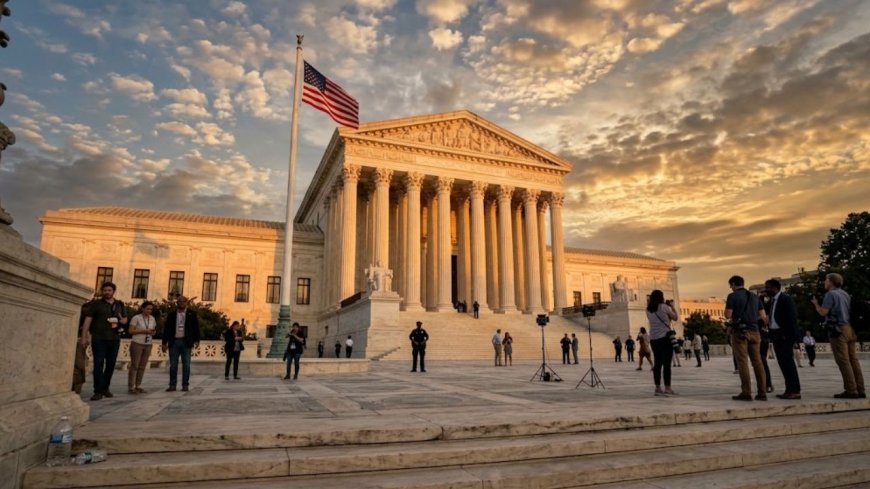
The United States Supreme Court opens its 2026-27 term on Monday, October 5, with one of the most consequential dockets in recent memory — a lineup of cases that could reshape climate change law, gun rights, and immigration policy across the country. The first argument of the new term is a climate lawsuit brought by the city and county of Boulder, Colorado, against oil giants Suncor Energy and ExxonMobil, a case with national implications for dozens of similar lawsuits filed by states and localities against fossil fuel companies. Following immediately in the weeks ahead are a Second Amendment challenge to state bans on AR-15-style semiautomatic rifles and a critical immigration detention case testing whether the Trump administration can hold certain migrants indefinitely without bond hearings. The court's six conservative justices and three liberal members will hear arguments through April 2027 and issue final rulings by the end of June.
The Supreme Court 2026 term arrives after a previous year in which the justices issued landmark rulings on Trump's tariff authority, his firing of top agency leaders, birthright citizenship, and LGBTQ rights — a term that left both political parties claiming wins and losses. Legal analysts had anticipated a quieter follow-up docket, but the cases that have accumulated for this term carry consequences that touch millions of American lives directly. From homeowners in coastal cities worried about climate-related flooding to gun owners in Illinois and Connecticut who want to own AR-15s, to migrants detained by DHS under policies no previous administration has adopted, the 2026-27 term will force the court's conservative supermajority to take clear positions on issues it has largely managed to avoid or delay. The term officially opens with the court at its full nine-member complement, though Justice Samuel Alito has already recused himself from the opening climate case without providing a public explanation.
The court has agreed to hear approximately 25 cases so far in the 2026-27 term, a number that will grow as justices accept additional petitions through the year. The October argument session alone covers seven cases running through October 13, with the climate and immigration matters heading the early calendar. Constitutional Accountability Center scholar Brianne Gorod warned observers not to be misled by the absence of the most explosive Trump administration cases from the immediate docket: "Just because there's an absence of cases involving Trump administration policies, that doesn't mean they are not coming." Several pending petitions involving Trump's deportation policies, restrictions on transgender prisoners and military personnel, and the administration's use of emergency powers are expected to reach the court before the term concludes.
The Climate Case: Can States Sue Oil Companies for Global Warming Damage?
The Supreme Court 2026 term opens Monday morning with oral arguments in Suncor Energy (U.S.A.) Inc. v. County Commissioners of Boulder County — a case that began in 2018 when Boulder sued Suncor and ExxonMobil under Colorado state law, alleging that the companies' sale and allegedly deceptive marketing of fossil fuels contributed to climate change and caused direct harm to Boulder residents. The legal question before the court is technical but enormously consequential: whether federal law — specifically the Clean Air Act and federal common law — prevents Boulder from pursuing its claims in state court. The Colorado Supreme Court ruled 5-2 in May 2025 that federal law does not preempt Boulder's state-law claims, allowing the lawsuit to proceed. Suncor and ExxonMobil appealed, and the Trump administration filed an unusual unsolicited brief in September 2025 urging the justices to take the case — a signal of where the administration stands on using federal preemption to block climate accountability suits.
The stakes extend far beyond Boulder. Dozens of similar lawsuits have been filed by cities, counties, and states across the United States seeking to hold fossil fuel companies liable for climate damages under state nuisance, trespass, and consumer protection laws. Legal advocates have compared the strategy to the litigation that ultimately produced massive settlements from the tobacco industry. If the Supreme Court rules that federal law preempts these state claims, every one of those pending lawsuits could be dismissed simultaneously, effectively immunizing the energy industry from state-level climate accountability litigation for the foreseeable future. If the court rules in Boulder's favor, it would open the door to a wave of jury trials and potential multi-billion dollar judgments against major oil and gas companies. Justice Alito's recusal leaves eight justices to decide the case, raising the possibility of a 4-4 tie that would preserve the Colorado ruling without setting binding national precedent.
The Gun Case: Does the Second Amendment Protect AR-15 Ownership?
Later this term, the court will hear Viramontes v. Cook County, a consolidated Second Amendment case asking whether state and local bans on AR-15-style semiautomatic rifles violate the Constitution. The case was brought by Cutberto Viramontes and Christopher Khaya, two Illinois residents barred from owning AR-15-pattern weapons under Cook County's assault weapons ban, who joined two gun rights organizations arguing the law violates both the Second and Fourteenth Amendments. A related case challenging Connecticut's assault weapons restrictions has been consolidated for joint argument. Gun rights advocates argue that AR-15s are in "common use" for lawful purposes — the legal standard established by the Supreme Court's landmark Heller and Bruen decisions — and that the government cannot ban an entire category of widely owned firearms. Gun control supporters counter that AR-15-style weapons are military-derived, capable of firing rapidly with high-capacity magazines, and are disproportionately used in mass shootings.
The case represents the most direct Second Amendment confrontation over weapons type the Supreme Court has accepted in years. Previous rulings addressed who can be prohibited from owning guns and where guns can be carried, but this is the first time the court has squarely taken up the question of whether the Second Amendment protects a specific category of commonly sold rifles. Attorney Erin Murphy, representing gun owners in the case, has framed the core question starkly: "The single most important question is who gets to decide what guns you have." A ruling striking down assault weapons bans would invalidate laws in multiple states including Illinois, Connecticut, Maryland, California, and others — directly affecting millions of Americans who live in states that have enacted these restrictions in the wake of mass shootings.
The Immigration Case: Can the Government Detain Migrants Indefinitely Without a Hearing?
The immigration detention case scheduled for October argument is Genalo v. Black, which asks whether noncitizens held in immigration detention after a criminal conviction are entitled to bond hearings when their confinement has become "unreasonably prolonged." The case arises from a Department of Homeland Security policy implemented in July 2025 under which certain immigrants — including some who have lived in the United States for many years — can be held in detention indefinitely without access to an immigration bond hearing. Lower courts have split on whether the Constitution or existing immigration statutes require hearings for long-term detainees, and that judicial disagreement has made Supreme Court resolution essentially inevitable. The case does not directly address Trump's broader mandatory detention policies, which are the subject of separate petitions still pending before the court, but a ruling in Genalo could establish precedent that shapes those larger battles.
The Supreme Court's 2026 term will ultimately be defined not just by the cases already on its docket, but by the emergency applications and late-term additions that arrive as political events unfold — including the November 3 midterm elections, which could produce legal challenges that land at the court before the year ends. The justices have already been asked to intervene in cases involving Trump administration restrictions on transgender military service and medical care for incarcerated transgender individuals, and those petitions could be accepted for argument this term. What the opening week's calendar makes clear is that the Supreme Court 2026 term is not a quiet consolidation year — it is another cycle in which the court's conservative majority will be asked to resolve some of the most contested questions in American law, with consequences that will be felt in communities, courtrooms, and legislatures across the country for decades.
Frequently Asked Questions
When does the Supreme Court 2026 term start and what is the first case?
The Supreme Court's 2026-27 term officially begins on Monday, October 5, 2026 — the first Monday in October, which is the traditional start of each new term. The very first case argued on opening day is Suncor Energy (U.S.A.) Inc. v. County Commissioners of Boulder County, a climate change lawsuit in which Boulder, Colorado, is suing oil companies Suncor Energy and ExxonMobil for damages related to fossil fuel emissions. The court will hear arguments through April 2027 and issue all decisions by the end of June 2027.
What is the AR-15 Supreme Court case in 2026?
The case is Viramontes v. Cook County, consolidated with a related Connecticut case, and it asks whether the Second and Fourteenth Amendments protect the right to own AR-15-style semiautomatic rifles. The plaintiffs are Illinois residents barred from owning AR-15-pattern weapons under Cook County's assault weapons ban. Gun rights advocates argue these weapons are in "common use" and constitutionally protected, while gun control supporters argue they are weapons of war inappropriate for civilian ownership. A ruling striking down such bans could invalidate assault weapons laws in multiple states including California, Maryland, and Connecticut.
What immigration case will the Supreme Court hear in October 2026?
The court will hear Genalo v. Black, which asks whether noncitizens detained in immigration custody after a criminal conviction have the right to a bond hearing when their detention has become "unreasonably prolonged." The case stems from a July 2025 DHS policy allowing indefinite detention of certain immigrants without bond hearings. This case is separate from the Trump administration's broader mandatory detention policies, which are the subject of additional pending petitions that could also be accepted for argument this term.
What's Your Reaction?
 Like
0
 Dislike
0
 Love
0
 Funny
0
 Angry
0
 Sad
0
 Wow
0