Lyte Raises $165M to Build Robot Perception Tech
Lyte AI raises $165 million at a $1.6 billion valuation, scaling robot perception technology, custom silicon and LyteVision for physical AI. Here's why.
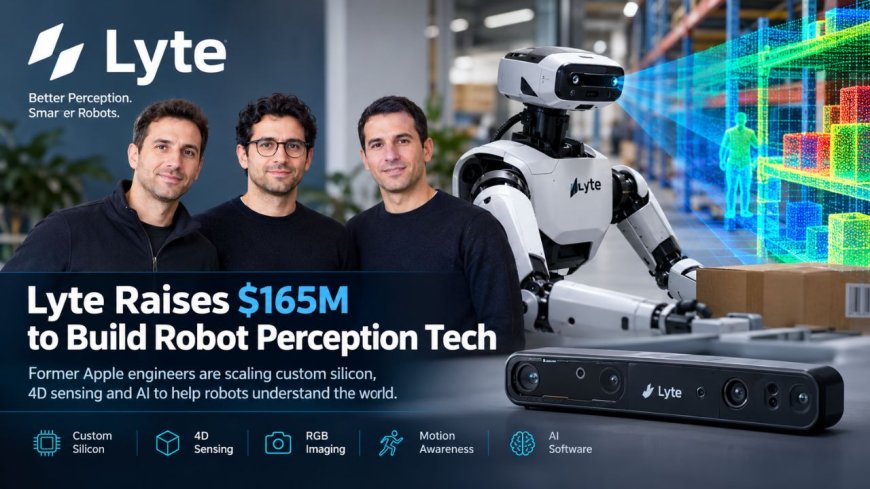
Lyte AI has raised $165 million in Series C funding at a $1.6 billion post-money valuation, giving the robotics perception company fresh capital to scale its sensing technology and production deployments. The Sunnyvale, California-based startup, founded by former Apple and PrimeSense engineers, is building hardware and software designed to help robots understand their position, surroundings and movement in real time. The new financing brings Lyte's total capital raised since its 2021 founding to $272 million.
The Series C was led by Maverick Silicon, with participation from Fidelity Management & Research Co., Atreides Management, Key1 Capital and Ora Global, formerly Exor Ventures, along with other investors. Andrew Homan, managing partner at Maverick Silicon, has also joined Lyte's board. The company says the money will support production of its sensing silicon and LyteVision platform, while expanding its AI and perception capabilities and deployments with robotics and industrial customers.
The timing is important because Lyte is moving beyond the long development period that preceded its public launch. The company emerged from stealth in January 2026 with $107 million in aggregate Series A and B funding. It now says it has entered production and is shipping to robotics customers in areas including inspection, logistics and manufacturing, turning its perception technology from a development project into a commercial platform.
How Lyte AI is building a perception system for robots
Lyte's central idea is that robots need more than cameras or conventional computer vision to operate reliably in unpredictable physical environments. Its LyteVision platform combines 4D coherent vision, high-resolution imaging and inertial sensing on a synchronized timeline. The company says its custom silicon measures position and motion natively rather than depending entirely on software to reconstruct those measurements from separate sensor streams.
That architecture addresses a practical problem in robotics: different sensors can produce information at different times, creating latency, calibration challenges and uncertainty about what is actually happening around a machine. By bringing sensing components together and controlling the underlying silicon, Lyte is attempting to make spatial information more consistent and immediately useful to robotic systems. The goal is not simply to help a robot recognize an object, but to give it a reliable picture of where objects are and how they are moving.
Who founded Lyte and what is the Apple connection?
Lyte was founded in 2021 by Alexander Shpunt, Arman Hajati and Yuval Gerson. All three previously worked in advanced sensing, engineering or perception roles connected to Apple, while Shpunt and Gerson also have ties to PrimeSense, the 3D-sensing company acquired by Apple in 2013.
Shpunt previously co-founded PrimeSense and served as its chief technology officer. PrimeSense developed the 3D-sensing technology that powered Microsoft's Kinect before the company was acquired by Apple. Lyte's founders later brought their experience in depth sensing, hardware integration and advanced engineering into a new effort aimed at physical machines rather than smartphones and consumer electronics.
Lyte's own account of that history emphasizes a common technical thread: teaching machines to understand depth, distance and movement. The company is now applying that experience to robotics, where perception has to work continuously in environments that can change from one moment to the next.
Why Lyte's $1.6 billion valuation matters for physical AI
Lyte's new valuation arrives during a much broader surge in investment around physical AI. Crunchbase reported that companies in the physical AI category attracted $47.4 billion across 521 deals during the first half of 2026. That was nearly four times the $12 billion invested across 470 deals in the second half of 2025 and about 80% above the $26.4 billion raised in the first half of 2025.
Unlike companies focused primarily on AI models or software applications, Lyte is targeting infrastructure at the point where digital intelligence meets the physical world. Its customers need sensors and perception systems that can work inside warehouses, factories and other environments where robots must navigate, inspect, manipulate or respond to moving objects.
The company's strategy also reflects a broader shift toward vertically integrated robotics technology. Instead of relying entirely on unrelated off-the-shelf sensors and reconstructing their data later, Lyte controls custom silicon, sensing hardware and perception software. That could give the company more control over latency, synchronization and system performance as robotics deployments become more demanding.
What happens next for Lyte?
The immediate challenge is turning the new funding into larger-scale production and customer adoption. Lyte says it plans to increase production of its sensing silicon and LyteVision platform while continuing development of its AI and perception capabilities. It also expects to expand deployments with robotics companies and industrial customers, putting greater pressure on the technology to perform consistently outside controlled demonstrations.
For investors and the wider robotics industry, the company's progress will be worth watching because perception remains one of the fundamental requirements for useful physical AI. Lyte has moved quickly from four years of development to a $1.6 billion valuation and production shipments, but its long-term position will depend on whether its integrated approach can deliver measurable advantages as more robots move into real-world operations.
Frequently Asked Questions
How much funding has Lyte raised?
Lyte has raised $272 million in total funding following its $165 million Series C round. The latest financing valued the company at $1.6 billion post-money.
What does Lyte make?
Lyte develops custom sensing silicon, multimodal sensors and spatial perception software for robotics. Its LyteVision platform combines 4D vision, imaging and inertial sensing to provide robots with synchronized information about their environment.
Who founded Lyte?
Lyte was founded in 2021 by Alexander Shpunt, Arman Hajati and Yuval Gerson. The founders have backgrounds at Apple and PrimeSense, with Shpunt having co-founded PrimeSense before its acquisition by Apple.
What's Your Reaction?
 Like
0
 Dislike
0
 Love
0
 Funny
0
 Angry
0
 Sad
0
 Wow
0