China Eastern Launches Record-Setting Shanghai–Buenos Aires Route - Bio Points News
China Eastern Airlines launches a record-setting 20,000 km flight from Shanghai to Buenos Aires via Auckland, offering travellers a faster, smoother Asia–South America connection.
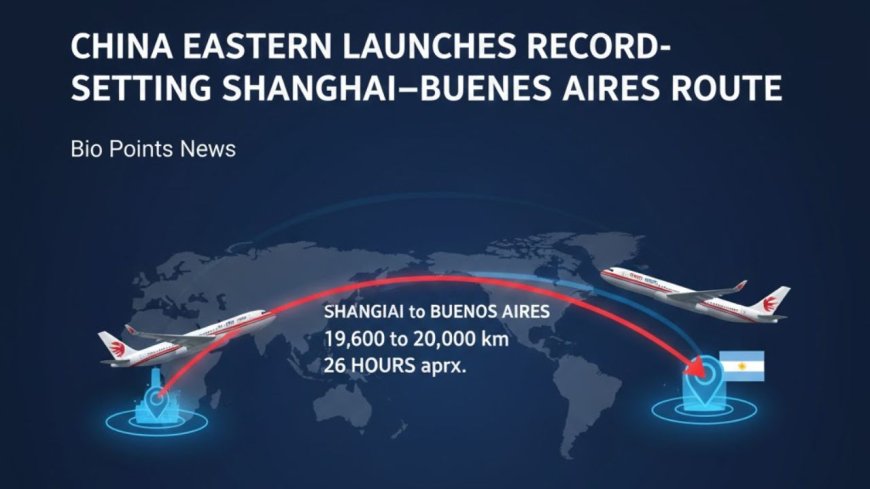
On 4 December 2025, China Eastern Airlines (CEA) officially launched a groundbreaking air route that will reshape intercontinental travel — a direct, single-flight connection from Shanghai Pudong International Airport (China) to Ezeiza International Airport, Buenos Aires (Argentina), with a refuelling stop in Auckland Airport (New Zealand). The new service spans nearly 20,000 kilometres and is being hailed as the world’s longest one-way scheduled commercial passenger flight.
This remarkable route promises to significantly shorten travel time between Asia and South America, while offering a seamless connection across hemispheres — a feat once considered implausible.
What the New Flight Offers
A Route Across Continents
Flight number MU745 departed Shanghai Pudong at 2:19 a.m. (local time) on its inaugural journey, bound for Buenos Aires via Auckland. The entire journey spans approximately 20,000 km, crossing Asia, Oceania, and South America.
For passengers, this means a direct, single-flight-number service — no plane change, even though there’s a technical stop in Auckland for refuelling.
Travel Time & Frequency
-
Outbound journey (Shanghai → Buenos Aires) takes about 25.5 hours.
-
Return leg (Buenos Aires → Shanghai) is estimated at around 29 hours, owing to headwinds and longer eastbound flight time.
-
The service will run twice weekly, with flights from Shanghai on Mondays and Thursdays, and return from Buenos Aires on Tuesdays and Fridays.
The aircraft used is the wide-body Boeing 777-300ER, a long-range jet capable of handling such ultra-long-haul trips.
Why It Matters: Significance & Impact
A New “Southern Corridor”
Previously, travellers between China and South America typically had to transit via Europe, the Middle East, or North America — involving multiple flights and long layovers. The new Shanghai–Auckland–Buenos Aires route establishes a direct “southern corridor” across the Pacific and southern hemisphere.
This corridor not only reduces travel time by more than four hours compared to conventional routes, but also offers more convenient transit, fewer time-zone disruptions, and simpler logistics for passengers and cargo.
Boost to Travel, Trade, and Connectivity
With this new link, trade and tourism between China and South America are expected to grow. The flight provides a direct air bridge for business travellers, tourists, students, and cargo — potentially facilitating faster exchange of goods like electronics, daily necessities, and perishables.
For Argentina and South America, the route opens up easier access to one of the world’s largest consumer and manufacturing markets — a strategic advantage in global economic connectivity.
Background & Context
The idea for the route was first officially announced in mid-2025. Aviation experts noted that despite the enormous distance, advances in aircraft range, fuel efficiency, and logistics coordination made such a route feasible.
Because nonstop flights from China to South America remain beyond current aircraft range and fuel-load capabilities, the planned stopover in Auckland was key — enabling refuelling and avoiding overextending the aircraft’s operational limits.
Officials at China Eastern described the launch as a major milestone in the ongoing globalization of Chinese aviation and a signature achievement in building a new “Air Silk Road” between Asia-Pacific and Latin America.
The Inaugural Flight & Early Reactions
On 4 December 2025, the first flight (MU745) carried 282 passengers from Shanghai to Buenos Aires, marking the official opening of the route.
The launch has drawn global attention from travelers, airlines, and logistics stakeholders alike, with many seeing it as a turning point for long-haul travel and intercontinental connectivity across the hemispheres.
China Eastern’s new Shanghai-to-Buenos Aires flight represents a landmark shift in global aviation — bridging Asia and South America like never before. By cutting travel time, simplifying routes, and offering a direct air corridor across continents, the airline has opened fresh opportunities for tourism, trade, business, and cultural exchange. For travellers and global commerce alike, this journey isn’t just long in distance — it’s potentially long in impact.
What's Your Reaction?
 Like
0
 Dislike
0
 Love
0
 Funny
0
 Angry
0
 Sad
0
 Wow
0