Ancient Anacondas Have Been Giants for 12 Million Years, Fossils Reveal - Bio Points News
New research on 12-million-year-old fossils shows anacondas kept their massive size through major environmental shifts, unlike other prehistoric reptiles that shrank or vanished. Discover the secrets of their enduring gigantism.
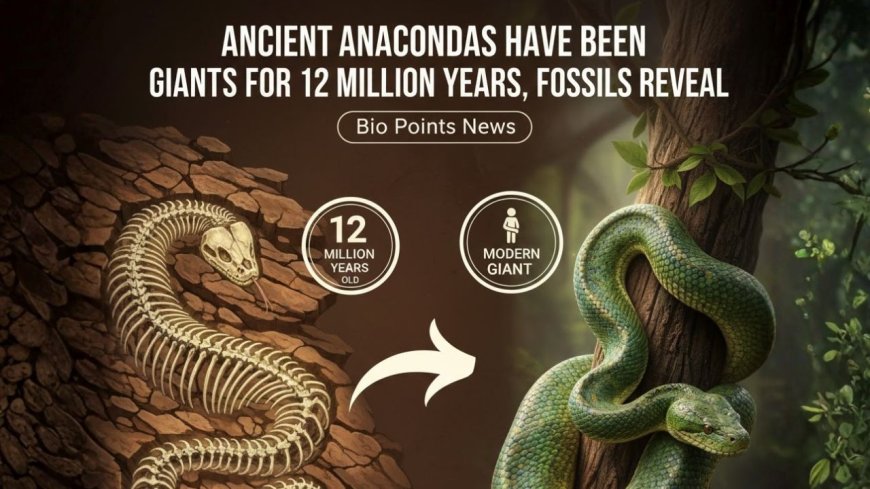
Imagine a snake as long as a school bus, slithering through ancient swamps. Recent fossil discoveries in Venezuela have unveiled that anacondas, the world's heaviest snakes, were just as enormous 12 million years ago as they are today. This finding challenges what we know about how prehistoric creatures adapted—or failed to adapt—to changing environments.
Scientists Analyzed
Scientists analyzed 183 fossilized vertebrae from at least 32 different anacondas, unearthed in Venezuela's Falcón State. These bones date back to the Middle to Upper Miocene epoch, roughly 12.4 to 5.3 million years ago. By measuring the vertebrae, researchers estimated the snakes' total body lengths averaged between 11.5 and 18 feet—similar to modern green anacondas, which typically reach 13 to 16 feet. Anacondas possess over 300 vertebrae in their spines, making individual bone sizes a reliable indicator of overall length.
What sets anacondas apart is their ability to maintain this gigantism. During the Miocene, the Earth was warmer with vast wetlands teeming with prey like giant rodents and crocodilians. As climates cooled and habitats shifted, many large reptiles, such as the 40-foot Purussaurus caiman or the massive Stupendemys turtle, either shrank or went extinct. Yet anacondas persisted in their tropical South American niches, relying on water-rich environments for hunting and survival.
Led by Andrés Alfonso-Rojas from the University of Cambridge's Department of Zoology, the team used linear regression models to calculate body sizes from the fossils. They expected ancient anacondas to be even larger due to the era's favorable conditions, but the evidence showed consistency over millions of years. This resilience highlights how some species evolve traits early and stick with them successfully.
Background and History
Anacondas belong to the Eunectes genus and have long fascinated scientists due to their size and strength. Fossil records of these snakes were scarce until recent digs in formations like Urumaco and Socorro provided key insights. The Miocene period marked a time of "megafauna" in South America, where oversized animals thrived before global cooling and habitat loss triggered mass changes. Anacondas' early gigantism likely stemmed from abundant food and warm, watery habitats that allowed them to ambush large prey efficiently.
Recent Updates
The study, published this week in the Journal of Vertebrate Paleontology, represents a breakthrough in understanding snake evolution. As of December 2025, researchers note that ongoing excavations could reveal more about anacondas' middle evolutionary stages. Current stats show modern anacondas facing threats from habitat destruction, but their ancient stability offers hope for conservation efforts in the Amazon.
This fossil evidence underscores anacondas' remarkable adaptability, proving that gigantism isn't always a liability in a changing world. For readers interested in paleontology, it reminds us how studying the past can inform present-day biodiversity protection—ensuring these ancient giants continue to thrive.
What's Your Reaction?
 Like
0
 Dislike
0
 Love
0
 Funny
0
 Angry
0
 Sad
0
 Wow
0