American Airlines Flight 2398 Laptop Fire Fills Cabin at Dallas
American Airlines flight smoke Dallas: a laptop fire injured passengers as Flight 2398 landed safely at DFW. See what happened and battery safety rules.
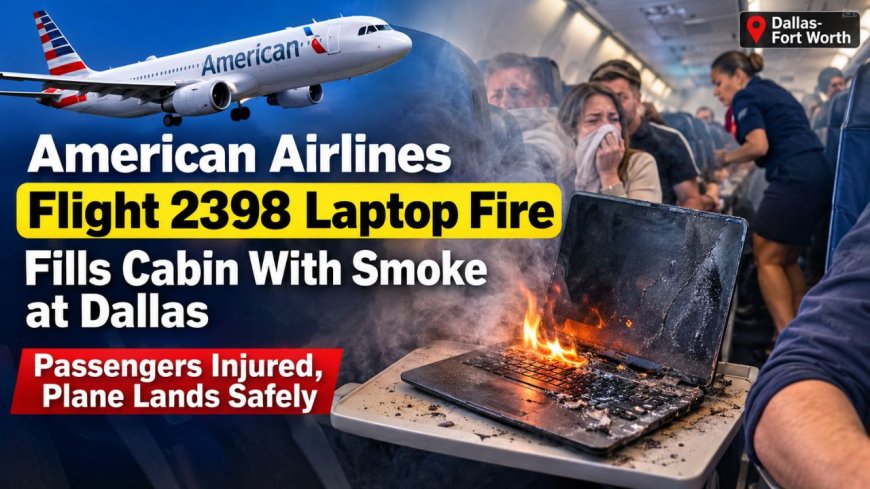
American Airlines Flight 2398 landed safely at Dallas-Fort Worth International Airport after a passenger's laptop caught fire during the flight from Atlanta, filling the cabin with smoke and prompting flight attendants to deploy a thermal containment bag. The pilot reported that four to five passengers may have suffered burns while dealing with the device, although authorities confirmed that one passenger was treated and released after landing. The Federal Aviation Administration is investigating the incident.
What happened on American Airlines Flight 2398?
The incident happened Friday as Flight 2398 was traveling from Hartsfield-Jackson Atlanta International Airport to Dallas-Fort Worth International Airport. The Airbus A321 was carrying 133 people when smoke began spreading through the cabin during the approach to Dallas.
Air traffic control audio obtained by CBS News captured the pilot reporting a cabin fire toward the rear of the aircraft. The crew identified a passenger's laptop as the source, and flight attendants moved quickly to contain the burning device while the aircraft continued toward DFW.
One passenger who was nearby later described heavy smoke inside the cabin. The situation was especially difficult because passengers were trying to move away from the smoke while crew members worked to control the burning laptop in a confined space.
Were passengers burned by the laptop?
The pilot told air traffic controllers that four to five passengers had been burned by the laptop. Passenger accounts and later reports indicate that people who tried to help with the device may have suffered burns to their hands.
That number should be treated carefully. It represents the pilot's report during the emergency rather than a final medical count. Airport officials confirmed that one passenger received medical attention after the plane arrived at DFW and was subsequently released.
The distinction matters because several headlines have described the incident as involving five injured passengers, while the confirmed medical response involved one person. The FAA and other authorities have not announced a final injury total.
How was the laptop fire contained?
Flight attendants used a thermal containment bag to secure the burning device. This was a critical part of the response because lithium-ion battery fires can behave differently from ordinary fires. A damaged battery can continue generating heat through a process known as thermal runaway.
FAA guidance explains that lithium-ion batteries can overheat and enter thermal runaway without warning. Damage, excessive heat, water exposure, overcharging, improper protection and manufacturing defects are among the factors that can contribute to the problem.
The crew's rapid response allowed the device to be isolated before the aircraft reached the airport. Flight 2398 then landed safely and taxied to the gate under its own power, where emergency personnel were waiting.
Why can a laptop battery catch fire on an airplane?
Laptops use lithium-ion batteries because they can store a large amount of energy in a relatively small package. Under normal conditions, those batteries are designed to operate safely. But if a battery is damaged or develops an internal fault, heat can build rapidly.
Thermal runaway occurs when an overheating battery cell begins a self-reinforcing reaction. As the temperature rises, the battery can release more heat, potentially causing smoke, flames or additional cell failures. That is why a smoking electronic device is treated seriously in an aircraft cabin.
The precise cause of the laptop fire on Flight 2398 has not been publicly established. The FAA investigation will be important in determining what caused the battery to fail.
What should passengers do if a laptop starts smoking?
Passengers should not attempt to handle a smoking or burning lithium-ion device on their own unless directed by crew members. The FAA advises passengers to immediately notify flight attendants if a battery-powered device becomes unusually hot, swells, smokes or begins burning.
Passengers should follow crew instructions and avoid putting themselves or others at unnecessary risk while attempting to move a burning device. The cabin crew is trained to recognize and respond to lithium battery fires and has equipment designed for these emergencies.
The FAA also recommends keeping lithium battery-powered portable electronics accessible in the cabin. Spare lithium batteries and power banks must be carried in carry-on baggage rather than checked luggage, subject to applicable battery-size and airline restrictions.
What are the FAA rules for laptop batteries?
Most ordinary lithium-ion batteries used in personal electronics are permitted on passenger aircraft when they meet FAA requirements. Rechargeable lithium-ion batteries rated at up to 100 watt-hours are generally permitted, while batteries between 101 and 160 watt-hours require airline approval and are subject to additional restrictions.
Spare lithium batteries and power banks must remain in carry-on baggage. The FAA says damaged or recalled batteries and battery-powered devices that could generate dangerous heat or sparks should not be carried aboard an aircraft unless they have been made safe.
Passengers should also check their airline's individual requirements because carriers can impose additional restrictions on battery-powered devices.
Did the American Airlines plane land safely?
Yes. Flight 2398 landed safely at Dallas-Fort Worth International Airport after the smoke incident. The aircraft was able to taxi to the gate under its own power, and emergency personnel met the plane when it arrived.
The incident therefore did not result in a crash or forced landing away from the airport. The immediate emergency was the smoke and fire inside the cabin, which the flight attendants were able to contain before landing.
What happens next in the investigation?
The FAA is investigating the incident. Investigators will be able to examine the laptop and battery, review the circumstances surrounding the fire and assess the crew's response.
At this stage, officials have not publicly identified a specific battery defect or confirmed why the laptop began smoking and burning. Until that information is available, it would be premature to attribute the fire to a particular manufacturer, model or charging practice.
The incident nevertheless highlights why aviation authorities continue to focus on lithium-ion battery safety. The FAA maintains a running record of aviation incidents involving lithium batteries and notes that the list covers events involving smoke, fire or extreme heat known to the agency.
For passengers, the main lesson is straightforward: keep battery-powered devices accessible, pay attention to signs of overheating and immediately notify cabin crew if a device begins smoking, swelling or burning.
What's Your Reaction?
 Like
0
 Dislike
0
 Love
0
 Funny
0
 Angry
0
 Sad
0
 Wow
0