



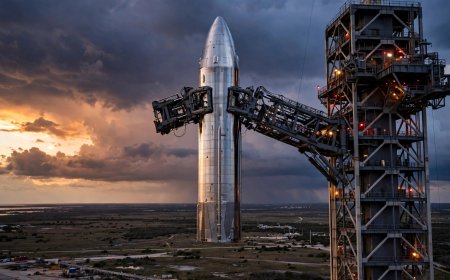





















































SpaceX Catches Starship From Orbit for the First Time — But Loses Its Booster
SpaceX has caught a Starship returning from orbit with its launch tower's giant arms for the first time, after the spacecraft spent 22 hours in space and deployed 26 satellites. The Super Heavy booster was lost on its way back.
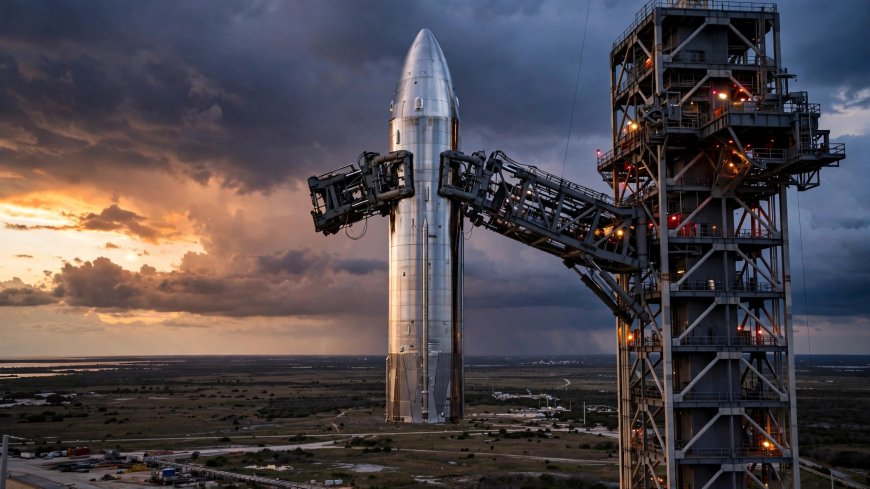
SpaceX has caught a spacecraft returning from orbit with its launch tower's giant mechanical arms for the first time, a milestone the company says brings a fully reusable rocket — and crewed missions to the Moon and Mars — a major step closer.
The upper stage of the Starship system, known as Ship 42, was caught at Starbase in Texas at about 3:20 p.m. Central time on Saturday, November 14, roughly 22 hours after it lifted off. The tower's arms, nicknamed "chopsticks" and sometimes called Mechazilla, closed around the 171-foot spacecraft as it descended, holding it in mid-air above the launch pad.
It was the first time any spacecraft returning from orbit has been caught this way. SpaceX had previously caught the Super Heavy booster with the tower arms three times, but the upper stage is a far harder target: it must survive a fiery re-entry from orbital speed before the tower can grab it.
A 22-hour flight — and 26 new satellites
Flight 15, the 15th full-scale Starship test flight since 2023, lifted off on Friday, November 13, at about 4:47 p.m. Central. The full Starship system stands 407 feet (124 metres) tall, making it the largest and most powerful rocket ever flown.
Ship 42 completed 14 orbits around Earth at an altitude of about 170 miles (260 kilometres) and deployed 26 new Starlink V3 satellites — the first flight of the larger V3 satellites, which are central to SpaceX's plans to expand its satellite internet network.
It was only the second time a Starship has reached orbit, after Flight 14 in September 2026.
Only a partial success
The mission was not a clean sweep. The Super Heavy booster, Booster 22, failed on its return about 10 minutes after liftoff: its boostback burn ended early, guidance triggered an automated abort, and the booster was destroyed over the Gulf of Mexico.
SpaceX had planned Flight 15 as its first attempt to recover both stages at the launch tower. Losing the booster means the company still has work to do, but engineers said the upper-stage catch — the harder of the two recoveries — was the flight's main objective.
NASA welcomed the result. The agency has committed billions of dollars to Starship as the lander for its Artemis Moon missions, and full reusability of both stages is the key to making those missions affordable. No date has been announced yet for Flight 16.
The achievement caps a weekend of high-stakes transport milestones in the United States. A day earlier, the Federal Aviation Administration lifted a nationwide ground stop after a telecom outage grounded every departure in the country for more than four hours. FAA Lifts Nationwide Ground Stop After 4-Hour Telecom Outage: 6,000 Flights Canceled, Delays Linger Into Saturday Federal investigators are also still working through the wreckage of a Florida Learjet crash that killed nine people. NTSB Recovers Cockpit Voice Recorder From Florida Learjet Crash That Killed 9
Frequently asked questions
What did SpaceX catch, exactly?
The upper stage of the Starship rocket, Ship 42, returning from orbit after 22 hours in space. The launch tower's giant mechanical arms caught it in mid-air at Starbase, Texas.
Has SpaceX done this before?
It had caught the Super Heavy booster three times, but never the upper stage — the part that must survive re-entry from orbital speed. This was the first orbital catch.
What happened to the booster?
Booster 22 failed its return about 10 minutes after liftoff and was destroyed over the Gulf of Mexico after an automated abort.
Why does the catch matter?
Catching both stages would make Starship fully reusable, sharply cutting the cost of each flight. NASA is counting on Starship as the lander for its Artemis Moon missions.
When is the next flight?
No date has been announced for Flight 16.
References
- Associated Press (via NPR Illinois): "SpaceX successfully catches Starship and makes history"
- Reuters (via WABX): "SpaceX Starship returns to landing pad from orbit, acing test for reusable rockets"
- Space.com / TheStreet: "Wild moment at SpaceX Starbase sends strong signal to investors"
What's Your Reaction?
 Like
0
 Dislike
0
 Love
0
 Funny
0
 Angry
0
 Sad
0
 Wow
0