























































US Loses Measles Elimination Status After 26 Years as Cases Hit Highest Level Since 1991
The United States has lost its measles elimination status after 26 years, an independent health commission has determined, after the virus spread without interruption for more than a year. More than 5,400 cases have been reported in 2026 — the highest annual total since 1991.
The United States has lost its measles elimination status after 26 years, an independent commission of health experts has determined, ending a public health achievement the country has held since 2000.
The news was first reported by The Wall Street Journal on Friday, November 13, and confirmed by CNN through a source close to the process. Reuters also reported that the Pan American Health Organization (PAHO) has revoked the country's measles-elimination status after finding that the virus has spread continuously in the United States for more than a year.
The decision was widely expected after years of falling vaccination levels and surging case counts, but it is still a serious setback for the nation's public health system. More than 5,400 measles cases have been reported in the United States this year — the highest annual total since 1991.
What losing elimination status means
Measles "elimination" does not mean the virus has been wiped out worldwide. It means that continuous, locally acquired transmission of the virus has been interrupted for at least 12 months, even though infections can still be brought in by travelers.
A country is considered to have re-established endemic transmission when the same strain of the virus keeps passing from person to person without a break for a year or more. The international committee that decides measles elimination status studies the genetic code of viruses sampled from patients to work out whether infections belong to the same chains of transmission.
In August, scientists with Utah's public health laboratory published a preprint study showing that the same strain of measles had been circulating in the state for more than a year, accounting for more than 95% of cases there. It traveled from the southwest part of the state to central Utah, causing more than 600 cases between June 2025 and June 2026.
"It wasn't exactly a tough call," said Dr. Angela Rasmussen, a virologist at the University of Saskatchewan in Canada and editor-in-chief of the journal Vaccine. "The Utah data alone would have been enough to make the case."
There have also been sustained outbreaks in South Carolina, Pennsylvania, Wisconsin and New York, as well as other states.
The numbers behind the decision
The US Centers for Disease Control and Prevention (CDC) counted 5,182 confirmed measles cases in 2026 through November 5, reported from 45 states, New York City and Washington, DC — more than double the 2,289 cases recorded in all of 2025. CNN reports the total has since passed 5,400, the highest number since 1991.
Most of this year's cases are linked to 43 new outbreaks in 2026, but more than 1,000 cases are linked to outbreaks that began last year. Nearly all of this year's cases have been in people who had not received the measles-mumps-rubella (MMR) vaccine or whose vaccination status is unknown.
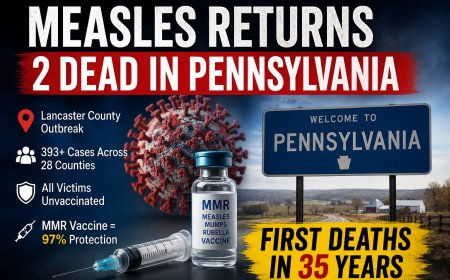
People have been hospitalized in roughly 1 in 9 reported cases, according to the CDC, and at least 10 people have died after catching measles, according to state reports. Pennsylvania has been hit especially hard — its outbreak is the largest in the state in more than three decades, and the state recorded its first measles deaths in 35 years earlier this year.
Childhood vaccination coverage in the United States has fallen to around 92%, the Associated Press reported.
Federal health agencies have been stretched across several fronts this year. Bio Points News has also tracked the year's major US health alerts, including the nationwide sprout-seed salmonella recalls that sickened 77 people across 16 states.
What happens now
Losing elimination status will not change how federal health officials fight the outbreaks, CDC Director Dr. Erica Schwartz told Reuters this week.
"Let's say we did lose our measles elimination status. We're going to be doing the same exact thing that we're doing today, which is working with the states," Schwartz said.
To win the status back, the United States must stop the continuous spread of the virus and then stay free of an outbreak for at least 12 months. Experts say that will not be easy.
"That's not easy, particularly in the current environment with diminished public trust in vaccines, the increasing nonmedical exemptions that we're seeing in schools, and declines in measles, mumps and rubella vaccination among our kindergarten students," said Dr. William Moss, a professor and measles expert at the Johns Hopkins Bloomberg School of Public Health. "So it's not going to be a trivial task for the United States to regain its measles elimination status."
Canada lost its measles elimination status last year after a lengthy outbreak, and Mexico — which has reported more than 20,500 cases and 50 deaths in its own outbreak — is also in danger of losing the designation. Measles is one of 30 diseases targeted for elimination by 2030 by PAHO.
Why measles is so hard to stop
Measles is one of the most contagious viruses known to science. A single infected person typically spreads it to 12 to 18 others. The virus is airborne and can float in a room for hours after a sick person leaves it.
Most people who catch measles will recover after a fever, a rash and several miserable days. But the infection can be far more serious than that. Measles can wipe out a person's immune memory, leaving the body vulnerable to secondary threats like pneumonia or diarrhea. If a pregnant woman catches measles, she can pass it to her baby in the womb. In rare cases, people who have had measles can develop serious neurologic complications years later, including subacute sclerosing panencephalitis, or SSPE, which is progressive and fatal.
"Measles elimination is a vital sign for our public health system. It shows cracks in our foundation. Losing elimination status means that we are less prepared as a nation to address infectious and noninfectious disease challenges," said Dr. Demetre Daskalakis, former director of the National Center for Immunization and Respiratory Diseases at the CDC.
All of these complications can be prevented by vaccination. The MMR vaccine is so effective that two doses cut an exposed person's chances of getting sick by 97% compared with someone who is unvaccinated.
"The United States losing its measles elimination status is incredibly embarrassing," said Dr. Peter Hotez, co-director of the Center for Vaccine Development at Texas Children's Hospital in Houston. "But basically, measles is back. Whether or not we've officially lost our elimination status to me is much less important than, basically, measles is here. It's pervasive, and vaccination rates are down across the country."
What families should do
Health officials say the most important step is to check that everyone in the family is up to date on the MMR vaccine. Children should receive two doses, and adults who are unsure of their vaccination history should ask their doctor whether they need a dose.
Anyone who thinks they may have been exposed to measles should call a doctor or local health department before visiting a clinic, because the virus spreads so easily through the air. Early symptoms include a high fever, cough, runny nose, red eyes and a rash that usually starts on the face before spreading.
Frequently asked questions
Does losing elimination status mean measles is now endemic in the US?
Effectively, yes. The commission found that the same strain of the virus has been spreading from person to person without interruption for more than 12 months, which meets the definition of re-established endemic transmission.
Will the CDC change its response?
No. CDC Director Dr. Erica Schwartz has said the agency will keep working with states on outbreak response and vaccination, exactly as it has been doing.
How can the US regain elimination status?
The country must interrupt continuous transmission and then go at least 12 months without a sustained outbreak. Experts warn this will take time, given falling vaccination coverage and rising exemption rates.
How effective is the MMR vaccine?
Two doses of the MMR vaccine cut an exposed person's chances of getting measles by 97% compared with someone who is unvaccinated, according to the CDC.
Who is most at risk?
Unvaccinated people, babies too young to be vaccinated, and people with weakened immune systems — for example after an organ transplant or during cancer treatment — face the highest risk in outbreak areas.
References
- CNN: "After 26 years, the US has lost its measles elimination status" — https://www.tmj4.com/health/the-us-has-had-the-tools-to-control-measles-for-almost-65-years-heres-how-its-come-raging-back
- Reuters: "US loses measles-free status after continued spread of the disease, WSJ reports" — https://www.kz1023.com/2026/11/13/us-loses-measles-free-status-after-continued-spread-of-the-disease-wsj-reports/
- Associated Press: "The US and Mexico are on the verge of forfeiting a major health victory. Here's what to know" — https://www.santaanaherald.com/stories/the-us-and-mexico-are-on-the-verge-of-forfeiting-a-major-health-victory-heres-what-to-know,2249972
What's Your Reaction?
 Like
0
 Dislike
0
 Love
0
 Funny
0
 Angry
0
 Sad
0
 Wow
0